 Back
Sketch #1
Study Guide - Smart Notes
 Tailored notes based on your materials, expanded with key definitions, examples, and context.
Neuronal Membrane Potentials and Ion Channels
Resting Membrane Potential
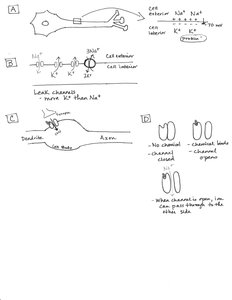
The resting membrane potential is the electrical potential difference across the plasma membrane of a neuron when it is not actively sending a signal. This potential is established by the unequal distribution of ions across the cell membrane and the selective permeability of the membrane to different ions.
Key Ions: Sodium (Na+) and Potassium (K+)
Distribution: Higher concentration of Na+ outside the cell, higher concentration of K+ inside the cell
Membrane Permeability: The membrane is more permeable to K+ than Na+
Result: The inside of the cell is negatively charged relative to the outside
Sodium-Potassium Pump
The sodium-potassium pump (Na+/K+ ATPase) is an active transport mechanism that maintains the resting membrane potential by moving ions against their concentration gradients.
For each cycle, the pump moves 3 Na+ ions out of the cell and 2 K+ ions into the cell
This process requires energy in the form of ATP
Helps maintain the negative resting membrane potential
Equation:
Ion Channels in Neurons
Neuronal membranes contain various types of ion channels that contribute to the movement of ions and the generation of electrical signals.
Leak Channels: Always open; allow passive movement of ions, especially K+ (more K+ leak channels than Na+ leak channels)
Gated Channels: Open or close in response to specific stimuli (e.g., voltage, ligands)
Structure of a Neuron
Neurons are specialized cells for communication in the nervous system. They have distinct structural regions:
Dendrites: Receive incoming signals
Cell Body (Soma): Contains the nucleus and organelles
Axon: Conducts electrical impulses away from the cell body
Gated Ion Channels
Gated ion channels can exist in open or closed conformations. When open, ions can pass through the channel, allowing for rapid changes in membrane potential.
No Channel: Ions cannot cross the membrane
Channel Closed: Channel present but not allowing ion passage
Channel Open: Ions can move through the channel to the other side
Example: Voltage-gated sodium channels open during an action potential, allowing Na+ influx.
Additional info: The concepts above are foundational for understanding how neurons generate and transmit electrical signals, which is essential for nervous system function (see Ch. 12 Nervous Tissue in standard A&P textbooks).
