 Back
BackNeurons: Cellular and Network Properties – Study Notes
Study Guide - Smart Notes
 Tailored notes based on your materials, expanded with key definitions, examples, and context.
Neurons: Cellular and Network Properties
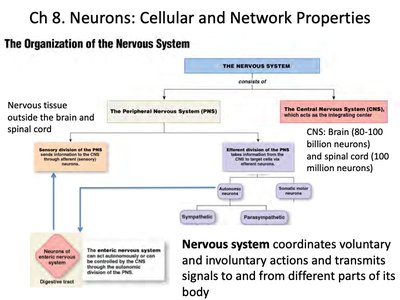
The Organization of the Nervous System
The nervous system is divided into the central nervous system (CNS) and the peripheral nervous system (PNS). The CNS consists of the brain and spinal cord, while the PNS includes all nervous tissue outside the CNS. The nervous system coordinates voluntary and involuntary actions and transmits signals throughout the body.
CNS: Brain (80–100 billion neurons) and spinal cord (100 million neurons)
PNS: Nerves and ganglia outside the CNS
Enteric nervous system: Controls the digestive tract, can function independently of the CNS
Afferent and Efferent Pathways
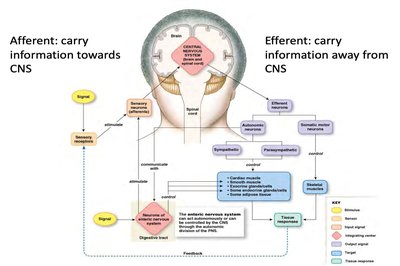
Neural pathways are classified as afferent (sensory) or efferent (motor). Afferent pathways carry information toward the CNS, while efferent pathways carry information away from the CNS to effectors such as muscles and glands.
Afferent: Sensory neurons transmit information from sensory receptors to the CNS
Efferent: Motor neurons transmit signals from the CNS to muscles and glands
Mixed nerves: Contain both afferent and efferent fibers
Neurons and Glial Cells
Neurons: Basic Functional Units
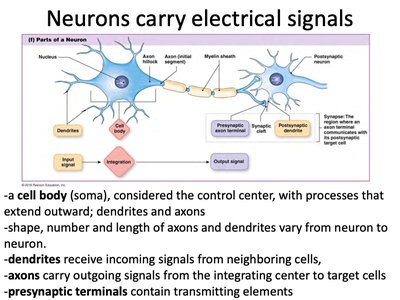
Neurons are the primary signaling cells of the nervous system. They carry electrical signals and are specialized for rapid communication. Each neuron consists of a cell body (soma), dendrites, axon, and presynaptic terminals.
Cell body (soma): Contains the nucleus and is the metabolic center
Dendrites: Receive incoming signals from other neurons
Axon: Transmits outgoing signals to target cells
Presynaptic terminals: Contain elements for transmitting signals to the next cell
Glial Cells: Support and Function
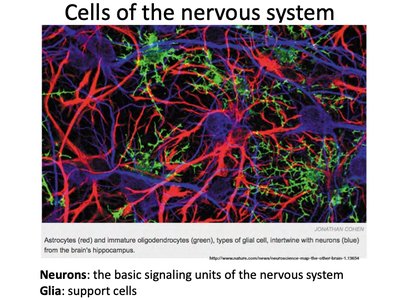
Glial cells, once thought to be mere support cells, play essential roles in nervous system function. Types include astrocytes and oligodendrocytes, which interact with neurons and contribute to homeostasis, myelination, and repair.
Astrocytes: Regulate the extracellular environment and support neurons
Oligodendrocytes: Form myelin sheaths in the CNS
Schwann cells: Form myelin sheaths in the PNS
Functional and Structural Categories of Neurons
Functional Categories
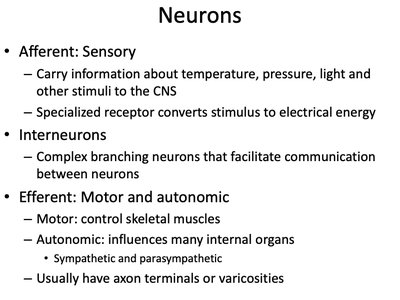
Neurons are classified by their function:
Afferent (Sensory) neurons: Carry information about temperature, pressure, light, and other stimuli to the CNS
Interneurons: Facilitate communication between neurons within the CNS
Efferent (Motor and Autonomic) neurons: Control skeletal muscles and influence internal organs
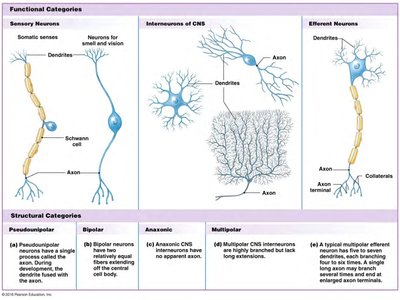
Structural Categories
Neurons are also classified by their structure:
Pseudounipolar: Single process that splits into two branches; common in sensory neurons
Bipolar: Two processes; found in sensory organs like vision and smell
Anaxonic: No apparent axon; found in CNS interneurons
Multipolar: Many dendrites and a single axon; typical of motor neurons and CNS interneurons
Nerves: Bundles of Neurons
Peripheral Nerves
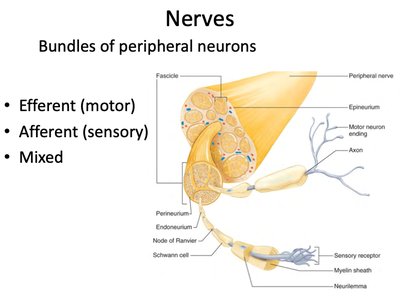
Nerves are bundles of peripheral neurons, which may be efferent, afferent, or mixed. The structure of a nerve includes fascicles, connective tissue layers, and myelinated axons.
Efferent (motor) nerves: Carry signals from CNS to muscles
Afferent (sensory) nerves: Carry signals from sensory receptors to CNS
Mixed nerves: Contain both types of fibers
Types of Sensory Input
Somatic, Visceral, and Special Sensory
Sensory input to the nervous system is categorized as somatic, visceral, or special sensory. Each type is responsible for monitoring different variables and transmitting information to the CNS.
Somatic sensory: General body sensations (pressure, temperature, pain)
Visceral sensory: Sensations from internal organs
Special sensory: Vision, hearing, taste, smell
Summary Table: Neuron Types and Functions
Type | Function | Structure |
|---|---|---|
Afferent (Sensory) | Transmit sensory information to CNS | Pseudounipolar, Bipolar |
Interneurons | Integrate and relay information within CNS | Anaxonic, Multipolar |
Efferent (Motor/Autonomic) | Transmit signals from CNS to effectors | Multipolar |
Key Equations and Concepts
Neuronal Signaling
Neurons transmit electrical signals via action potentials. The membrane potential is governed by ion gradients and permeability.
Resting membrane potential: Typically −70 mV in neurons
Action potential: Rapid change in membrane potential that propagates along the axon
Key Equation:
Where: = membrane potential, = gas constant, = temperature, = Faraday's constant, and = potassium ion concentrations outside and inside the cell.
Additional info: The notes cover the main concepts from Ch. 8 (Neurons: Cellular and Network Properties) and related nervous system structure and function, suitable for ANP college students.
