 Back
Neurotransmitters and Neuromodulators: Types, Functions, and Mechanisms
Study Guide - Smart Notes
 Tailored notes based on your materials, expanded with key definitions, examples, and context.
Neurotransmitters and Neuromodulators
Overview of Chemical Communication in the Nervous System
The nervous system utilizes a complex array of chemical messengers to regulate cellular activity and communication. Neurotransmitters and neuromodulators are key molecules that influence the function of neurons and their synaptic connections. Their effects depend not only on their chemical nature but also on the properties of their receptors.
Neurotransmitters: Chemicals released by neurons to transmit signals across synapses.
Neuromodulators: Substances that modify the response of neurons to neurotransmitters, often with longer-lasting effects.
Effects are classified as excitatory (promoting action potentials) or inhibitory (suppressing action potentials).
The effect depends on the receptor type, not solely on the neurotransmitter.
Classes of Neurotransmitters and Neuromodulators
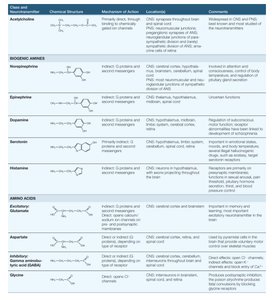
Neurotransmitters and neuromodulators are categorized based on their chemical structure and function. Major classes include biogenic amines, amino acids, neuropeptides, dissolved gases, purines, hormones, and lipids.
Biogenic amines: Norepinephrine, epinephrine, dopamine, serotonin, histamine
Amino acids: Glutamate, aspartate, GABA, glycine
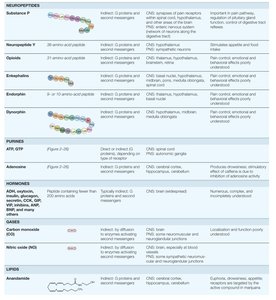
Neuropeptides: Substance P, opioids (enkephalins, endorphins, dynorphins)
Dissolved gases: Nitric oxide (NO), carbon monoxide (CO)
Purines: ATP, GTP, adenosine
Hormones: ADH, oxytocin, insulin, glucagon, etc.
Lipids: Anandamide
Biogenic Amines
Biogenic amines are neurotransmitters derived from amino acids and play diverse roles in the CNS and PNS.
Norepinephrine (NE): Excitatory, found in brain and ANS; released at adrenergic synapses.
Dopamine: Can be excitatory or inhibitory; involved in motor control and reward pathways. Deficiency linked to Parkinson's disease.
Serotonin: Regulates mood, attention, and sleep; low levels associated with depression.
Histamine: Modulates arousal and attention in the CNS.
Amino Acid Neurotransmitters
Amino acids serve as neurotransmitters with both excitatory and inhibitory effects.
Glutamate: Major excitatory neurotransmitter in the CNS.
Aspartate: Excitatory, less prevalent than glutamate.
GABA: Major inhibitory neurotransmitter; reduces anxiety and neuronal excitability.
Glycine: Inhibitory, especially in the spinal cord.
Neuropeptides
Neuropeptides are small chains of amino acids that act as neuromodulators or neurotransmitters, often with long-lasting effects.
Substance P: Involved in pain transmission.
Opioids: Includes enkephalins, endorphins, dynorphins; inhibit pain by blocking substance P release.
Dissolved Gases
Lipid-soluble gases function as neurotransmitters, diffusing through membranes to activate intracellular enzymes.
Nitric oxide (NO): Regulates blood vessel tone and neural signaling.
Carbon monoxide (CO): Functions as a neurotransmitter in the brain.
Purines, Hormones, and Lipids
Other classes include purines (ATP, GTP), hormones (ADH, oxytocin), and lipids (anandamide), each with specialized roles in neural communication.
Mechanisms of Action: How Neurotransmitters and Neuromodulators Work
Direct Effects on Membrane Potential
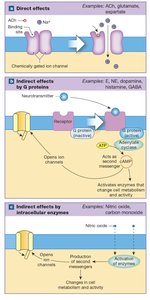
Some neurotransmitters directly alter membrane potential by opening or closing chemically gated ion channels. This is known as an ionotropic effect.
Examples: Acetylcholine (ACh), glutamate, aspartate
Directly change ion flow, leading to rapid depolarization or hyperpolarization.
Indirect Effects via G Proteins and Second Messengers
Many neurotransmitters and neuromodulators act indirectly by activating G protein-coupled receptors (GPCRs). This triggers intracellular signaling cascades involving second messengers such as cyclic-AMP (cAMP).
First messenger: Neurotransmitter binds to receptor.
G protein: Activated by receptor, turns on enzymes like adenylate cyclase.
Second messenger: cAMP opens ion channels or activates enzymes, altering cell activity.
Indirect Effects by Intracellular Enzymes
Lipid-soluble gases (NO, CO) diffuse into cells and activate intracellular enzymes, leading to the production of second messengers and changes in cellular metabolism and activity.
These effects are slower and longer-lasting than direct ion channel modulation.
Summary Table: Major Neurotransmitters and Neuromodulators
The following table summarizes the major neurotransmitters and neuromodulators, their chemical structure, mechanism of action, location, and comments on their function.
Key Points and Applications
The effect of a neurotransmitter depends on the receptor type, not just the chemical itself.
Neurotransmitters and neuromodulators can have direct (ionotropic) or indirect (metabotropic) effects.
Many drugs (e.g., SSRIs, antianxiety medications) target neurotransmitter systems to treat neurological and psychiatric disorders.
Over 100 neurotransmitters have been identified, reflecting the complexity of neural communication.
Example: Dopamine and Parkinson's Disease
Dopamine's inhibitory effect on motor neurons prevents excessive muscle tone. Loss of dopamine-producing neurons leads to Parkinson's disease, characterized by rigidity and tremors.
Example: SSRIs and Depression
Selective serotonin reuptake inhibitors (SSRIs) increase serotonin levels at synapses, alleviating symptoms of depression by enhancing neurotransmitter signaling.
Example: Opioids and Pain Relief
Endogenous opioids (endorphins, enkephalins) inhibit pain transmission by blocking substance P release, providing natural analgesia.
Additional info:
Metabotropic effects involve slower, multi-step signaling pathways, often leading to changes in gene expression or long-term cellular adaptation.
Ionotropic effects are rapid and transient, suitable for fast synaptic transmission.
