 Back
Nonspecific Body Defenses and Immunity: Innate and Adaptive Immune Responses
Study Guide - Smart Notes
 Tailored notes based on your materials, expanded with key definitions, examples, and context.
Ch. 21 The Immune System: Innate and Adaptive Body Defenses
I. Overview of Body Defense Systems
The human body utilizes two major defense systems to protect against pathogens: the innate (nonspecific) defense system and the adaptive (specific) defense system. These systems work together to prevent infection, contain the spread of invaders, and eliminate threats.
Innate (Nonspecific) Defense System: Provides immediate, general protection against pathogens. Includes the first and second lines of defense.
Adaptive (Specific) Defense System: Provides targeted responses to specific pathogens. Involves the third line of defense and takes longer to activate.
II. Innate (Nonspecific) Defenses
Innate defenses are present at birth and provide the first and second lines of defense against infection.
A. Surface Barriers: Skin and Mucous Membranes
Skin: Covers external body surfaces, forming a physical barrier to pathogens.
Mucous Membranes: Line all body cavities open to the external environment (digestive, respiratory, urinary, reproductive tracts).
Protective Chemicals:
Acid mantle: Low pH inhibits bacterial growth.
Sebum: Contains chemicals toxic to bacteria.
Vaginal secretions: Highly acidic, deterring pathogens.
Stomach mucosa: Secretes hydrochloric acid and protein-digesting enzymes to kill microorganisms.
Saliva and tears: Contain lysozyme, an enzyme that destroys bacteria.
Mucus: Traps foreign substances in respiratory passages.
Breaks in surface barriers (cuts, nicks) can allow pathogens to invade deeper tissues.
B. Internal Defenses: Cells and Chemicals
Phagocytes: Cells that engulf and digest pathogens and debris.
Macrophages: Develop from monocytes; can be free (wandering) or fixed in tissues.
Neutrophils: Phagocytize bacteria and small particles.
Eosinophils: Release chemicals to digest parasitic worms; weakly phagocytic.
Mast cells: Can phagocytize a variety of bacteria.
Natural Killer (NK) Cells: Lymphocytes that target infected or cancerous cells by detecting abnormal MHC proteins. Induce apoptosis and secrete chemicals to enhance inflammation. Not phagocytic.
Inflammation: Local tissue response to injury or infection.
Functions: Prevents spread of damage, disposes of debris/pathogens, alerts adaptive immunity, sets stage for repair.
Cardinal signs: Redness, heat, swelling, pain (and sometimes loss of function).
Caused by vasodilation and increased vascular permeability due to inflammatory chemicals (e.g., histamine, kinins, prostaglandins, complement).
Macrophages use Toll-like receptors (TLRs) to recognize invaders and release cytokines, triggering inflammation.
Clotting factors form a fibrin mesh to isolate the area; pus forms from WBCs, pathogens, and debris.
Antimicrobial Proteins:
Interferons: Secreted by virus-infected cells; stimulate production of antiviral proteins in neighboring cells and activate macrophages/NK cells.
Complement Proteins: Plasma proteins that, when activated, enhance inflammation, promote phagocytosis, and cause cell lysis.
Fever: Systemic response to infection. Pyrogens released by leukocytes/macrophages raise body temperature, inhibiting bacterial growth and speeding up tissue repair. High fevers can be dangerous.
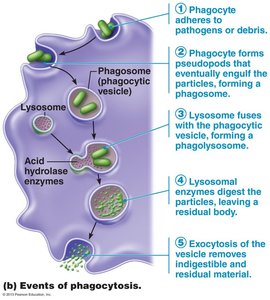
Phagocytosis: Steps and Mechanism
Phagocytosis is a key process by which phagocytes ingest and destroy pathogens. The steps are as follows:
Phagocyte adheres to pathogens or debris.
Phagocyte forms pseudopods that engulf the particles, forming a phagosome (phagocytic vesicle).
Lysosome fuses with the phagocytic vesicle, forming a phagolysosome.
Lysosomal enzymes digest the particles, leaving a residual body.
Exocytosis of the vesicle removes indigestible and residual material.
III. Adaptive (Specific) Defense System
The adaptive immune system targets specific foreign substances (antigens) and provides long-lasting immunity. It is characterized by specificity, systemic action, and memory.
Antigen: Any substance recognized as "non-self" by the immune system (e.g., pathogens, abnormal cells, foreign tissues).
Self-Antigens (MHC proteins): Unique to each individual; allow immune cells to distinguish self from non-self.
A. Cells of the Immune System
B Lymphocytes (B cells): Responsible for humoral (antibody-mediated) immunity.
T Lymphocytes (T cells): Responsible for cell-mediated immunity.
Antigen-Presenting Cells (APCs): Engulf antigens and present fragments on their surface for T cell recognition. Types include macrophages, dendritic cells (most effective), and B lymphocytes.
B. Humoral Immune Response
Primary Immune Response: First exposure to antigen activates specific B cells, leading to clonal selection and production of plasma cells (which secrete antibodies) and memory cells.
Secondary Immune Response: Faster and stronger response upon re-exposure to the same antigen, due to memory cells.
Active Immunity: Body produces its own antibodies after exposure to antigen (natural infection or vaccination).
Passive Immunity: Antibodies are received from another source (e.g., maternal antibodies, immune serum); provides short-term protection.
C. Antibodies (Immunoglobulins)
Proteins that bind specifically to antigens; circulate in blood and lymph.
Five classes: IgM, IgA, IgD, IgG, IgE (mnemonic: MADGE).
Four basic defense mechanisms:
Neutralization: Block pathogen binding sites.
Agglutination: Clump antigens together for easier removal.
Precipitation: Soluble molecules aggregate and settle out.
Complement Fixation & Activation: Triggers complement cascade, enhancing inflammation, opsonization, and cell lysis.
All antigen-antibody reactions result in the formation of an antigen-antibody complex.
D. Cell-Mediated Immune Response
T Lymphocytes: Originate in bone marrow, mature in thymus, and become immunocompetent.
Types of T Cells:
Helper T Cells (CD4): Activate B cells, other T cells, and macrophages; essential for adaptive immunity.
Cytotoxic T Cells (CD8): Destroy infected or abnormal cells by releasing perforin (causes cell lysis) or inducing apoptosis.
Regulatory T Cells: Suppress immune response to prevent autoimmunity.
Memory T Cells: Provide rapid response upon re-exposure to antigen.
Antigen Presentation: APCs display antigen fragments on MHC proteins for T cell recognition.
Summary Table: Innate vs. Adaptive Immunity
Feature | Innate Immunity | Adaptive Immunity |
|---|---|---|
Specificity | Nonspecific (general) | Specific (targets particular antigens) |
Response Time | Immediate (minutes to hours) | Slower (days to weeks) |
Memory | None | Yes (memory cells) |
Main Components | Barriers, phagocytes, NK cells, inflammation, fever, complement | B cells, T cells, antibodies, APCs |
