 Back
Nonspecific Body Defenses and Immunity: Innate and Adaptive Immune Responses
Study Guide - Smart Notes
 Tailored notes based on your materials, expanded with key definitions, examples, and context.
Chapter 21: Nonspecific Body Defenses and Immunity
Overview of Body Defense Systems
The human body utilizes two major defense systems to protect against pathogens: the innate (nonspecific) defense system and the adaptive (specific) defense system. The innate system provides immediate, general protection, while the adaptive system targets specific threats and develops memory for future responses.
Innate (Nonspecific) System: First and second lines of defense; rapid response.
Adaptive (Specific) System: Third line of defense; slower but highly specific and has memory.
I. Innate (Nonspecific) Defenses
A. Surface Barriers: Skin and Mucous Membranes
Surface barriers are the body's first line of defense, preventing pathogen entry through physical and chemical means.
Skin: Covers external body surfaces, forming a physical barrier.
Mucous Membranes: Line body cavities open to the environment (digestive, respiratory, urinary, reproductive tracts).
Chemical Defenses:
Acid mantle (skin/vaginal secretions) inhibits bacterial growth.
Sebum contains bactericidal chemicals.
Stomach mucosa secretes hydrochloric acid and enzymes to destroy pathogens.
Saliva and tears contain lysozyme, an enzyme that digests bacterial cell walls.
Mucus traps foreign particles in respiratory passages.
Breaks in barriers (cuts, nicks) allow deeper tissue invasion.
B. Internal Defenses: Cells and Chemicals
If pathogens breach surface barriers, internal defenses are activated, including various cells and antimicrobial chemicals.
1. Phagocytes
Macrophages: Derived from monocytes; can be free (wandering) or fixed in tissues.
Neutrophils: Engulf and digest bacteria and small particles.
Eosinophils: Attack parasitic worms and phagocytize antigen-antibody complexes.
Mast Cells: Can phagocytize bacteria and release inflammatory mediators.
Phagocytosis is a multi-step process by which cells engulf and digest pathogens or debris.
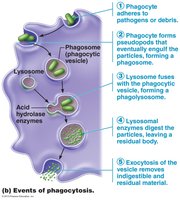
Step 1: Phagocyte adheres to pathogen or debris.
Step 2: Engulfment forms a phagocytic vesicle (phagosome).
Step 3: Lysosome fuses with phagosome, forming a phagolysosome.
Step 4: Lysosomal enzymes digest the contents.
Step 5: Indigestible material is removed by exocytosis.
2. Natural Killer (NK) Cells
Type of lymphocyte (not B or T cell).
Detect abnormal cells (e.g., lacking "self" MHC proteins).
Induce apoptosis (programmed cell death) in target cells.
Secrete chemicals to enhance inflammation.
3. Inflammation: Tissue Response to Injury
Inflammation is a localized response to injury or infection, characterized by redness, heat, swelling, and pain.
Functions:
Prevents spread of damaging agents.
Disposes of debris and pathogens.
Alerts adaptive immune system.
Prepares tissue for repair.
Cardinal Signs: Redness, heat, swelling, pain (sometimes loss of function).
Mechanisms: Vasodilation, increased vascular permeability, leukocyte recruitment.
Chemicals Involved: Histamine, kinins, prostaglandins, complement, cytokines.
Outcomes: Increased blood flow, edema, attraction of immune cells, formation of pus, and tissue repair.
4. Antimicrobial Proteins
Interferons: Proteins released by virus-infected cells; protect neighboring cells by inducing antiviral protein synthesis (e.g., PKR), activate macrophages and NK cells.
Complement Proteins: Group of ~20 plasma proteins; when activated, enhance inflammation, promote phagocytosis, and cause cell lysis.
5. Fever
Systemic response to infection; pyrogens released by leukocytes/macrophages raise body temperature.
Benefits: Inhibits bacterial growth (by sequestering iron/zinc), accelerates tissue repair.
High fevers can be dangerous due to protein denaturation and organ damage.
II. Adaptive (Specific) Defense System
The adaptive immune system targets specific antigens and develops immunological memory for faster, stronger responses upon re-exposure.
Antigen: Any substance recognized as foreign (non-self) by the immune system.
Self-Antigens (MHC proteins): Unique to each individual; allow immune system to distinguish self from non-self.
A. Characteristics of Adaptive Immunity
Antigen-specific: Targets particular antigens.
Systemic: Not restricted to infection site.
Memory: Enhanced response to previously encountered antigens.
B. Cells of the Immune System
B Lymphocytes (B cells): Responsible for humoral (antibody-mediated) immunity.
T Lymphocytes (T cells): Responsible for cell-mediated immunity.
Antigen-Presenting Cells (APCs): Engulf antigens and present fragments on their surface for T cell recognition (e.g., dendritic cells, macrophages, B cells).
1. Lymphocyte Development
Origin: All lymphocytes originate from hemocytoblasts in red bone marrow.
B cells mature in bone marrow; T cells mature in thymus.
Immunocompetence: Ability to recognize a specific antigen via unique surface receptors.
Naive lymphocytes have not yet encountered their specific antigen.
2. Antigen-Presenting Cells (APCs)
Engulf antigens, process them, and display peptide fragments on MHC proteins for T cell recognition.
Dendritic cells: Most effective APCs; present antigens to T cells in lymph nodes.
Macrophages: Present antigens and become more active upon T cell interaction.
B lymphocytes: Present antigens to helper T cells.
III. Humoral Immune Response
A. Immunological Memory
Primary Response: First exposure to antigen; B cell activation, clonal selection, plasma cell formation, and antibody production (peak in ~10 days). Some cells become long-lived memory cells.
Secondary Response: Faster, stronger response upon re-exposure (peak in 2-3 days), often preventing symptoms.
B. Active and Passive Humoral Immunity
Active Immunity: Body produces its own antibodies.
Naturally acquired: Infection.
Artificially acquired: Vaccination.
Passive Immunity: Antibodies are received from another source (short-term protection).
Naturally acquired: Maternal antibodies via placenta or breast milk.
Artificially acquired: Injection of immune serum (e.g., for rabies, tetanus).
C. Antibodies (Immunoglobulins)
Proteins produced by plasma cells; bind specifically to antigens.
Five classes: IgM, IgA, IgD, IgG, IgE (mnemonic: MADGE).
Functions: Inactivate antigens and tag them for destruction.
Antibody Defense Mechanisms
Neutralization: Block pathogen binding sites.
Agglutination: Clump antigens together for easier phagocytosis.
Precipitation: Soluble molecules aggregate and settle out of solution.
Complement Fixation & Activation: Triggers complement cascade, enhancing inflammation, opsonization, and cell lysis.
Mnemonic: Antibodies have a PLAN: Precipitation, Lysis, Agglutination, Neutralization.
IV. Cell-Mediated Immune Response
A. T Lymphocytes
Produced in bone marrow, mature in thymus.
Classified by surface receptors: CD4 (helper T cells, regulatory T cells) and CD8 (cytotoxic T cells).
Activated T cells differentiate into effector and memory cells.
Major Types of T Cells
Helper T Cells (CD4): Activate B cells, cytotoxic T cells, macrophages; release cytokines to amplify immune response.
Cytotoxic T Cells (CD8): Destroy infected or abnormal cells by releasing perforin (induces lysis) or triggering apoptosis.
Regulatory T Cells: Suppress immune response to prevent autoimmunity; mechanisms not fully understood.
Summary Table: Major Immune Cells and Their Functions
Cell Type | Main Function | Key Features |
|---|---|---|
Macrophage | Phagocytosis, antigen presentation | Innate & adaptive immunity; fixed or wandering |
Neutrophil | Phagocytosis | First responder to infection |
Natural Killer Cell | Kill abnormal cells | Non-specific; induce apoptosis |
B Lymphocyte | Produce antibodies | Humoral immunity |
T Lymphocyte | Cell-mediated immunity | Helper, cytotoxic, regulatory roles |
Dendritic Cell | Antigen presentation | Most effective APC |
Additional info: The immune system's complexity ensures robust protection but can also lead to disorders if regulation fails (e.g., autoimmunity, immunodeficiency).
