 Back
Nonspecific Body Defenses and Immunity: Study Notes
Study Guide - Smart Notes
 Tailored notes based on your materials, expanded with key definitions, examples, and context.
Ch. 21 The Immune System: Innate and Adaptive Body Defenses
Overview of Body Defense Systems
The human body employs two major defense systems to protect against pathogens and harmful substances: the innate (nonspecific) defense system and the adaptive (specific) defense system. The innate system responds rapidly, while the adaptive system targets specific threats and takes longer to activate.
Innate (Nonspecific) Defense: First and second lines of defense; present at birth; responds within minutes.
Adaptive (Specific) Defense: Third line of defense; mounts targeted attacks against specific foreign substances; slower response.
Innate (Nonspecific) Defenses
Innate defenses are always present and provide immediate protection. They include surface barriers and internal cellular and chemical defenses.
Surface Barriers: Skin and Mucous Membranes
Skin: Covers the body, acts as a physical barrier.
Mucous Membranes: Line cavities open to the environment (digestive, respiratory, urinary, reproductive).
Protective Chemicals:
Acid mantle (skin acidity)
Sebum (contains antibacterial chemicals)
Vaginal secretions (acidic)
Stomach mucosa (hydrochloric acid and enzymes)
Saliva and tears (contain lysozyme)
Mucus (traps foreign substances)
Small cuts or nicks can allow pathogens to invade deeper tissues.
Internal Defenses: Cells and Chemicals
When surface barriers are breached, internal defenses are activated. These include phagocytes, natural killer cells, inflammation, antimicrobial proteins, and fever.
Phagocytes
Macrophages: Develop from monocytes; can be free (wandering) or fixed (stationary in organs).
Neutrophils: Phagocytize bacteria and small particles.
Eosinophils: Digest parasitic worms; weakly phagocytic; can phagocytize antigen-antibody complexes.
Mast Cells: Can phagocytize a variety of bacteria.
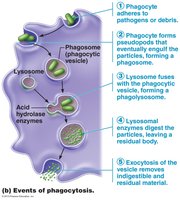
Example: The process of phagocytosis involves the phagocyte adhering to pathogens, engulfing them, digesting with lysosomal enzymes, and removing indigestible material via exocytosis.
Natural Killer (NK) Cells
Lymphocytes that are neither B nor T cells.
Detect abnormal cells (lack of "self" MHC proteins).
Kill through direct contact, inducing apoptosis.
Secrete chemicals to enhance inflammation.
Inflammation: Tissue Response to Injury
Inflammation is a localized response to injury or infection, characterized by redness, heat, swelling, and pain.
Functions: Prevents spread of damage, disposes of debris/pathogens, alerts adaptive immunity, initiates repair.
Mechanisms: Vasodilation, increased vascular permeability, release of inflammatory chemicals (histamine, kinins, prostaglandins, complement).
Cardinal Signs: Redness, heat, swelling, pain; possible temporary loss of function.
Cellular Events: Macrophages use Toll-like receptors (TLRs) to recognize invaders and release cytokines.
Outcome: Attraction of leukocytes, formation of pus, clotting to isolate area, eventual antibody response.
Antimicrobial Proteins
Interferons: Produced by virus-infected cells; stimulate synthesis of PKR protein to block viral replication; activate macrophages and NK cells.
Complement Proteins: Plasma proteins activated to enhance inflammation, cause cell lysis, and promote phagocytosis.
Fever
Systemic response to infection.
Pyrogens released by leukocytes/macrophages raise body temperature.
Liver and spleen sequester iron and zinc, inhibiting bacterial growth.
Speeds up metabolism and healing; high fevers can be dangerous.
Adaptive (Specific) Defense System
The adaptive immune system targets specific antigens and provides long-lasting protection. It is antigen-specific, systemic, and has memory.
Antigen: Anything recognized as "non-self" (microorganisms, damaged cells, infected cells, cancer cells, foreign tissues).
Self-Antigens: MHC proteins identify cells as "self"; unique to each individual.
Cells of the Immune System
B Lymphocytes (B cells): Responsible for humoral immunity (antibody-mediated).
T Lymphocytes (T cells): Responsible for cell-mediated immunity.
Antigen-Presenting Cells (APCs): Engulf antigens and present fragments on MHC proteins for T cell recognition (macrophages, dendritic cells, B cells).
Example: Dendritic cells phagocytize antigens in the skin, migrate to lymph nodes, and present antigens to T cells. Macrophages activate T cells and themselves, becoming potent killers. B cells present antigens to helper T cells.
Humoral Immune Response
B cells mediate humoral immunity by producing antibodies. Immunological memory ensures faster, stronger responses upon re-exposure to the same antigen.
Immunological Memory
Primary Response: First exposure; B cell activation, clonal selection, plasma cell formation, antibody production (peak in ~10 days); memory cells formed.
Secondary Response: Faster, stronger response (peak in 2-3 days); often prevents symptoms.
Active & Passive Humoral Immunity
Active Immunity: Antigen stimulates antibody production; long-term protection.
Naturally acquired: Infection.
Artificially acquired: Vaccination.
Passive Immunity: Antibodies received; short-term protection.
Naturally acquired: Maternal antibodies (placenta, breast milk).
Artificially acquired: Injection of immune sera (e.g., for rabies, tetanus).
Antibodies (Immunoglobulins)
Proteins with specific shapes to bind antigens.
Produced during immune responses; circulate in blood and lymph.
Five classes: IgM, IgA, IgD, IgG, IgE ("MADGE").
Defense mechanisms: Neutralization, Agglutination, Precipitation, Complement Fixation & Activation.
Formation of antigen-antibody complex is central to all reactions.
Types of Antigen-Antibody Reactions
Neutralization: Antibodies block sites on pathogens, preventing entry/injury.
Agglutination: Antigens and antibodies form clumps, facilitating phagocytosis.
Precipitation: Soluble molecules aggregate and settle out, easier for phagocytes to engulf.
Complement Fixation & Activation: Antibody binding exposes sites for complement proteins, activating the complement cascade (enhances inflammation, attracts phagocytes, opsonization, cell lysis).
Mnemonic: Antibodies have a PLAN: Precipitation, Lysis, Agglutination, Neutralization.
Cell-Mediated Immune Response
T cells mediate cellular immunity, targeting infected or abnormal cells. They are classified by surface receptors (CD4 or CD8) and differentiate into effector cells upon activation.
T Lymphocytes
Produced in bone marrow, mature in thymus.
Naive T cells express CD4 or CD8 receptors.
Activated CD4 cells become helper or regulatory T cells; CD8 cells become cytotoxic T cells.
Effector cells: Helper T cells (activate B cells, T cells, macrophages), Cytotoxic T cells (destroy infected/cancerous cells), Regulatory T cells (moderate immune response).
Memory T cells formed for rapid future responses.
Cytotoxic T Cells
Destroy infected or abnormal cells by recognizing class I MHC proteins.
Mechanisms: Release perforin (cell lysis), induce apoptosis.
Targets: Virus-infected cells, bacteria, parasites, cancer cells, foreign cells (transplants).
Helper T Cells
Activated by class II MHC proteins.
Release cytokines to mobilize lymphocytes, macrophages, and amplify innate defenses.
Essential for adaptive immune response.
Regulatory T Cells
Slow or stop immune response when antigen is destroyed.
Prevent autoimmune reactions; release inhibitory cytokines or act via direct contact.
Additional info: The immune system is highly complex, with many mechanisms still under investigation. Genetic factors determine the range of antigens an individual's immune system can respond to.
