 Back
Nutrition, Metabolism, and Energy Balance: Study Notes chap 24
Study Guide - Smart Notes
 Tailored notes based on your materials, expanded with key definitions, examples, and context.
Nutrition, Metabolism, and Energy Balance
Introduction
This chapter explores the essential nutrients required by the human body, their metabolic pathways, and the mechanisms that regulate energy balance. Understanding these processes is crucial for making informed dietary choices and maintaining optimal health.
Part 1 – Nutrients
Macronutrients
Macronutrients are nutrients required in large amounts and serve as the primary sources of energy and structural materials for the body.
Carbohydrates: Main energy source, especially for neurons and red blood cells.
Lipids: Provide energy, insulation, and are essential for cell membranes and hormone synthesis.
Proteins: Required for growth, repair, and synthesis of enzymes and hormones.
Micronutrients
Micronutrients are required in smaller amounts but are vital for proper physiological function.
Vitamins: Organic compounds, mostly functioning as coenzymes.
Minerals: Inorganic elements necessary for enzyme function, nerve transmission, and structural roles.
Water: Essential for all biochemical reactions and transport processes.
Essential vs. Nonessential Nutrients
Essential nutrients: Must be obtained from the diet because the body cannot synthesize them.
Nonessential nutrients: Can be synthesized by the body from other nutrients if not supplied in the diet.
Energy Value of Food
Measured in kilocalories (kcal).
1 kcal = amount of heat needed to raise the temperature of 1 kg of water by 1°C.
Dietary Guidelines: USDA MyPlate
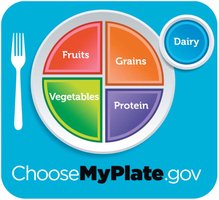
The USDA's MyPlate provides a visual guide for balanced eating, emphasizing the importance of fruits, vegetables, grains, protein, and dairy.
Carbohydrates
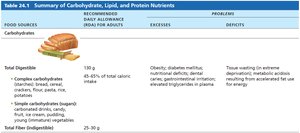
Carbohydrates are primarily derived from plant sources and are classified as simple (sugars) or complex (starches and fibers).
Uses in the body: Main fuel for ATP production; essential for brain and red blood cell function.
Dietary requirements: 45–65% of total calories, mainly from complex carbohydrates.
Excess intake: Can lead to obesity and metabolic disorders.
Lipids
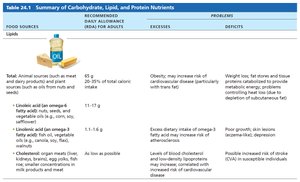
Lipids include triglycerides, phospholipids, and cholesterol. They are found in both animal and plant foods.
Uses in the body: Energy storage, insulation, cell membrane structure, and hormone synthesis.
Essential fatty acids: Linoleic (omega-6) and linolenic (omega-3) acids must be obtained from the diet.
Dietary requirements: 20–35% of total caloric intake; saturated fats should be limited to less than 10%.
Proteins
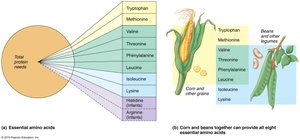
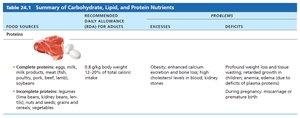
Proteins are composed of amino acids and are necessary for tissue growth, repair, and the synthesis of enzymes and hormones.
Complete proteins: Contain all essential amino acids (e.g., animal products, soybeans).
Incomplete proteins: Lack one or more essential amino acids (e.g., legumes, grains).
Dietary requirements: 0.8 g per kg body weight per day.
Vitamins
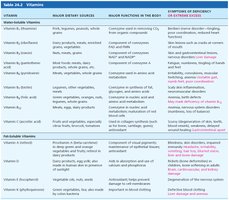
Vitamins are organic compounds that function mainly as coenzymes. They are classified based on solubility:
Water-soluble: B-complex and C; not stored in the body, excess excreted in urine.
Fat-soluble: A, D, E, K; stored in body tissues, excess can be toxic.
Minerals
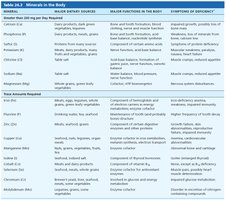
Minerals are inorganic elements required for various physiological processes, including bone formation, nerve function, and fluid balance.
Major minerals: Calcium, phosphorus, potassium, sulfur, sodium, chlorine, magnesium.
Trace minerals: Required in smaller amounts (e.g., iron, zinc, iodine).
Part 2 – Metabolism
Overview of Metabolism
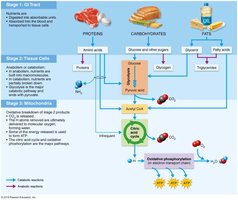
Metabolism is the sum of all biochemical reactions in the body, including both anabolic (building) and catabolic (breaking down) processes.
Anabolism: Synthesis of large molecules from smaller ones (e.g., protein synthesis).
Catabolism: Breakdown of complex molecules into simpler ones (e.g., glycolysis).
Cellular respiration: Catabolic process that generates ATP from nutrients.
Carbohydrate Metabolism
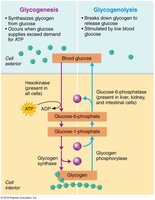
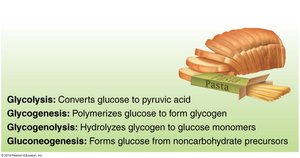
Carbohydrate metabolism includes glycolysis, glycogenesis, glycogenolysis, and gluconeogenesis.
Glycolysis: Converts glucose to pyruvic acid (anaerobic, cytosol).
Glycogenesis: Formation of glycogen from glucose (mainly in liver and muscle).
Glycogenolysis: Breakdown of glycogen to glucose (in response to low blood glucose).
Gluconeogenesis: Formation of glucose from non-carbohydrate sources (e.g., amino acids, glycerol).
Protein Synthesis and Metabolism
Amino acids are used for protein synthesis or, if not needed, can be converted to energy or stored as fat. Protein synthesis is hormonally regulated and requires all essential amino acids.
Nitrogen balance: Reflects the balance between protein synthesis and breakdown.
Positive nitrogen balance: Synthesis exceeds breakdown (e.g., growth, pregnancy).
Negative nitrogen balance: Breakdown exceeds synthesis (e.g., starvation, illness).
Lipid Metabolism
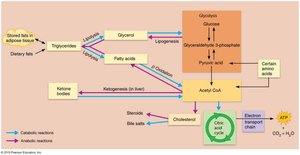
Lipids provide a high energy yield and are metabolized through several pathways:
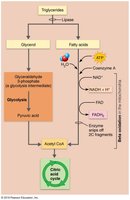
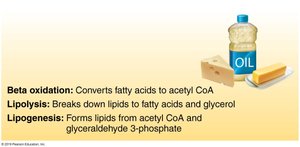
Lipogenesis: Synthesis of triglycerides from glucose or amino acids when energy intake exceeds demand.
Lipolysis: Breakdown of triglycerides into fatty acids and glycerol for energy use.
Beta oxidation: Conversion of fatty acids to acetyl CoA for entry into the citric acid cycle.
Ketogenesis: Formation of ketone bodies from excess acetyl CoA in the liver during prolonged fasting or carbohydrate restriction.
Absorptive and Postabsorptive States
Absorptive State (Fed State)
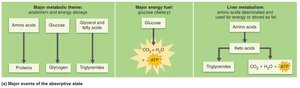
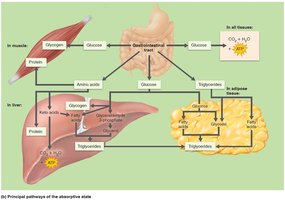
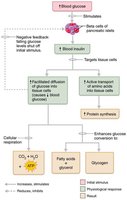
Occurs during and shortly after eating, when nutrients are being absorbed. Anabolism exceeds catabolism, and excess nutrients are stored.
Carbohydrates: Used for energy or stored as glycogen/fat.
Fats: Stored in adipose tissue.
Amino acids: Used for protein synthesis or converted to energy/fat if in excess.
Hormonal control: Insulin is the primary hormone, promoting glucose uptake and storage.
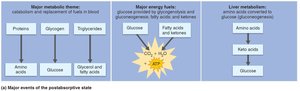
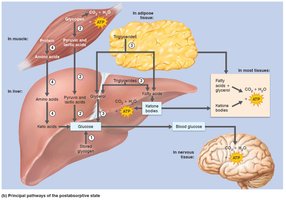
Postabsorptive State (Fasting State)
Occurs when the GI tract is empty and the body relies on stored reserves for energy. Catabolism exceeds anabolism.
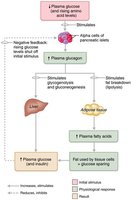
Sources of blood glucose: Glycogenolysis, lipolysis, gluconeogenesis, and protein catabolism (during prolonged fasting).
Glucose sparing: Most tissues use fatty acids for energy, reserving glucose for the brain.
Hormonal control: Glucagon and the sympathetic nervous system are primary regulators.
Hormonal Regulation of Metabolism
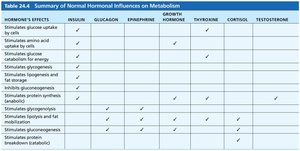
Multiple hormones influence metabolism, including insulin, glucagon, epinephrine, growth hormone, thyroxine, and corticosteroids.
Hormone | Main Effects |
|---|---|
Insulin | Promotes glucose uptake, glycogen synthesis, protein synthesis, and fat storage |
Glucagon | Stimulates glycogenolysis, gluconeogenesis, and lipolysis |
Epinephrine | Stimulates glycogenolysis and fat mobilization |
Growth Hormone | Stimulates protein synthesis, lipolysis |
Thyroxine | Increases metabolic rate |
Corticosteroids | Stimulate gluconeogenesis, protein breakdown |
Regulation of Food Intake and Body Weight
Energy Balance
Body weight remains stable when energy intake equals energy output. Imbalance leads to weight gain or loss.
Body Mass Index (BMI)
BMI is a measure of body fat based on weight and height.
Formula:
Overweight: BMI 25–30; Obese: BMI > 30
Metabolic Rate
Basal Metabolic Rate (BMR)
BMR is the energy required for essential body functions at rest. It is influenced by age, gender, body temperature, stress, and thyroid hormone levels.
Measured in kcal/m2/h
Increased by thyroxine, stress, and higher body temperature
Lipid Metabolism in Detail
Fat Catabolism and Anabolism
Beta oxidation: Converts fatty acids to acetyl CoA for the citric acid cycle.
Lipogenesis: Forms triglycerides from acetyl CoA and glycerol when energy is abundant.
Lipolysis: Breaks down triglycerides into fatty acids and glycerol for energy use.
Ketogenesis: Excess acetyl CoA is converted to ketone bodies during prolonged fasting or diabetes.
Clinical Note: Excessive ketone bodies can lead to ketosis, a potentially dangerous condition seen in starvation, diabetes, or extreme dieting.
