 Back
BackOsseous Tissue: Structure, Classification, and Histology
Study Guide - Smart Notes
 Tailored notes based on your materials, expanded with key definitions, examples, and context.
Osseous Tissue
Overview of the Skeletal System
The skeletal system provides structural support, protection for internal organs, facilitates movement, stores minerals, and houses bone marrow for blood cell production. Bones are dynamic tissues that undergo constant remodeling and play a crucial role in homeostasis.
Classification of Bones
Types of Bones
Bones are classified based on their shape and function. The main types include long, flat, short, irregular, and sesamoid bones. Each type has distinct anatomical features and roles in the body.
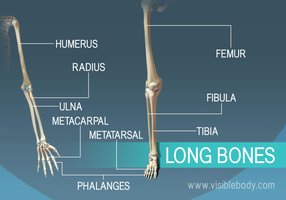
Long Bones
Long bones are characterized by a greater length than width and are primarily found in the limbs. They function as levers for movement and support the weight of the body.
Examples: Humerus, radius, ulna, femur, tibia, fibula, metacarpals, metatarsals, phalanges
Structure: Consist of a shaft (diaphysis) and two ends (epiphyses)
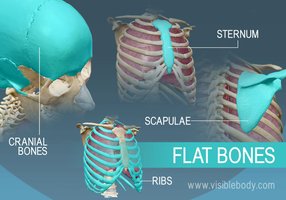
Flat Bones
Flat bones are thin, flattened, and often curved. They provide protection for internal organs and serve as sites for muscle attachment.
Examples: Cranial bones, sternum, ribs, scapulae
Function: Protection and muscle attachment
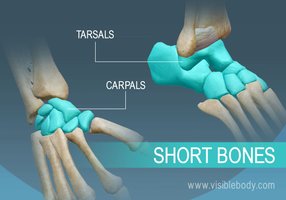
Short Bones
Short bones are roughly cube-shaped and provide stability with limited movement. They are found in areas requiring strength and compactness.
Examples: Carpals (wrist), tarsals (ankle)
Function: Support and stability
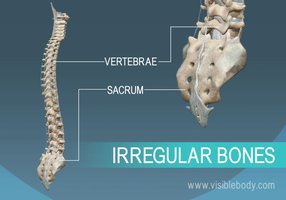
Irregular Bones
Irregular bones have complex shapes that do not fit into other categories. They often serve specialized functions.
Examples: Vertebrae, sacrum
Function: Protection of nervous tissue, muscle attachment
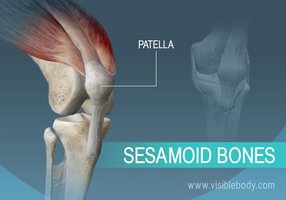
Sesamoid Bones
Sesamoid bones are small, round bones embedded within tendons. They protect tendons and increase their mechanical advantage.
Example: Patella (kneecap)
Function: Modify pressure, reduce friction, and alter direction of muscle pull
Anatomy of Bone
Gross Structure
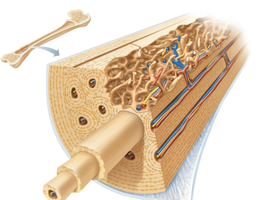
Bones have a complex structure that includes both compact and spongy regions. The outer layer is dense and strong, while the inner layer is porous and lightweight.
Compact bone: Dense, forms the outer layer
Spongy bone: Porous, found inside bones
Periosteum: Membrane covering the outer surface
Endosteum: Membrane lining the internal surface
Medullary cavity: Central cavity containing bone marrow
Histological Structure of Bone
Microscopic Anatomy
The histology of bone reveals specialized structures that contribute to its strength and function. Compact bone is organized into osteons, while spongy bone consists of trabeculae.
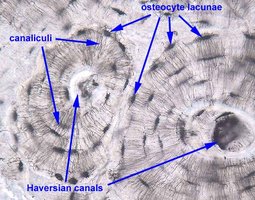
Osteon (Haversian system): Structural unit of compact bone
Lamellae: Layers of bone matrix
Concentric lamellae: Surround the central canal
Central canal (Haversian canal): Contains blood vessels and nerves
Perforating canal (Volkmann’s canal): Connects osteons
Osteocyte: Mature bone cell
Lacunae: Small spaces housing osteocytes
Canaliculi: Tiny channels for cell communication
Trabeculae: Network of spongy bone
Spongy Bone Histology
Spongy bone is composed of a lattice of trabeculae, which provide structural support and house bone marrow. The spaces between trabeculae are filled with red or yellow marrow, depending on the bone and age.
Trabeculae: Irregularly arranged lamellae
Marrow spaces: Contain hematopoietic tissue

Bone Histology Terms
Key Definitions
Compact bone: Dense bone forming the outer layer
Spongy bone: Porous bone inside the structure
Periosteum: Fibrous membrane covering bone
Endosteum: Membrane lining internal bone surfaces
Medullary cavity: Central cavity containing marrow
Lamellae: Layers of bone matrix
Osteon: Functional unit of compact bone
Central canal: Channel for blood vessels and nerves
Osteocyte: Mature bone cell in lacunae
Lacunae: Small spaces for osteocytes
Canaliculi: Channels connecting lacunae
Trabeculae: Latticework in spongy bone
Additional info:
Bone tissue is highly vascularized and innervated, allowing for rapid repair and remodeling.
Mineralization of bone matrix provides rigidity and strength, primarily through deposition of hydroxyapatite crystals.
