 Back
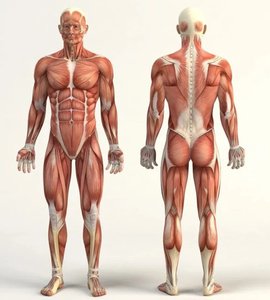
BackOverview of Human Muscular System: Anterior and Posterior Views
Study Guide - Smart Notes
 Tailored notes based on your materials, expanded with key definitions, examples, and context.
Muscles
Introduction to the Human Muscular System
The human muscular system is composed of over 600 muscles that are responsible for movement, posture, and heat production. Muscles are classified based on their structure and function, and they work in coordination with the skeletal system to facilitate voluntary and involuntary movements.
Skeletal Muscles: These are voluntary muscles attached to bones and are responsible for body movements.
Cardiac Muscle: Found only in the heart, this muscle is responsible for pumping blood throughout the body.
Smooth Muscles: Located in the walls of internal organs, these muscles control involuntary movements such as digestion.
Major Muscle Groups (Anterior and Posterior Views)
The major muscle groups of the human body can be observed from both the front (anterior) and back (posterior) views. Understanding their locations and functions is essential for studying human anatomy and physiology.
Anterior View: Shows muscles such as the pectoralis major (chest), rectus abdominis (abdomen), quadriceps femoris (thigh), biceps brachii (upper arm), and tibialis anterior (shin).
Posterior View: Highlights muscles like the trapezius (upper back), latissimus dorsi (mid-back), gluteus maximus (buttocks), hamstrings (back of thigh), and gastrocnemius (calf).
Functions of Skeletal Muscles
Movement: Muscles contract to produce movement of body parts.
Posture Maintenance: Continuous muscle contractions help maintain body posture.
Heat Production: Muscle activity generates heat, which helps maintain body temperature.
Muscle Structure and Contraction
Skeletal muscles are composed of muscle fibers, which contain myofibrils made up of actin and myosin filaments. Muscle contraction occurs through the sliding filament mechanism, where actin and myosin slide past each other to shorten the muscle.
Sliding Filament Theory: Explains how muscles contract at the molecular level.
Neuromuscular Junction: The site where a motor neuron stimulates a muscle fiber to contract.
Equation for Muscle Force:
Where is force, is mass, and is acceleration.
Classification of Skeletal Muscles
Muscle Group | Location | Primary Function |
|---|---|---|
Pectoralis Major | Chest | Arm flexion, adduction |
Rectus Abdominis | Abdomen | Trunk flexion |
Quadriceps Femoris | Front of thigh | Knee extension |
Trapezius | Upper back | Scapula movement |
Gluteus Maximus | Buttocks | Hip extension |
Example: Biceps Brachii
The biceps brachii is a muscle located in the upper arm. It is responsible for flexing the elbow and rotating the forearm. When you lift an object, the biceps contract to bring the forearm toward the shoulder.
