 Back
BackPeripheral Nervous System: Structure, Function, and Clinical Relevance
Study Guide - Smart Notes
 Tailored notes based on your materials, expanded with key definitions, examples, and context.
Peripheral Nervous System (PNS): Overview and Divisions
Introduction to the PNS
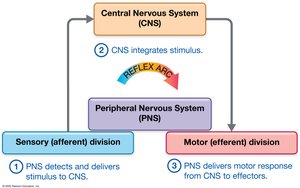
The Peripheral Nervous System (PNS) serves as the communication link between the Central Nervous System (CNS) and the rest of the body, including the external environment. It is responsible for detecting sensory stimuli and delivering them to the CNS, which processes the input and sends motor commands back through the PNS to effectors such as muscles and glands.
Spinal Nerves and Cranial Nerves are part of the PNS, even though they attach directly to the spinal cord and brain.
The PNS is divided into Sensory (Afferent) and Motor (Efferent) divisions.
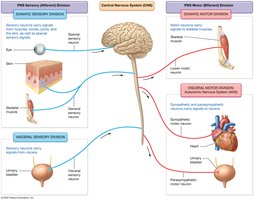
Divisions of the PNS
Sensory (Afferent) Division:
Somatic Sensory Division: Carries signals from muscles, bones, joints, skin, and special senses.
Visceral Sensory Division: Carries signals from organs in the thoracic and abdominopelvic cavities.
Motor (Efferent) Division:
Somatic Motor Division: Sends signals to skeletal muscles.
Visceral Motor Division (Autonomic Nervous System, ANS): Sends signals to cardiac and smooth muscle and glands.
Sympathetic Nervous System: "Fight or Flight" response.
Parasympathetic Nervous System: "Rest and Digest" response.
Peripheral Nerves and Associated Ganglia
Structure of Peripheral Nerves
Peripheral nerves are bundles of axons from many neurons, bound together by connective tissue sheaths. They innervate most body structures and are classified as:
Mixed Nerves: Contain both sensory and motor axons.
Sensory Nerves: Contain only sensory axons.
Motor Nerves: Contain mostly motor axons, with some sensory axons for monitoring muscle stretch and tension.
Spinal Nerve Structure
Anterior Root: Contains axons of motor neurons.
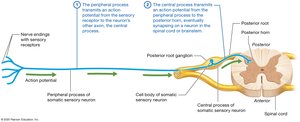
Posterior Root: Contains axons of sensory neurons; the Posterior Root Ganglion houses sensory neuron cell bodies.
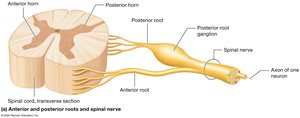
Connective Tissue Sheaths
Epineurium: Surrounds the entire nerve.
Perineurium: Surrounds each fascicle (bundle of axons).
Endoneurium: Surrounds each individual axon.
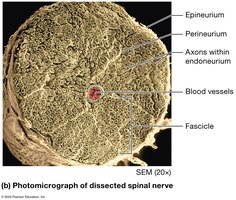
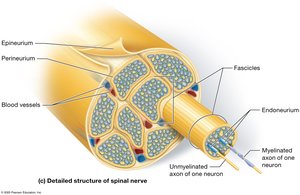
Cranial Nerves
Overview and Classification
There are twelve pairs of cranial nerves, each with specific sensory, motor, or mixed functions. They are often remembered using mnemonics for their names and functions.
Sensory Only: Olfactory, Optic, Vestibulocochlear
Motor Only: Oculomotor, Trochlear, Abducens, Accessory, Hypoglossal
Mixed: Trigeminal, Facial, Glossopharyngeal, Vagus
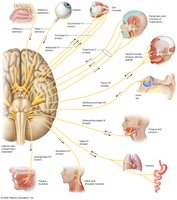
Examples of Cranial Nerve Functions
Olfactory Nerve (I): Sense of smell
Optic Nerve (II): Vision
Trigeminal Nerve (V): Sensation in the face and motor functions such as biting and chewing
Facial Nerve (VII): Facial expressions, taste, and some glandular functions
Spinal Nerves and Plexuses
Spinal Nerve Branches
Spinal nerves split into posterior and anterior rami after leaving the vertebral cavity. The anterior rami of certain spinal nerves form complex networks called nerve plexuses (cervical, brachial, lumbar, and sacral), which innervate specific body regions.
Cervical Plexus: Innervates neck muscles and diaphragm (via the phrenic nerve).
Brachial Plexus: Innervates the upper limb.
Lumbar Plexus: Innervates the pelvis and lower limb.
Sacral Plexus: Innervates the pelvis, gluteal region, and lower limb (including the sciatic nerve).
Sensory Receptors and Sensation
Types and Functions of Sensory Receptors
Sensory receptors convert environmental stimuli into electrical signals (sensory transduction). They are classified by structure, location, and the type of stimulus detected.
Encapsulated Nerve Endings: Surrounded by specialized cells.
Free Nerve Endings: Lack supportive cells.
Classification by Stimulus Type
Mechanoreceptors: Respond to mechanical deformation (touch, pressure, stretch).
Thermoreceptors: Respond to temperature changes.
Chemoreceptors: Respond to chemical stimuli.
Photoreceptors: Respond to light (in the eye).
Nociceptors: Detect pain.
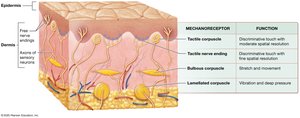
Mechanism of Sensory Transduction
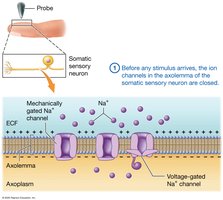
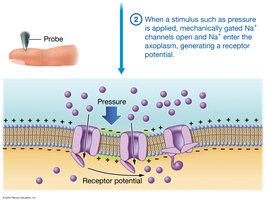
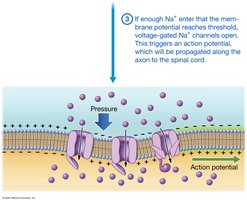
Stimuli open or close ion channels in the axolemma of sensory neurons, leading to changes in membrane potential. If threshold is reached, an action potential is generated and propagated to the CNS.
Somatic Sensory Neurons and Sensory Pathways
Structure and Function
First-order somatic sensory neurons are pseudounipolar, with a cell body in the posterior root ganglion and processes extending to sensory receptors and the CNS.
Receptive Fields and Two-Point Discrimination
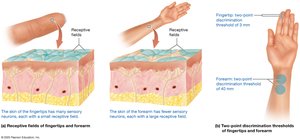
Receptive Field: Area served by a single sensory neuron.
Two-Point Discrimination: Ability to distinguish two closely spaced stimuli; smaller receptive fields allow finer discrimination.
Dermatomes and Referred Pain
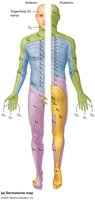
Dermatome: Area of skin supplied by a single spinal nerve.
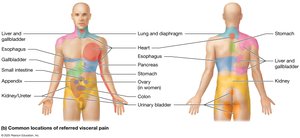
Referred Pain: Pain perceived at a location other than the site of the painful stimulus, often due to shared neural pathways.
Motor Output: From CNS to PNS
Motor Neurons and Control of Movement
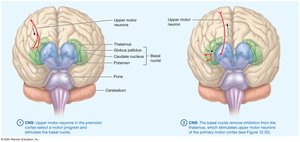
Movement is initiated by upper motor neurons in the CNS, which relay signals to lower motor neurons in the PNS. Lower motor neurons stimulate muscle fibers to contract.
Alpha (α) Motor Neurons: Stimulate skeletal muscle contraction.
Gamma (γ) Motor Neurons: Innervate muscle spindle stretch receptors.
Reflex Arcs and Types of Reflexes
Reflex Arc
A reflex is a programmed, automatic response to a specific sensory input, often serving a protective function. Reflex arcs involve a sensory receptor, sensory neuron, integration center, motor neuron, and effector.
Types of Reflexes
Monosynaptic Reflex: Involves a single synapse (e.g., patellar reflex).
Polysynaptic Reflex: Involves multiple synapses (e.g., withdrawal reflex).
Somatic Reflex: Involves skeletal muscles.
Visceral Reflex: Involves internal organs.
Stretch and Golgi Tendon Reflexes
Muscle Spindles: Detect muscle stretch and initiate contraction to maintain optimal length.
Golgi Tendon Organs: Detect tension and trigger muscle relaxation to prevent damage.
Clinical Relevance: Disorders of the PNS
Peripheral Neuropathies
Sensory Neuron Disorders: Affect sensation depending on the nerve involved.
Lower Motor Neuron Disorders: Cause paralysis or weakness of affected muscles.
Upper Motor Neuron Disorders: Result in spasticity and abnormal reflexes (e.g., Babinski sign).
Amyotrophic Lateral Sclerosis (ALS)
ALS is a neurodegenerative disease affecting both upper and lower motor neurons, leading to progressive muscle weakness and, eventually, death.
Summary Table: Major Sensory and Motor Cranial Nerves
Nerve | Type | Main Function |
|---|---|---|
Olfactory (I) | Sensory | Smell |
Optic (II) | Sensory | Vision |
Oculomotor (III) | Motor | Eye movement, pupil constriction |
Trigeminal (V) | Mixed | Facial sensation, mastication |
Facial (VII) | Mixed | Facial expression, taste |
Vagus (X) | Mixed | Visceral organ control, taste |
Accessory (XI) | Motor | Neck and shoulder movement |
Hypoglossal (XII) | Motor | Tongue movement |
Additional info: This guide covers the structure and function of the PNS, including sensory and motor pathways, major nerves and plexuses, sensory receptors, reflexes, and clinical disorders relevant to the ANP college curriculum.
