 Back
BackCh.13 Peripheral Nervous System: Structure, Function, and Clinical Correlates
Study Guide - Smart Notes
 Tailored notes based on your materials, expanded with key definitions, examples, and context.
Peripheral Nervous System (PNS): Structure and Function
Overview of the Peripheral Nervous System
The Peripheral Nervous System (PNS) connects the Central Nervous System (CNS) to the body and the external environment. It is responsible for detecting sensory stimuli and delivering them to the CNS as sensory input. The CNS processes this input and sends impulses through the PNS to effectors (muscle cells and glands) for motor output. Both spinal nerves and cranial nerves are part of the PNS, even though they attach directly to the spinal cord and brain.
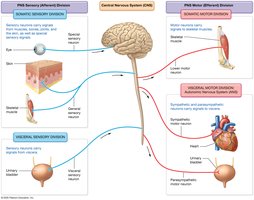
Divisions of the PNS
Sensory (Afferent) Division
Somatic Sensory Division: Carries signals from muscles, bones, joints, skin, and special sensory signals to the CNS.
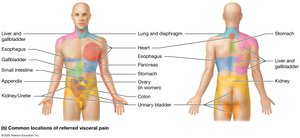
Visceral Sensory Division: Carries signals from organs of the thoracic and abdominopelvic cavities to the CNS.
Motor (Efferent) Division
Somatic Motor Division: Carries signals to skeletal muscles.
Visceral Motor Division (Autonomic Nervous System, ANS): Carries signals to cardiac and smooth muscles and glands.
Sympathetic Nervous System: "Fight or Flight" system.
Parasympathetic Nervous System: "Rest and Digest" system.
Peripheral Nerves and Associated Ganglia
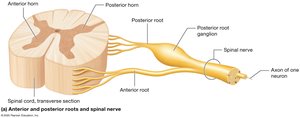
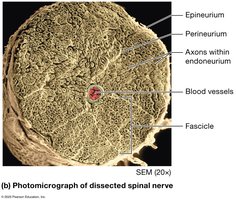
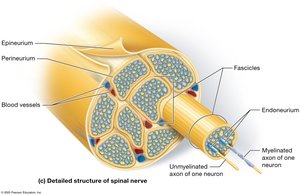
Peripheral nerves are bundles of axons bound together by connective tissue sheaths. They innervate most body structures and are classified as:
Mixed nerves: Contain both sensory and motor axons.
Sensory nerves: Contain only sensory axons.
Motor nerves: Contain mostly motor axons, with some sensory axons for monitoring muscle stretch and tension.
Cranial nerves attach to the brain and innervate structures of the head and neck. Spinal nerves (31 pairs) branch from the spinal cord and innervate structures below the neck.
Cranial Nerves
Overview and Classification
There are 12 pairs of cranial nerves, each with specific sensory, motor, or mixed functions. They are often remembered using mnemonics for their order and function.
Sensory Only: Olfactory, Optic, Vestibulocochlear
Motor Only: Oculomotor, Trochlear, Abducens, Accessory, Hypoglossal
Mixed: Trigeminal, Facial, Glossopharyngeal, Vagus
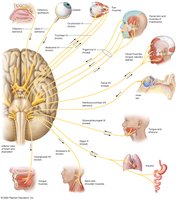
Selected Cranial Nerve Disorders
Trigeminal Neuralgia: Chronic pain syndrome affecting the trigeminal nerve, causing brief attacks of intense, unilateral facial pain. Triggers include chewing or light touch. Treatment may involve anticonvulsant drugs.
Bell’s Palsy: Rapid-onset weakness or paralysis of facial muscles due to impairment of the facial nerve, often affecting one side. May impact facial expressions, tear/saliva production, and taste. Most recover within weeks; treatment may include medication or physical therapy.



Spinal Nerves and Plexuses
Structure of Spinal Nerves
Spinal nerves exit the vertebral column and split into:
Posterior Ramus: Serves the posterior body.
Anterior Ramus: Serves the anterior body and limbs.
Ramus Communicans: Contains autonomic (visceral motor) axons of the sympathetic nervous system.
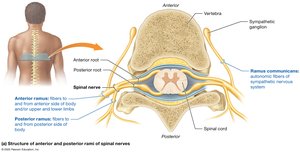
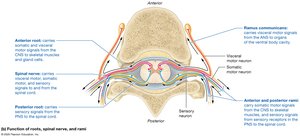
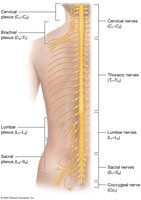
Cervical Plexus
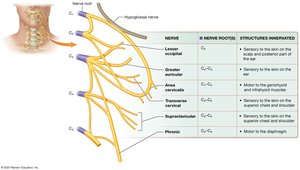
The cervical plexus is located deep in the neck and supplies sensory and motor branches to the neck, head, chest, and shoulders. The major motor branch is the phrenic nerve, which innervates the diaphragm ("3, 4, 5 to stay alive").
Brachial Plexus
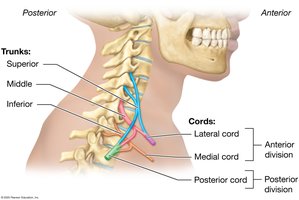
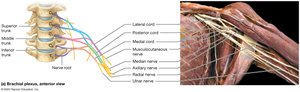
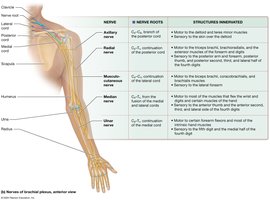
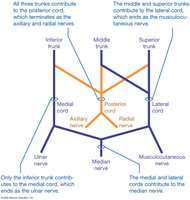
The brachial plexus provides sensory and motor innervation to the upper limb. It is organized into trunks, divisions, cords, and branches. The five major nerves are:
Axillary: Deltoid and teres minor muscles; skin over deltoid
Radial: Posterior arm/forearm, triceps, extensors
Musculocutaneous: Biceps brachii, coracobrachialis, brachialis; lateral forearm
Median: Most wrist/digit flexors; anterior thumb and fingers
Ulnar: Intrinsic hand muscles; medial hand and fingers
Lumbar Plexus
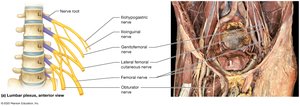
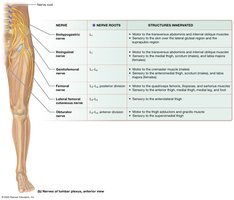
The lumbar plexus supplies the pelvis and lower extremity. Major nerves include:
Obturator nerve: Thigh adductors, gracilis; superomedial thigh
Femoral nerve: Quadriceps femoris, iliopsoas, sartorius; anterior/medial thigh and leg
Sacral Plexus
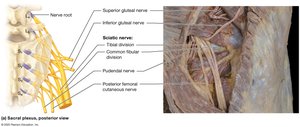
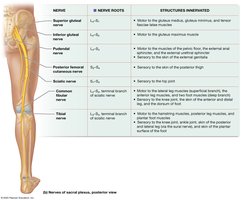
The sacral plexus supplies the pelvis, gluteal region, and much of the lower limb. The largest nerve is the sciatic nerve, which splits into:
Tibial nerve: Posterior leg, plantar foot
Common fibular nerve: Anterior/distal leg, dorsum of foot
Sensory Receptors and Sensation
Sensory Transduction and Receptor Types
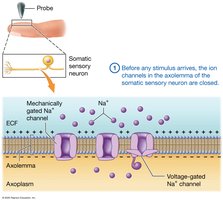
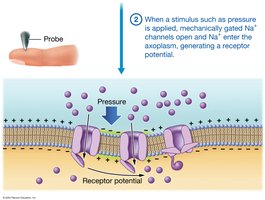
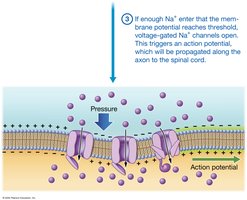
Sensory transduction is the conversion of a stimulus into an electrical signal at a sensory receptor. Sensory receptors can be:
Encapsulated nerve endings: Surrounded by supporting cells
Free nerve endings: "Naked" without supporting cells
Receptors are classified by location and stimulus type:
Exteroceptors: Detect external stimuli (e.g., touch, temperature)
Interoceptors: Detect internal stimuli (e.g., organ stretch)
Mechanoreceptors: Respond to mechanical deformation
Thermoreceptors: Respond to temperature changes
Chemoreceptors: Respond to chemicals
Photoreceptors: Respond to light (in the eye)
Nociceptors: Detect pain
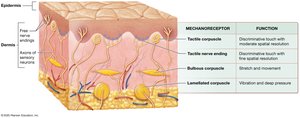
Mechanoreceptors in the Skin
Mechanoreceptor | Function |
|---|---|
Tactile (Merkel) nerve endings | Discriminative touch with fine spatial resolution |
Tactile (Meissner) corpuscles | Discriminative touch (less fine than Merkel) |
Bulbous corpuscles (Ruffini endings) | Stretch and movement |
Lamellated corpuscles (Pacinian) | Vibration and deep pressure |
Somatic Sensory Neurons
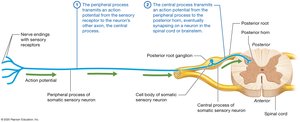
First-order somatic sensory neurons are pseudounipolar, with a cell body in the posterior root ganglion, a peripheral process with sensory receptors, and a central process entering the CNS. The speed of action potential conduction depends on axon diameter and myelination.
Receptive Fields and Dermatomes
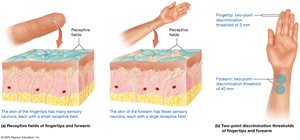
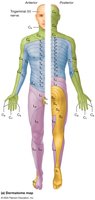
A receptive field is the area served by a neuron. Small receptive fields (e.g., fingertips) allow for fine sensation, while large fields (e.g., back) provide less sensitivity. Dermatomes are skin regions supplied by specific spinal nerves, useful for clinical testing.
Motor Output and Reflexes
Motor Pathways
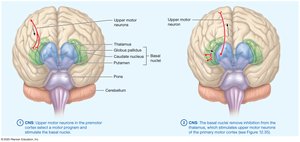
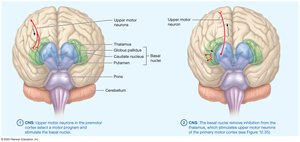
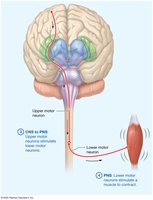
Movement is initiated by upper motor neurons in the primary motor cortex, which relay signals to lower motor neurons in the CNS. Lower motor neurons innervate skeletal muscle fibers, causing contraction. Motor neuron pools innervate the same muscle; alpha (α) motor neurons stimulate contraction, while gamma (γ) motor neurons innervate muscle spindle fibers.
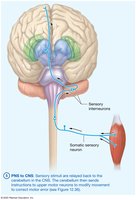
Reflex Arcs
A reflex is a programmed, automatic response to sensory input, often protective. Reflexes can be:
Monosynaptic: Single synapse (e.g., stretch reflex)
Polysynaptic: Multiple synapses (e.g., withdrawal reflex)
Somatic: Involve skeletal muscles
Visceral: Involve internal organs
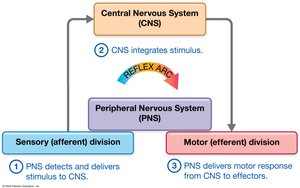
Types of Somatic Reflexes
Simple Stretch Reflex: Monosynaptic; muscle contracts in response to stretch (e.g., patellar reflex).
Flexion (Withdrawal) Reflex: Polysynaptic; withdrawal from painful stimulus.
Crossed-Extension Reflex: Extension of opposite limb to maintain balance during withdrawal.
Golgi Tendon Reflex: Inhibits muscle contraction if tension is too high, protecting muscles and tendons.
Cranial Nerve Reflexes: Involve cranial nerves (e.g., gag reflex, corneal blink reflex).
Clinical Correlates: Sensory and Motor Neuron Disorders
Peripheral Neuropathies
Disorders affecting sensory and motor neurons of the PNS. Symptoms depend on the nerves involved and may include paralysis or weakness (paresis).
Lower Motor Neuron Disorders: Injury to spinal/cranial nerves or cell bodies; may cause paralysis.
Upper Motor Neuron Disorders: Affect CNS neurons; may cause initial paralysis (spinal shock), followed by spasticity and abnormal reflexes (e.g., Babinski sign).
Amyotrophic Lateral Sclerosis (ALS)
ALS (Lou Gehrig’s Disease) involves degeneration of α-motor neurons in the spinal cord and upper motor neurons in the cortex. Symptoms include muscle weakness, upper motor neuron signs, and cognitive changes. Death typically occurs within 5 years of onset.
