 Back
BackPhysiology of Digestion and Absorption: Carbohydrates and Proteins
Study Guide - Smart Notes
 Tailored notes based on your materials, expanded with key definitions, examples, and context.
Mechanisms of Digestion and Absorption
Overview of Digestion and Absorption
Digestion is the catabolic process by which ingested food is broken down into its chemical building blocks, allowing for absorption into the body. Only molecules small enough to cross the wall of the small intestine can be absorbed. Enzymatic hydrolysis, primarily by intrinsic and accessory gland enzymes, is the main mechanism of digestion, where water is added to break chemical bonds in macromolecules.
Digestion: Breaks down macromolecules (carbohydrates, proteins, fats) into monomers (monosaccharides, amino acids, fatty acids, and glycerol).
Absorption: The process of moving digested end products from the lumen of the gut into the body, primarily through the epithelial cells of the small intestine.
Tight junctions: Ensure that substances must pass through, not between, epithelial cells.
Lipid absorption: Lipids can diffuse passively, but most other nutrients require active transport mechanisms.
Site of absorption: Most nutrients are absorbed before chyme reaches the ileum.
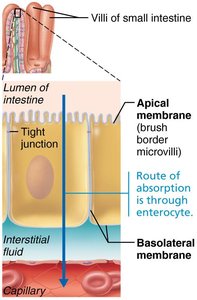
Digestion and Absorption of Carbohydrates
Enzymatic Breakdown and Absorption Pathways
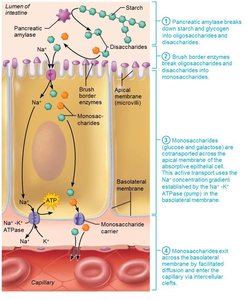
Carbohydrate digestion begins in the mouth and continues in the small intestine. Only monosaccharides (glucose, fructose, galactose) can be absorbed. Starch and disaccharides are broken down into oligosaccharides and disaccharides, then further into monosaccharides by brush border enzymes.
Salivary amylase: Begins starch digestion in the mouth.
Pancreatic amylase: Continues digestion in the small intestine, breaking down starch and glycogen into oligosaccharides and disaccharides.
Brush border enzymes: Dextrinase, lactase, glucoamylase, maltase, and sucrase complete the breakdown into monosaccharides.
Absorption: Monosaccharides are absorbed via secondary active transport (with Na+) or facilitated diffusion across the apical membrane, then exit via facilitated diffusion across the basolateral membrane into the blood.
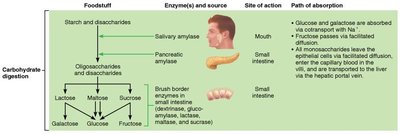
Mechanism of Carbohydrate Absorption
Monosaccharides are transported across the intestinal epithelium by specific mechanisms:
Glucose and galactose: Cotransported with Na+ via secondary active transport (SGLT1 transporter).
Fructose: Absorbed by facilitated diffusion (GLUT5 transporter).
All monosaccharides exit the basolateral membrane by facilitated diffusion (GLUT2 transporter) and enter the capillary blood in the villi.
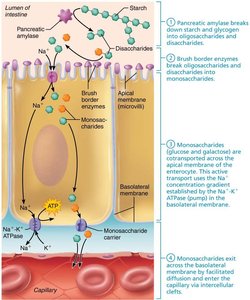
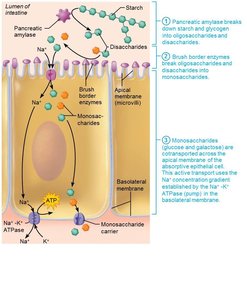
Clinical Correlation: Lactose Intolerance
Lactose intolerance results from a deficiency of the enzyme lactase, leading to the inability to digest lactose. Undigested lactose creates an osmotic gradient, preventing water absorption and causing diarrhea. Bacterial fermentation of lactose produces gas, leading to bloating, flatulence, and cramping. Treatment involves lactase supplements or avoiding lactose-containing foods.
Digestion and Absorption of Proteins
Enzymatic Breakdown and Absorption Pathways
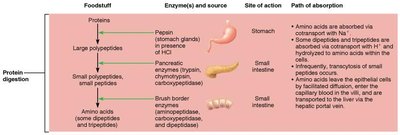
Protein digestion begins in the stomach and continues in the small intestine. Proteins are broken down into large polypeptides, then into smaller peptides and amino acids by various enzymes.
Stomach: Pepsin (active at pH 1.5–2.5) initiates protein digestion, producing large polypeptides.
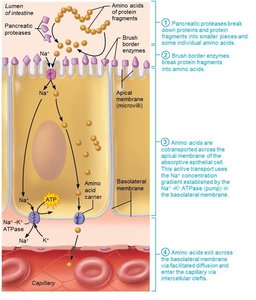
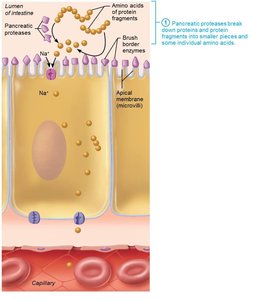
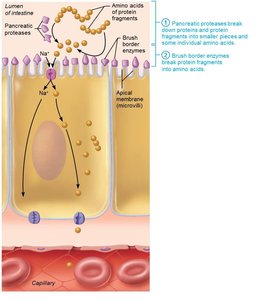
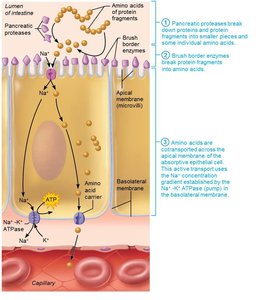
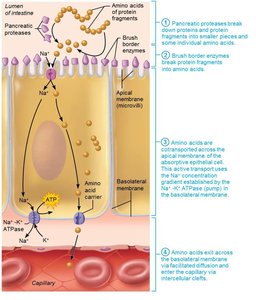
Small intestine: Pancreatic proteases (trypsin, chymotrypsin, carboxypeptidase) and brush border enzymes (aminopeptidases, carboxypeptidases, dipeptidases) further break down peptides into amino acids.
Absorption: Amino acids are absorbed via secondary active transport (with Na+ or H+) across the apical membrane and exit via facilitated diffusion across the basolateral membrane.
Mechanism of Protein Absorption
Amino acids and small peptides are transported across the intestinal epithelium by specific mechanisms:
Amino acids: Cotransported with Na+ or H+ via secondary active transporters.
Dipeptides and tripeptides: Absorbed by H+-dependent cotransporters and hydrolyzed to amino acids within epithelial cells.
All amino acids exit the basolateral membrane by facilitated diffusion and enter the capillary blood in the villi.
Summary Table: Digestion and Absorption of Carbohydrates and Proteins
Foodstuff | Enzyme(s) and Source | Site of Action | Path of Absorption |
|---|---|---|---|
Starch and Disaccharides | Salivary amylase (mouth), Pancreatic amylase (small intestine), Brush border enzymes (small intestine) | Mouth, Small intestine | Glucose and galactose: cotransport with Na+; Fructose: facilitated diffusion; All exit via facilitated diffusion to blood |
Proteins | Pepsin (stomach), Pancreatic proteases (small intestine), Brush border enzymes (small intestine) | Stomach, Small intestine | Amino acids: cotransport with Na+ or H+; Dipeptides/tripeptides: cotransport with H+; All exit via facilitated diffusion to blood |
Additional info: The mechanisms described here are essential for understanding nutrient assimilation and the consequences of malabsorption syndromes, such as lactose intolerance or protein-energy malnutrition.
