 Back
BackPregnancy and Human Development: Fertilization to Placentation
Study Guide - Smart Notes
 Tailored notes based on your materials, expanded with key definitions, examples, and context.
Pregnancy and Human Development
Overview and Key Terms
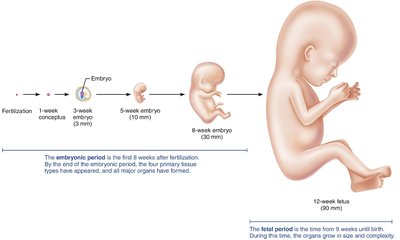
Pregnancy and human development encompass the intricate series of events that transform a single cell into a fully formed human being. This process involves fertilization, embryonic and fetal development, implantation, and placentation. Understanding these stages is essential for students of anatomy and physiology.
Conceptus: The developing offspring during pregnancy.
Pregnancy: The period during which a woman carries a conceptus, typically lasting about 280 days from the last menstrual period to birth.
Embryo: The developing human from fertilization until the end of week 8.
Fetus: The developing human from week 9 until birth.
Fertilization
Mechanisms and Events of Fertilization
Fertilization is the process by which sperm and a secondary oocyte combine to form a zygote. This event restores the diploid chromosome number and initiates embryonic development.
Sperm Capacitation: Sperm must undergo biochemical changes in the female reproductive tract to increase motility and prepare for fertilization. This process involves membrane changes induced by enzyme release.
Chemotaxis: Sperm are guided toward the oocyte by chemical signals.
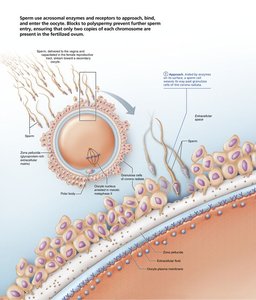
Blocks to Polyspermy: Mechanisms that prevent more than one sperm from fertilizing the oocyte, ensuring the zygote remains diploid.
Sperm–Oocyte Interaction
The interaction between sperm and oocyte involves several coordinated steps:
Approach: Sperm reach the oocyte via chemotaxis.
Acrosomal Reaction: Enzymes are released from the sperm's acrosome to penetrate the oocyte's protective layers.
Binding: Sperm bind to receptors on the oocyte membrane.
Fusion and Entry: The sperm and oocyte membranes fuse, allowing the sperm nucleus to enter the oocyte.
Blocks to Polyspermy: Fast and slow blocks prevent additional sperm from entering.

Completion of Meiosis II and True Fertilization
Upon sperm entry, the oocyte completes meiosis II, forming the ovum and a second polar body. The male and female pronuclei fuse, combining chromosomes to form a diploid zygote.
Calcium Surge: Triggers completion of meiosis II in the oocyte.
Pronuclei Formation: The female and male pronuclei form and migrate toward each other.
Chromosome Combination: Fusion of pronuclei results in a diploid zygote, marking true fertilization.

Early Embryonic Development: Zygote to Blastocyst
Cleavage and Blastocyst Formation
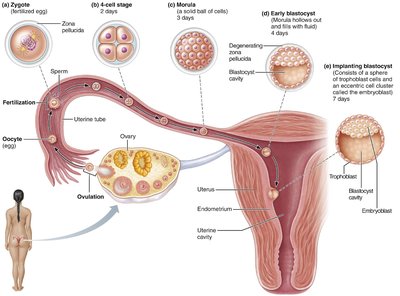
After fertilization, the zygote undergoes rapid mitotic divisions called cleavage as it travels through the uterine tube toward the uterus. This process produces smaller cells called blastomeres and leads to the formation of a morula and then a blastocyst.
Cleavage: Rapid mitotic divisions without growth, resulting in blastomeres.
Morula: A solid ball of at least 16 cells formed about 72 hours after fertilization.
Blastocyst: A fluid-filled structure (~100 cells) that forms by day 4–5 and consists of an outer trophoblast and an inner cell mass (embryoblast).
Trophoblast: Forms the placenta and chorion.
Embryoblast: Gives rise to the embryo and extraembryonic membranes.

Implantation and Placentation
Implantation Process
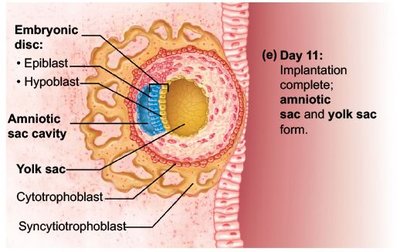
Implantation occurs around day 6–7 post-ovulation when the blastocyst adheres to the endometrium. The trophoblast differentiates into two layers: the cytotrophoblast (inner) and the syncytiotrophoblast (outer), which invades the endometrium and facilitates embedding of the blastocyst.
Inflammatory-like Response: Increases vascular permeability at the implantation site.
Endometrial Sealing: The endometrium grows over the implanted blastocyst, sealing it in place.
Role of hCG (Human Chorionic Gonadotropin)
hCG is secreted by the trophoblast and later the chorion. It maintains the corpus luteum, ensuring continued production of progesterone and estrogen to support early pregnancy and placental development. hCG levels peak by the end of the second month, after which the placenta assumes hormone production.
hCG Detection: Basis for most pregnancy tests.
Failure to Implant: If implantation does not occur, the endometrium becomes nonreceptive and is shed during menstruation.
Placentation: Formation and Structure of the Placenta
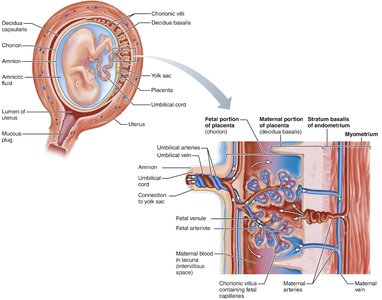
The placenta is a temporary organ formed from both embryonic (chorion, chorionic villi) and maternal (decidua basalis and capsularis) tissues. It serves as the site of nutrient, gas, and waste exchange between mother and fetus, and also functions as an endocrine organ.
Chorionic Villi: Fingerlike projections that vascularize and connect to the embryo via umbilical arteries and vein.
Decidua Basalis: The maternal portion of the placenta, derived from the endometrium.
Decidua Capsularis: The part of the endometrium facing the uterine cavity.
Placental Barrier: Maternal and fetal blood supplies are separated by thin layers of tissue, preventing direct mixing.

Placental Functions and Hormones
The placenta becomes fully functional by the end of the third month of pregnancy. It performs nutritive, respiratory, excretory, and endocrine roles. Early in pregnancy, hCG maintains the corpus luteum; later, the placenta produces estrogen and progesterone to support pregnancy and prepare the breasts for lactation.
Nutritive Role: Transfers nutrients from maternal to fetal blood.
Respiratory Role: Facilitates gas exchange (O2 and CO2).
Excretory Role: Removes fetal metabolic wastes.
Endocrine Role: Secretes hormones essential for pregnancy maintenance.
Summary Table: Key Events in Early Pregnancy
Event | Timing (Days Post-Ovulation) | Main Features |
|---|---|---|
Fertilization | 0 | Sperm and oocyte fuse to form zygote |
Cleavage | 1–3 | Rapid mitotic divisions, formation of morula |
Blastocyst Formation | 4–5 | Blastocyst reaches uterus, consists of trophoblast and embryoblast |
Implantation | 6–12 | Blastocyst embeds in endometrium, hCG secretion begins |
Placentation | Begins ~day 12 | Chorionic villi and decidua form placenta, hormone production shifts to placenta |
