 Back
Principles of Muscular Strength and Endurance Training
Study Guide - Smart Notes
 Tailored notes based on your materials, expanded with key definitions, examples, and context.
Improving Muscular Strength & Endurance
Overload Principle
The overload principle is fundamental to improving fitness. It states that the muscular and cardiorespiratory systems must be stressed beyond their accustomed levels to stimulate adaptation and improvement. Overload does not require workouts to be painful or exhausting, but rather involves manipulating fitness variables to challenge the body.
Intensity of exercise: Can be low, moderate, or vigorous.
Duration of exercise: Refers to the time spent exercising.
Progressive overload involves gradually increasing resistance or challenge over time. The ten percent rule suggests that training intensity or duration should not be increased by more than 10% per week, and only one variable should be increased at a time to minimize injury risk.
Principle of Specificity
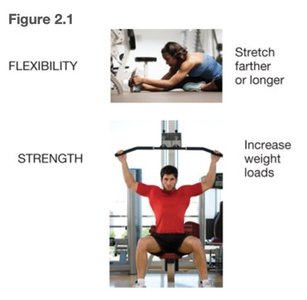
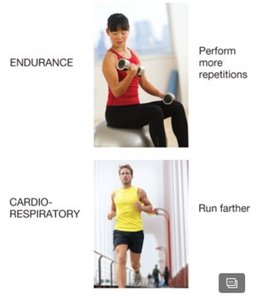
The principle of specificity states that the effects of exercise are specific to the muscles and energy systems involved. This underscores the importance of varied exercises for overall fitness improvement and highlights that adaptations are specific to the type of training performed.
Muscle group exercised: Only muscles involved in the activity will adapt.
Training intensity: High-intensity training increases muscle size and strength, while low-intensity training improves endurance.
Adaptations: Training for muscular endurance will not greatly improve muscular strength, and vice versa.
Strength Training Adaptations
Strength training induces several physiological changes and adaptations in the body. These include changes in muscle fiber recruitment patterns and hypertrophy, which is an increase in muscle size due to enlargement of individual muscle fibers.
Rate of improvement: Rapid strength gains are seen in beginners, while trained individuals experience more gradual gains.
Gender differences: Initial responses to strength training are similar between genders, but men typically achieve greater long-term gains due to higher testosterone levels.
Designing a Resistance Training Program
To create an effective resistance training program, it is important to:
Identify the purpose of the program
Identify muscle groups to be exercised
Select the order of exercises
Determine appropriate starting loads
Set guidelines for progressively overloading muscle groups

The FITT Formula Applied to Resistance Training
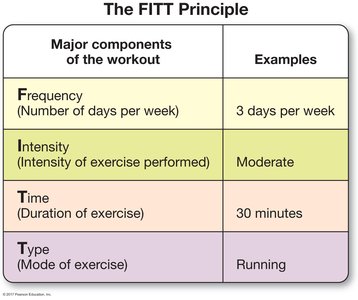
The FITT principle is a framework for structuring exercise programs. It stands for Frequency, Intensity, Time, and Type:
Frequency: Number of days per week
Intensity: Level of resistance or effort
Time: Duration of each session
Type: Mode of exercise (e.g., bodyweight, dumbbell, barbell, kettlebell)
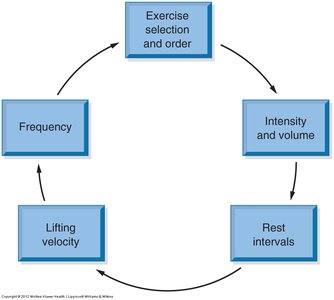
The Acute Program Variables
Acute program variables are the elements manipulated within a single workout session to achieve specific training outcomes. These include:
Exercise selection and order
Intensity and volume
Rest intervals
Lifting velocity
Frequency
Exercise Order & Workout Structure
Proper exercise order maximizes effectiveness and recovery. Common strategies include:
Performing at least one exercise per major muscle group
Starting with multi-joint exercises
Alternating upper and lower body exercises
Alternating agonist and antagonist muscle groups
Compound sets or tri-sets for the same muscle group
Supersetting agonist and antagonist groups without rest
Typical Resistance Prescription
A typical resistance training prescription for general fitness includes:
Frequency: 2-3 times per week (full-body)
Intensity: Moderate weight (50-65% 1-RM, about 12 RM)
Sets: 2-3 per exercise
Repetitions: 8-12 per set
Rest: 1-3 minutes between sets
Number of exercises: 8-10
Repetition Continuum and Training Stimuli
The repetition continuum describes how different loads and repetitions stimulate specific adaptations:
High load, low reps: Muscular strength
Moderate load, moderate reps: Hypertrophy
Low load, high reps: Muscular endurance
Stimulus for Strength
Frequency: 2-7 sessions/week
Intensity: ≥85% 1RM
Sets/Reps: 2-6 sets, ≤6 reps
Maximal exertion and force, longer rest intervals
Stimulus for Endurance
Frequency: 2-7 sessions/week
Intensity: ≤65% 1RM
Sets/Reps: 2-3 sets, ≥12 reps
Higher repetitions, short rest intervals

Stimulus for Hypertrophy
Frequency: 2-7 sessions/week
Intensity: 65-85% 1RM
Sets/Reps: 3-6 sets, 6-12 reps
Maximal exertion, moderate loading, shorter rest, high volume, time under tension, eccentric loading
Stimulus for Power
Frequency: 2-7 sessions/week
Intensity: 75-90% 1RM
Sets/Reps: 3-5 sets, 1-5 reps
Maximal force, high velocity, longer rest periods
POWER = Force × Velocity

Safety and Etiquette in Resistance Training
Safety and proper etiquette are essential for effective and injury-free resistance training. Key points include:
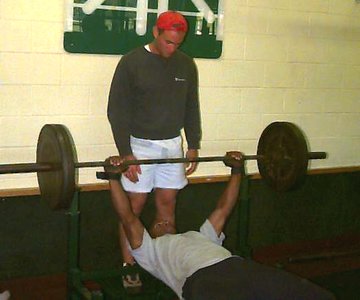
Use spotters for heavy lifts
Use collars on free weight bars
Do not drop weights
Always warm up before exercising
Breathe during exercises
Use slow, controlled movements
Start with light weights and progress gradually

Summary Table: FITT Principle
Major components of the workout | Examples |
|---|---|
Frequency (Number of days per week) | 3 days per week |
Intensity (Intensity of exercise performed) | Moderate |
Time (Duration of exercise) | 30 minutes |
Type (Mode of exercise) | Running |
Additional info: The notes above expand on the original content by providing definitions, examples, and context for each principle and training variable. The repetition continuum and training stimuli are described in detail to clarify how different resistance training prescriptions target strength, endurance, hypertrophy, and power.
