 Back
BackProtection of the Brain: Cerebrospinal Fluid, Blood Brain Barrier, and Cranial Meninges
Study Guide - Smart Notes
 Tailored notes based on your materials, expanded with key definitions, examples, and context.
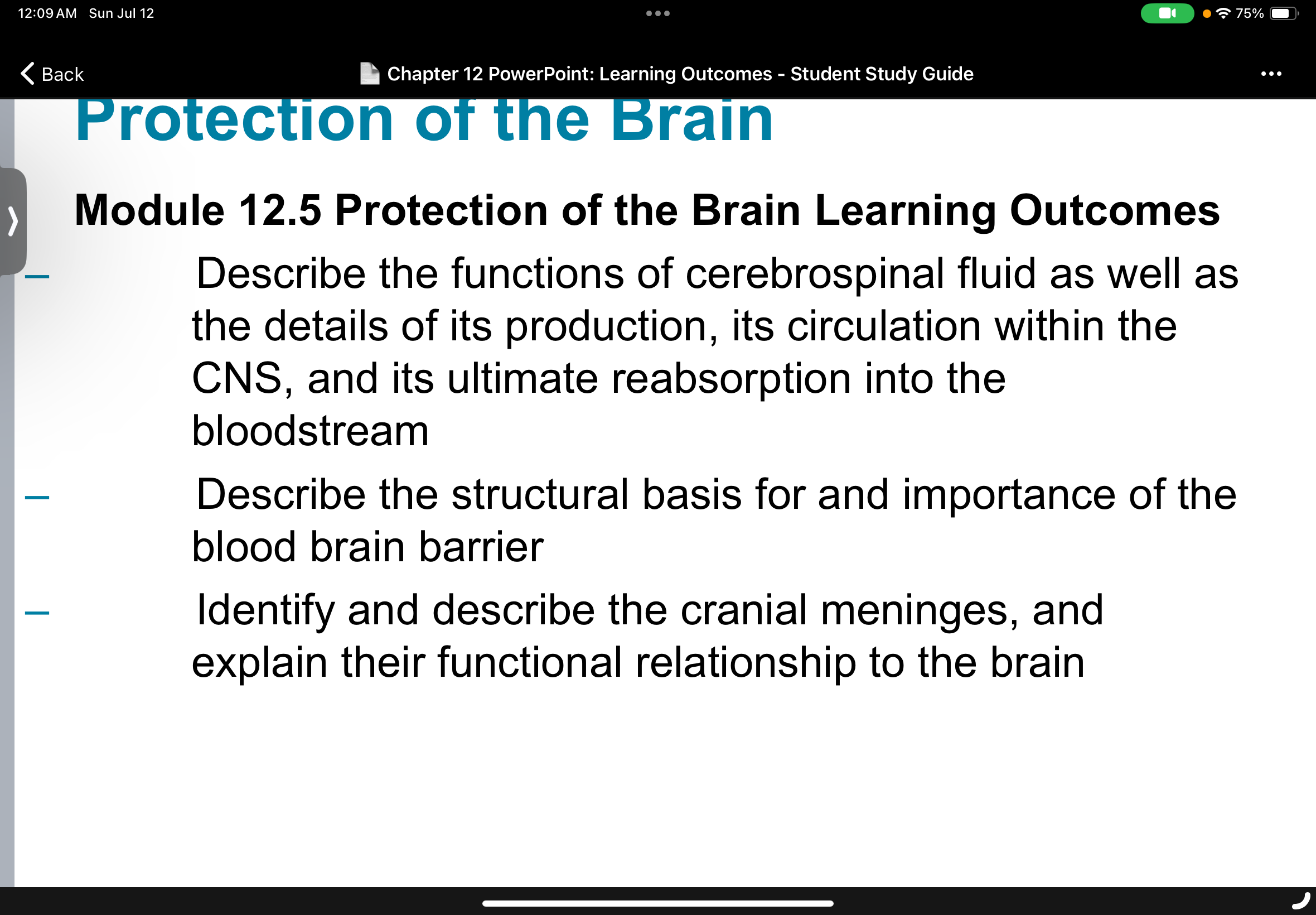
Protection of the Brain
Cerebrospinal Fluid (CSF): Functions, Production, Circulation, and Reabsorption
The brain is protected by several mechanisms, one of which is the presence of cerebrospinal fluid (CSF). CSF is a clear, colorless fluid that surrounds the brain and spinal cord, providing mechanical and chemical protection.
Functions of CSF:
Acts as a cushion, absorbing shocks and reducing the impact of trauma.
Maintains a stable chemical environment for neuronal function.
Removes metabolic waste from the central nervous system (CNS).
Production:
CSF is produced by the choroid plexuses located in the ventricles of the brain.
Production involves filtration of blood plasma through ependymal cells.
Circulation:
CSF flows from the lateral ventricles to the third ventricle, then through the cerebral aqueduct to the fourth ventricle.
From the fourth ventricle, CSF enters the subarachnoid space surrounding the brain and spinal cord.
Reabsorption:
CSF is reabsorbed into the bloodstream via arachnoid granulations in the superior sagittal sinus.
Example: Disruption in CSF circulation can lead to conditions such as hydrocephalus, where excess fluid accumulates in the ventricles.
Blood Brain Barrier: Structure and Importance
The blood brain barrier (BBB) is a selective barrier that protects the brain from harmful substances in the blood while allowing essential nutrients to pass through.
Structural Basis:
Formed by tight junctions between endothelial cells of brain capillaries.
Astrocyte end-feet reinforce the barrier.
Importance:
Prevents toxins, pathogens, and certain drugs from entering the brain tissue.
Maintains the brain's internal environment for proper neuronal function.
Example: The BBB restricts entry of many antibiotics, making treatment of brain infections challenging.
Cranial Meninges: Structure and Functional Relationship to the Brain
The cranial meninges are three connective tissue membranes that surround the brain and spinal cord, providing protection and structural support.
Layers:
Dura mater: The tough, outermost layer; provides mechanical protection.
Arachnoid mater: The middle layer; contains the subarachnoid space filled with CSF.
Pia mater: The delicate, innermost layer; closely adheres to the brain surface.
Functional Relationship:
Meninges protect the brain from injury and infection.
Facilitate the circulation and reabsorption of CSF.
Example: Inflammation of the meninges, known as meningitis, can disrupt brain function and is a medical emergency.
Additional info: The above content expands on the brief learning outcomes by providing definitions, examples, and structural details relevant to college-level Anatomy & Physiology.
