 Back
BackPyruvate Oxidation and the Krebs Cycle: Cellular Respiration Study Notes
Study Guide - Smart Notes
 Tailored notes based on your materials, expanded with key definitions, examples, and context.
Energy & Cell Processes
Pyruvate Oxidation (The Link Reaction)
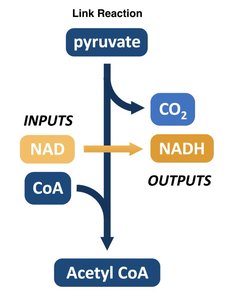
Pyruvate oxidation is a crucial step in cellular respiration, connecting glycolysis to the Krebs cycle. It occurs in the mitochondrial matrix and prepares pyruvate for entry into the Krebs cycle by converting it into acetyl-CoA.
Main Goal: Convert pyruvate into a form usable by the Krebs cycle (acetyl-CoA).
Location: Mitochondrial matrix in eukaryotes; cytoplasm in prokaryotes.
Steps:
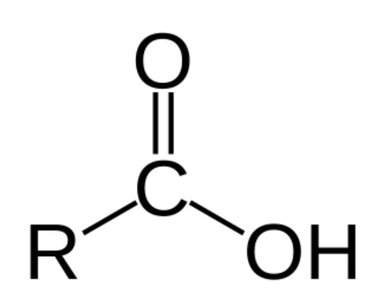
Decarboxylation: Carboxyl group removed from pyruvate, released as CO2, leaving a two-carbon molecule.
Oxidation: The two-carbon molecule is oxidized; electrons are transferred to NAD+ to form NADH. The molecule is now called an acetyl group.
Acetyl-CoA Formation: The acetyl group binds to coenzyme A (CoA), forming acetyl-CoA, which enters the Krebs cycle.
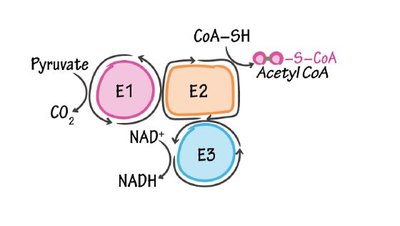
Enzyme Complex: Pyruvate dehydrogenase complex catalyzes all three steps and regulates acetyl-CoA entry into the Krebs cycle.
Net Products (per glucose): 2 acetyl-CoA, 2 NADH, 2 CO2
The Krebs Cycle (Citric Acid Cycle)
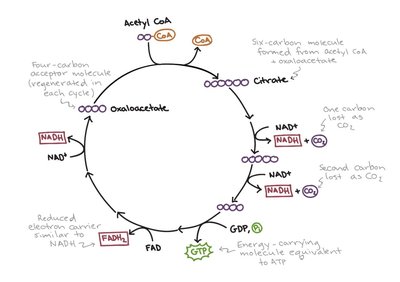
The Krebs cycle is a series of eight enzyme-catalyzed reactions that further oxidize acetyl-CoA, producing electron carriers for the next stage of cellular respiration. It is a closed loop, regenerating its starting molecule, oxaloacetate, at the end of each cycle.
Location: Mitochondria in eukaryotes; cytoplasm in prokaryotes.
Cycle Steps:
Step 1: Acetyl-CoA joins oxaloacetate (4C) to form citrate (6C); CoA is released.
Step 2: Citrate is converted to isocitrate (isomerization).
Step 3: Isocitrate is oxidized, releasing CO2 and forming alpha-ketoglutarate; NAD+ is reduced to NADH.
Step 4: Alpha-ketoglutarate is oxidized, releasing CO2 and forming succinyl-CoA; NAD+ is reduced to NADH.
Step 5: Succinyl-CoA is converted to succinate; a phosphate group is transferred to ADP (or GDP) to form ATP (or GTP).
Step 6: Succinate is oxidized to fumarate; FAD is reduced to FADH2.
Step 7: Fumarate is hydrated to malate.
Step 8: Malate is oxidized to regenerate oxaloacetate; NAD+ is reduced to NADH.
Products (per cycle):
2 CO2
3 NADH
1 FADH2
1 ATP (or GTP)
Note: Each glucose yields two acetyl-CoA, so the cycle turns twice per glucose.
Importance: Although only a small amount of ATP is produced directly, the cycle generates many reduced electron carriers (NADH, FADH2) that drive ATP production in the electron transport chain.
Summary Table: Krebs Cycle Inputs and Outputs
Input (per 2 acetyl-CoA) | Output |
|---|---|
2 Acetyl-CoA | 4 CO2 |
2 ADP (or GDP) | 2 ATP (or GTP) |
6 NAD+ | 6 NADH |
2 FAD | 2 FADH2 |
Key Equations
Overall Krebs Cycle Reaction (per 2 acetyl-CoA):
Example: In muscle cells, the Krebs cycle is essential for aerobic energy production, providing NADH and FADH2 for the electron transport chain, which generates most of the cell's ATP.
Additional info: The Krebs cycle is also known as the citric acid cycle or TCA (tricarboxylic acid) cycle. It is tightly regulated by enzymes such as isocitrate dehydrogenase and pyruvate dehydrogenase complex, ensuring efficient energy production and metabolic balance.
