 Back
Ranking Orbital Speeds Using Kepler’s Second Law
Study Guide - Smart Notes
 Tailored notes based on your materials, expanded with key definitions, examples, and context.
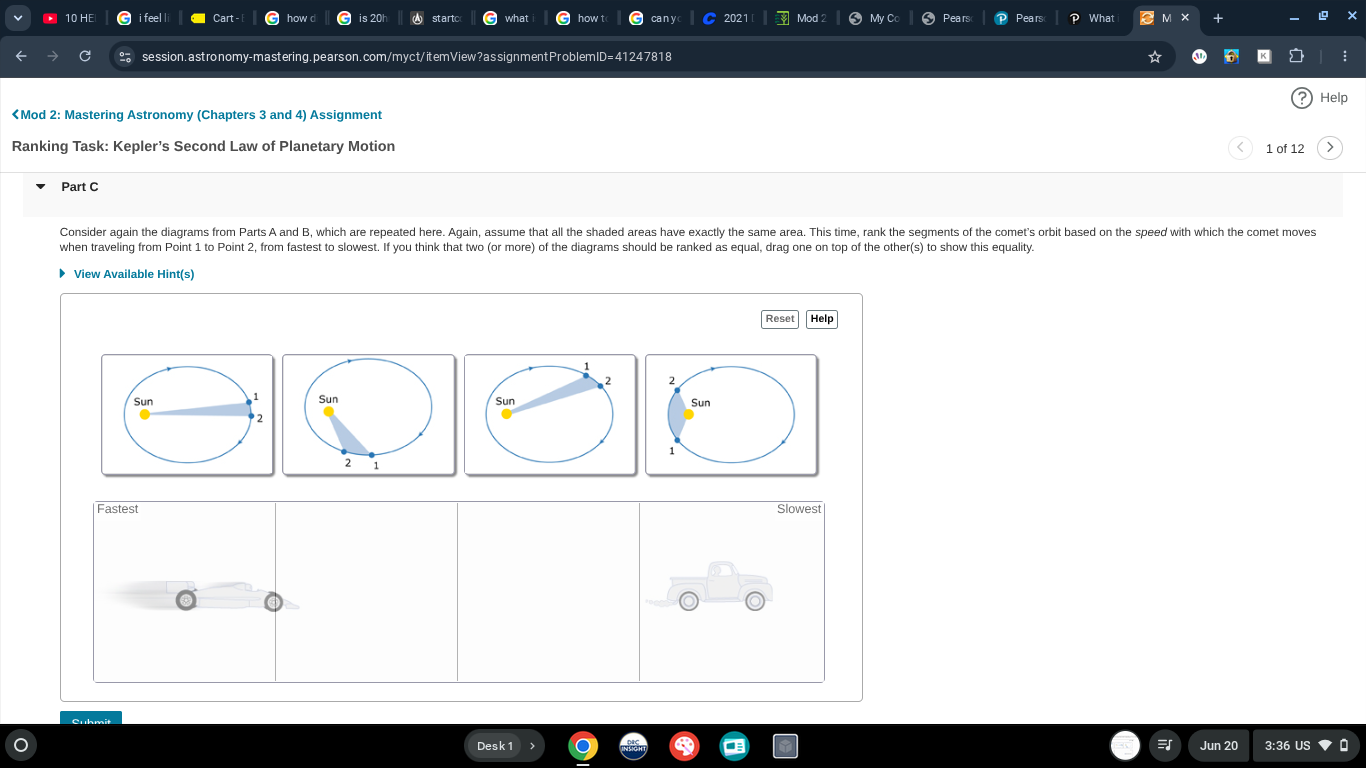
Q1. Rank the segments of the comet's orbit based on the speed with which the comet moves from Point 1 to Point 2, from fastest to slowest. Assume all shaded areas are equal.
Background
Topic: Kepler’s Second Law of Planetary Motion
This question tests your understanding of Kepler’s Second Law, which states that a planet (or comet) sweeps out equal areas in equal times as it orbits the Sun. This means that the object moves faster when it is closer to the Sun and slower when it is farther away, so that the area swept out over a given time is always the same.
Key Terms and Concepts
Kepler’s Second Law: Also called the Law of Equal Areas, it states: "A line joining a planet and the Sun sweeps out equal areas during equal intervals of time."
Orbital Speed: The speed at which an object moves along its orbit. It is higher when the object is closer to the Sun and lower when farther away.
Key Formula (Conceptual):
For equal areas swept in equal times:
= orbital speed
= distance from the Sun
Step-by-Step Guidance
Examine each diagram and identify the relative distance of the comet from the Sun at the shaded segment. The closer the comet is to the Sun, the faster it must move to sweep out the same area in the same time.
Recall that for equal areas, the segment closer to the Sun corresponds to a higher speed, and the segment farther from the Sun corresponds to a lower speed.
Rank the segments by comparing how close the shaded area is to the Sun in each diagram. The segment with the shaded area closest to the Sun will be the fastest, and the one farthest will be the slowest.
Arrange the diagrams from fastest to slowest based on your observations of the comet's distance from the Sun during the shaded segment.
Try solving on your own before revealing the answer!
Final Answer:
The segment where the shaded area is closest to the Sun is the fastest, and the segment where it is farthest is the slowest. For example, if the first diagram's shaded area is closest to the Sun, it is ranked fastest, and so on. This follows directly from Kepler's Second Law.
