 Back
Regulation and Effects of Male Reproductive Function
Study Guide - Smart Notes
 Tailored notes based on your materials, expanded with key definitions, examples, and context.
Regulation of Male Reproductive Function
Hormonal Control of the Male Reproductive System
The male reproductive system is regulated by a complex interplay of hormones involving the hypothalamus, anterior pituitary gland, and testes. This regulatory network is known as the hypothalamic-pituitary-gonadal (HPG) axis.
Hypothalamus: Releases gonadotropin-releasing hormone (GnRH), which travels to the anterior pituitary via the hypophyseal portal system.
Anterior Pituitary: In response to GnRH, secretes follicle-stimulating hormone (FSH) and luteinizing hormone (LH).
FSH: Stimulates sustentocytes (Sertoli cells) in the seminiferous tubules to produce androgen-binding protein (ABP), which maintains high local concentrations of testosterone necessary for spermatogenesis.
LH: Stimulates interstitial endocrine cells (Leydig cells) to produce testosterone.
Testosterone: Supports spermatogenesis, development of male secondary sex characteristics, and exerts negative feedback on the hypothalamus and pituitary to regulate hormone levels.
Inhibin: Released by sustentocytes in response to high sperm count, inhibits FSH release from the anterior pituitary.
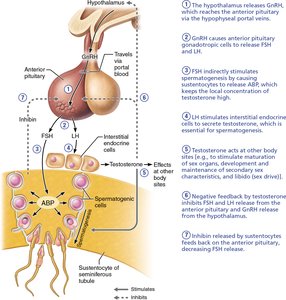
Additional info: The HPG axis is under central nervous system (CNS) control, and disruption of GnRH or gonadotropin secretion leads to testicular atrophy and cessation of sperm and testosterone production.
Developmental Changes in Testosterone and Sperm Production
Testosterone and sperm production vary throughout the male lifespan, with distinct patterns during fetal development, infancy, puberty, and adulthood.
Prenatal: Testosterone secretion is essential for the development of male reproductive structures.
Infancy: Gonadotropin and testosterone levels are high for a few months after birth, then decline and remain low during childhood.
Puberty: A rise in testosterone initiates the adult pattern of hormone regulation and the onset of spermatogenesis.
Adulthood: Testosterone and sperm production stabilize and remain high until late in life, after which they gradually decline.
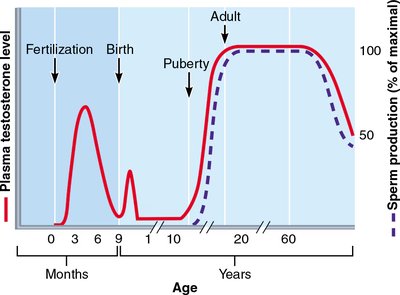
Additional info: The establishment of hormonal balance during puberty typically takes about three years.
Mechanism and Effects of Testosterone Activity
Testosterone Synthesis and Action
Testosterone is a steroid hormone synthesized from cholesterol. It acts by binding to intracellular receptors, which then activate specific genes to increase protein synthesis in target cells.
Conversion: In some tissues, testosterone is converted to dihydrotestosterone (DHT) or estradiol to exert its effects.
Target Organs: Testosterone stimulates the growth and function of accessory reproductive organs (ducts, glands, penis) and maintains their adult function.
Deficiency: Lack of testosterone leads to atrophy of accessory organs, reduced semen volume, and impaired sexual function.
Male Secondary Sex Characteristics
Testosterone is responsible for the development of male secondary sex characteristics at puberty, which are features not directly related to reproduction.
Growth of pubic, axillary, and facial hair
Enhanced body hair growth (e.g., chest)
Enlargement of the larynx and deepening of the voice
Thicker, oilier skin (predisposing to acne)
Increased bone size and density
Increased skeletal muscle mass
These somatic effects also include increased basal metabolic rate and influence on male behavior, including libido (sex drive).
Other Sources of Androgens
Although the testes are the primary source of testosterone, the adrenal glands also secrete small amounts of androgens (gonadocorticoids). However, these are insufficient to maintain normal male reproductive function.
Summary Table: Hormonal Regulation of Male Reproductive Function
Hormone | Source | Main Action |
|---|---|---|
GnRH | Hypothalamus | Stimulates anterior pituitary to release FSH and LH |
FSH | Anterior pituitary | Stimulates sustentocytes to support spermatogenesis |
LH | Anterior pituitary | Stimulates interstitial cells to produce testosterone |
Testosterone | Testes (Leydig cells) | Supports spermatogenesis, secondary sex characteristics, negative feedback |
Inhibin | Sustentocytes | Inhibits FSH release |
