 Back
BackRegulation of Body Temperature (Thermoregulation)
Study Guide - Smart Notes
 Tailored notes based on your materials, expanded with key definitions, examples, and context.
Regulation of Body Temperature (Thermoregulation)
Introduction to Thermoregulation
Thermoregulation is the process by which the body maintains its internal temperature within a narrow, optimal range, ensuring that cellular and enzymatic functions proceed efficiently. This balance is achieved through the integration of heat production and heat loss mechanisms, primarily coordinated by the hypothalamus.
Heat Production and Heat Loss: The Balance
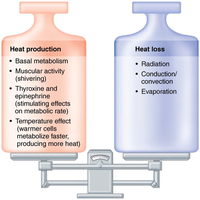
Body temperature is determined by the equilibrium between heat generated by metabolic processes and heat lost to the environment. At rest, organs such as the liver, heart, brain, kidneys, and endocrine glands are the main sources of heat, while skeletal muscles contribute significantly during physical activity. The average body temperature is approximately 37°C, with normal fluctuations throughout the day.
Heat Production: Basal metabolism, muscular activity (including shivering), hormonal effects (thyroxine and epinephrine), and the temperature effect (increased metabolic rate with higher temperature).
Heat Loss: Occurs via radiation, conduction/convection, and evaporation.
Key Points:
Vigorous exercise can increase heat production by skeletal muscle up to 30-40 times the resting rate.
For every 1°C rise in temperature, the rate of chemical reactions increases by about 10%.
Excessively high temperatures can denature proteins and depress neuronal activity, while moderate cooling is better tolerated and used therapeutically (e.g., in heart surgery).
Core and Shell Temperatures
The body is divided into core (internal organs) and shell (skin, subcutaneous tissue, limbs) compartments. Core temperature is tightly regulated, while shell temperature fluctuates with environmental conditions and activity levels. Blood acts as the main medium for heat exchange between the core and shell.
Core temperature: Highest, most stable; best measured rectally.
Shell temperature: More variable; can range from 20°C to 40°C depending on conditions.
Heat is lost from the shell when it is warmer than the environment; blood flow to the skin is adjusted to conserve or dissipate heat as needed.
Mechanisms of Heat Exchange
Overview of Heat Exchange Mechanisms
Heat always moves down its thermal gradient, from warmer to cooler regions. The body exchanges heat with the environment through four main mechanisms:
Radiation: Loss of heat as infrared waves; accounts for about 50% of body heat loss. Example: warming a cool room with people present.
Conduction: Direct transfer of heat between objects in contact. Example: heat transfer from the body to a chair.
Convection: Transfer of heat by movement of air or liquid. Example: wind or a fan increases heat loss by moving air across the skin.
Evaporation: Heat loss as water vaporizes from body surfaces. Includes insensible loss (continuous, unnoticed) and sensible loss (sweating during heat or exercise).

Example: A person in a hot tub experiences conduction (contact with water), convection (movement of water), radiation (infrared heat exchange), and evaporation (if sweating occurs).
Neural Control of Body Temperature
Role of the Hypothalamus
The hypothalamus is the primary integrating center for thermoregulation. It receives input from peripheral and central thermoreceptors and initiates appropriate heat-loss or heat-promoting responses. Central thermoreceptors (in the hypothalamus) are more influential, but peripheral signals can trigger protective responses to preserve core temperature.
Heat-loss center: Activates mechanisms to dissipate heat.
Heat-promoting center: Activates mechanisms to conserve or generate heat.
Heat-Promoting (Conservation) Mechanisms
Mechanisms to Increase or Conserve Body Heat
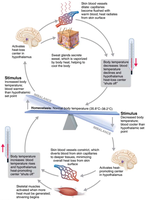
When body temperature drops, the hypothalamus triggers several mechanisms to conserve or generate heat:
Vasoconstriction: Sympathetic nerves constrict cutaneous blood vessels, reducing blood flow to the skin and minimizing heat loss.
Shivering: Involuntary muscle contractions generate heat.
Increased metabolic rate: Norepinephrine release (especially in infants with brown adipose tissue) increases heat production (nonshivering thermogenesis).
Enhanced thyroxine release: In infants, cold stimulates thyroid hormone release, increasing metabolic rate and heat production.
Behavioral modifications: Seeking warmth, changing posture, increasing activity, or wearing more clothing.

Example: Putting on a coat or huddling to reduce exposed surface area are behavioral adaptations to conserve heat.
Heat-Loss Mechanisms
Mechanisms to Reduce Body Temperature
When core temperature rises, the hypothalamus activates heat-loss mechanisms, primarily through the skin:
Vasodilation: Cutaneous blood vessels dilate, increasing blood flow to the skin and promoting heat loss by radiation, conduction, and convection.
Enhanced sweating: Sweat glands secrete fluid, which evaporates and removes heat. This is most effective in dry air.
Behavioral modifications: Reducing activity, seeking shade, using fans, or wearing light, loose clothing to minimize heat gain.
Hyperthermia
Consequences of Failed Heat Loss
Hyperthermia occurs when heat loss mechanisms are overwhelmed and core temperature rises to dangerous levels (~41°C). This can depress hypothalamic function, leading to a positive feedback loop of increasing temperature, metabolic rate, and heat production. If unchecked, this can result in heat stroke, organ damage, and potentially death.

Symptoms: Hot, dry skin; confusion; possible loss of consciousness.
Prevention: Adequate hydration, avoiding excessive heat exposure, and prompt cooling measures.
Summary Table: Mechanisms of Heat Exchange
Mechanism | Description | Example |
|---|---|---|
Radiation | Transfer of heat via infrared waves | Body losing heat to a cooler room |
Conduction | Direct transfer of heat between objects in contact | Sitting on a cold bench |
Convection | Transfer of heat by movement of air or liquid | Wind increasing heat loss from skin |
Evaporation | Heat loss as water vaporizes from body surfaces | Sweating during exercise |
Additional info: In infants, brown adipose tissue (BAT) plays a significant role in nonshivering thermogenesis due to its high mitochondrial content. In adults, behavioral and physiological adaptations are more prominent for thermoregulation.
