 Back
BackRegulation of Hormone Release: Types of Endocrine Stimuli
Study Guide - Smart Notes
 Tailored notes based on your materials, expanded with key definitions, examples, and context.
Regulation of Hormone Release
Overview of Hormone Release Mechanisms
The synthesis and release of most hormones are regulated by negative feedback mechanisms. These mechanisms ensure that hormone levels in the blood remain within a narrow range, maintaining homeostasis. Hormone release is triggered by three main types of stimuli: humoral, neural, and hormonal stimuli. Some endocrine organs may respond to more than one type of stimulus.
Types of Endocrine Gland Stimuli
Humoral Stimuli
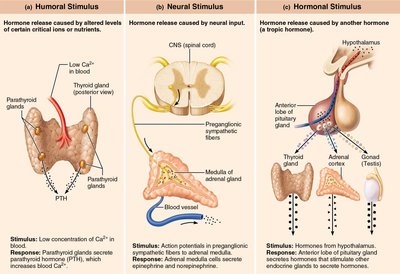
Humoral stimuli refer to hormone release in response to changes in blood levels of certain ions or nutrients. This is the simplest form of endocrine control. For example, the parathyroid glands monitor blood calcium levels and release parathyroid hormone (PTH) as needed. Other hormones released in response to humoral stimuli include insulin (in response to increased blood glucose) and aldosterone (in response to changes in blood sodium or potassium levels).
Definition: Hormone release triggered by altered levels of critical ions or nutrients in the blood.
Example: Low blood calcium stimulates parathyroid glands to release PTH.
Application: Insulin secretion in response to elevated blood glucose.
Neural Stimuli
In some cases, hormone release is triggered by neural input. The classic example is the response to stress, where the sympathetic nervous system stimulates the adrenal medulla to release norepinephrine and epinephrine. Neural stimuli are less common but are crucial for rapid responses.
Definition: Hormone release triggered by nerve fibers.
Example: Sympathetic nervous system activation causes adrenal medulla to release catecholamines.
Application: Oxytocin release during breastfeeding is triggered by neural input from suckling.
Hormonal Stimuli
Many endocrine glands release hormones in response to hormones produced by other endocrine organs. For instance, hypothalamic releasing and inhibiting hormones regulate the secretion of anterior pituitary hormones, which in turn stimulate other endocrine organs. This feedback loop is central to endocrine regulation and often results in rhythmic hormone release patterns.
Definition: Hormone release triggered by another hormone (tropic hormone).
Example: Hypothalamic hormones stimulate the anterior pituitary, which then stimulates target endocrine glands.
Application: Feedback inhibition regulates hormone levels.
Nervous System Modulation
Integration of Nervous and Endocrine Systems
The nervous system can modify both the activation (turn-on) and inhibition (turn-off) factors affecting the endocrine system. This allows for adjustments to maintain homeostasis beyond simple feedback mechanisms. For example, during severe stress, the nervous system can override normal endocrine controls to increase blood glucose levels, ensuring sufficient energy for vigorous activity.
Key Point: Nervous system modulation ensures adaptive responses to changing internal and external conditions.
Example: Stress-induced increase in blood glucose via hypothalamic and sympathetic activation.
Summary Table: Types of Endocrine Stimuli
Stimulus Type | Trigger | Example Hormone | Example Organ |
|---|---|---|---|
Humoral | Changes in blood ions/nutrients | Parathyroid hormone (PTH), Insulin | Parathyroid gland, Pancreas |
Neural | Nerve impulses | Epinephrine, Oxytocin | Adrenal medulla, Posterior pituitary |
Hormonal | Other hormones | Thyroid hormone, Cortisol | Thyroid gland, Adrenal cortex |
Negative Feedback in Hormone Regulation
Mechanism of Feedback Inhibition
Negative feedback is a fundamental mechanism in endocrine regulation. As hormone levels rise, target organ effects inhibit further hormone release, maintaining balance. This prevents excessive hormone production and ensures stable physiological conditions.
Key Point: Negative feedback maintains hormone levels within a narrow range.
Example: Rising blood calcium inhibits further PTH release.
Practice Questions
What are the three types of stimuli that control hormone release?
Elevated blood glucose levels stimulate cells of the pancreas to secrete insulin. The pancreas is responding to which type of stimulus?
Additional info: The notes expand on the brief points in the original material, providing definitions, examples, and a summary table for clarity. The included image (image_1) directly illustrates the three types of endocrine stimuli and is highly relevant to the explanations above. Image_2 is not included, as it is only a title slide and does not add educational value to the content.
