Back
BackRespiratory Physiology: Mechanics, Pressures, and Gas Exchange
Study Guide - Smart Notes
 Tailored notes based on your materials, expanded with key definitions, examples, and context.
Mechanics of Breathing
Pulmonary Ventilation
Pulmonary ventilation is the process by which air is moved into and out of the lungs, consisting of two phases: inspiration and expiration. This mechanical process depends on changes in the volume of the thoracic cavity, which lead to pressure changes and subsequent airflow.
Inspiration: Gases flow into the lungs.
Expiration: Gases exit the lungs.
Pressure Relationships in the Thoracic Cavity
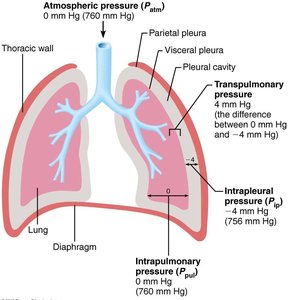
Several pressures are involved in breathing, each playing a critical role in lung inflation and deflation:
Atmospheric Pressure (Patm): The pressure exerted by air surrounding the body, typically 760 mm Hg at sea level.
Intrapulmonary Pressure (Ppul): The pressure within the alveoli, fluctuating with breathing and eventually equalizing with Patm.
Intrapleural Pressure (Pip): The pressure within the pleural cavity, always negative relative to Patm and Ppul, usually 4 mm Hg less than Ppul. This negative pressure is essential for keeping the lungs inflated.
Transpulmonary Pressure: The difference between Ppul and Pip, which keeps lung spaces open.
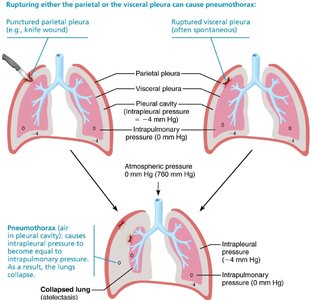
Pneumothorax and Atelectasis
Pneumothorax occurs when air enters the pleural cavity, causing Pip to equalize with Patm or Ppul, resulting in lung collapse (atelectasis). This can be caused by trauma or spontaneous rupture of the pleura.
Atelectasis: Collapse of lung tissue due to plugged bronchioles or pneumothorax.
Treatment: Removal of air via chest tubes and reinflation of the lung once the pleurae heal.
Sequence of Events During Inspiration and Expiration
Inspiration
Inspiration is an active process involving contraction of the diaphragm and external intercostal muscles, increasing thoracic volume and decreasing intrapulmonary pressure, allowing air to flow into the lungs.
Diaphragm contracts: Moves inferiorly and flattens, increasing thoracic volume.
External intercostals contract: Rib cage lifts up and out.
Pressure changes: Intrapulmonary pressure drops below atmospheric pressure, air flows in.
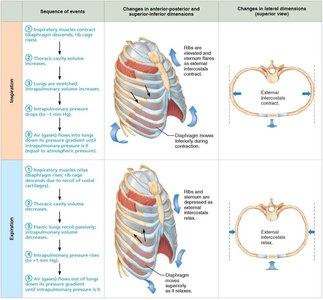
Expiration
Expiration is usually a passive process where inspiratory muscles relax, thoracic volume decreases, and lungs recoil, causing intrapulmonary pressure to rise above atmospheric pressure and air to flow out.
Quiet expiration: Passive, due to muscle relaxation and lung recoil.
Forced expiration: Active, involving abdominal and internal intercostal muscles.
Physical Factors Influencing Pulmonary Ventilation
Airway Resistance
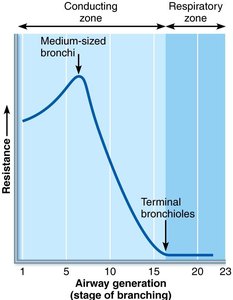
Airway resistance is primarily due to friction in the airways. It is usually insignificant except in medium-sized bronchi, and disappears at terminal bronchioles where diffusion drives gas movement.
Relationship: (Pressure gradient = Flow × Resistance)
Clinical relevance: Increased resistance (e.g., asthma) makes breathing more strenuous; epinephrine can reduce resistance by dilating bronchioles.
Alveolar Surface Tension
Surface tension in alveoli is caused by the attraction of liquid molecules, which tends to shrink alveoli. Surfactant, produced by type II alveolar cells, reduces surface tension and prevents alveolar collapse.
Clinical relevance: Insufficient surfactant in premature infants leads to Infant Respiratory Distress Syndrome (IRDS), requiring surfactant therapy or mechanical ventilation.
Lung Compliance
Lung compliance measures the ease with which lungs can expand. It is determined by the distensibility of lung tissue and the presence of surfactant.
Formula:
Factors reducing compliance: Fibrosis, decreased surfactant, decreased thoracic flexibility.
Assessing Ventilation
Respiratory Volumes and Capacities
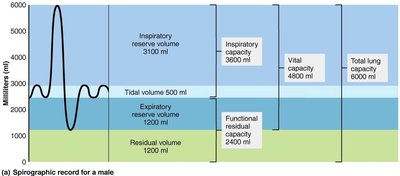
Respiratory volumes are measured to assess lung function. These include:
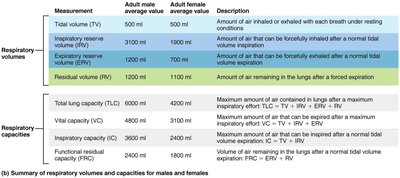
Tidal Volume (TV): Air moved in/out per breath (~500 ml).
Inspiratory Reserve Volume (IRV): Air inspired beyond TV (2100–3200 ml).
Expiratory Reserve Volume (ERV): Air expelled beyond TV (1000–1200 ml).
Residual Volume (RV): Air remaining in lungs after forced expiration (needed to keep alveoli open).
Respiratory Capacities
Inspiratory Capacity (IC): TV + IRV
Functional Residual Capacity (FRC): RV + ERV
Vital Capacity (VC): TV + IRV + ERV
Total Lung Capacity (TLC): TV + IRV + ERV + RV
Dead Space
Anatomical dead space: Air in passageways not involved in gas exchange (~150 ml).
Alveolar dead space: Nonfunctional alveoli due to collapse or obstruction.
Total dead space: Sum of anatomical and alveolar dead space.
Pulmonary Function Tests
Obstructive disease: Increased airway resistance (e.g., bronchitis), increased TLC, FRC, RV.
Restrictive disease: Reduced TLC (e.g., fibrosis), decreased VC, TLC, FRC, RV.
Forced Vital Capacity (FVC): Gas expelled after deep breath.
Forced Expiratory Volume (FEV): Gas expelled in specific time intervals (FEV1: air expelled in 1st second).
Alveolar Ventilation
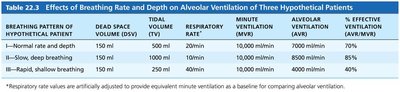
Minute ventilation: Total gas flow per minute (~6 L/min at rest).
Alveolar ventilation rate (AVR): Flow of gases into/out of alveoli per time, calculated as:
Clinical relevance: Increasing TV is more effective for increasing AVR than increasing frequency.
Gas Exchange
Basic Properties of Gases
Dalton’s Law: Total pressure of a gas mixture equals the sum of partial pressures of each gas.
Partial pressure: Pressure exerted by each gas, proportional to its percentage in the mixture.
Henry’s Law: Each gas dissolves in liquid in proportion to its partial pressure and solubility.
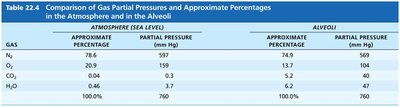
Composition of Alveolar Gas
Alveoli contain more CO2 and water vapor than atmospheric air due to gas exchange, humidification, and mixing of inspired and residual air.
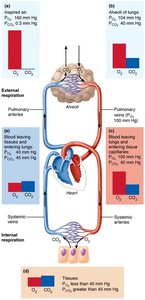
External Respiration
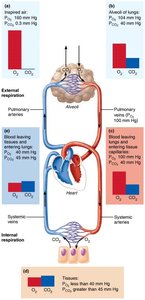
External respiration is the exchange of O2 and CO2 across the respiratory membrane, influenced by partial pressure gradients, membrane thickness, surface area, and ventilation-perfusion coupling.
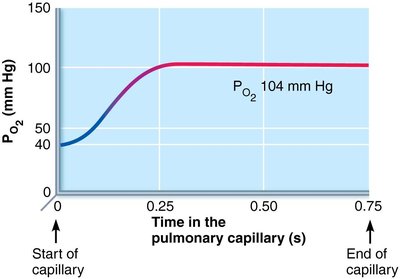
O2 gradient: Steep gradient drives O2 into blood (Alveolar PO2 = 104 mm Hg, Venous PO2 = 40 mm Hg).
CO2 gradient: Less steep, but CO2 diffuses equally due to higher solubility.
Membrane thickness: Thin membranes and large surface area facilitate efficient gas exchange.
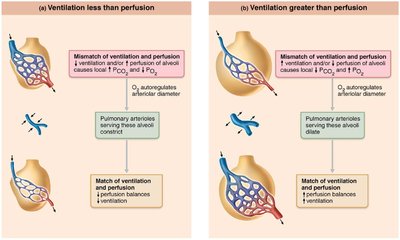
Ventilation-perfusion coupling: Matching of alveolar ventilation with blood perfusion for optimal exchange.
Internal Respiration
Internal respiration is the exchange of gases between blood and tissues. Partial pressures and diffusion gradients are reversed compared to external respiration, with O2 moving from blood to tissues and CO2 moving from tissues to blood.
Tissue PO2: Always lower than arterial blood PO2, so O2 moves into tissues.
Tissue PCO2: Always higher than arterial blood PCO2, so CO2 moves into blood.