 Back
Respiratory Physiology: Structure, Function, and Gas Exchange
Study Guide - Smart Notes
 Tailored notes based on your materials, expanded with key definitions, examples, and context.
Basics of the Respiratory System
Functions of the Respiratory System
The respiratory system is essential for gas exchange, regulation of blood pH, protection, vocalization, and as a source of water and heat loss. It works closely with the cardiovascular system to transport oxygen to tissues and remove carbon dioxide.
Gas Exchange: Oxygen is taken up from the atmosphere and delivered to cells, while carbon dioxide is removed from tissues and expelled.
pH Regulation: The rate of CO2 release influences blood pH, which is tightly regulated between 7.38–7.42.
Protection: The respiratory tract filters, warms, and humidifies air, and contains immune defenses.
Vocalization: Air movement across the vocal cords produces sound.
Water and Heat Loss: Breathing contributes to the loss of water vapor and heat from the body.

Structural Organization
The respiratory system is divided into the upper and lower tracts, each with specific roles in conduction and gas exchange.
Upper Respiratory Tract: Nasal cavity, pharynx, larynx – warms, humidifies, and filters air.
Lower Respiratory Tract: Trachea, bronchi, bronchioles, alveoli – conducts air and facilitates gas exchange.
Conduction Portion: Air passages that do not participate in gas exchange (trachea to terminal bronchioles).
Exchange Portion: Respiratory bronchioles and alveoli where gas exchange occurs.

Muscles and Membranes in Respiration
Breathing is driven by pressure changes created by the coordinated action of respiratory muscles and the pleural membranes.
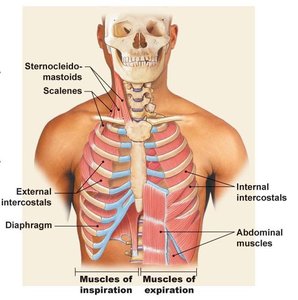
Primary Muscle: Diaphragm (responsible for 60–75% of volume change).
Accessory Muscles: Sternocleidomastoid, scalenes, external and internal intercostals, abdominal muscles.
Pleural Membranes: Visceral and parietal pleura create a cohesive force via serous fluid, enabling lung expansion and recoil.

Mechanics of Breathing
Ventilation and Pressure Changes
Ventilation is the process of moving air into and out of the lungs, driven by pressure gradients created by changes in thoracic volume.
Inspiration: Thoracic cavity expands, alveolar pressure drops below atmospheric pressure, air flows in.
Expiration: Thoracic cavity recoils, alveolar pressure rises above atmospheric pressure, air flows out.
Compliance: The ease with which the lungs expand (ΔV/ΔP).
Elastance: The ability of the lungs to return to their original shape after stretching (inverse of compliance).

Gas Laws Relevant to Respiration
Boyle’s Law: or – Pressure and volume are inversely related.
Charles’ Law: – Volume is directly proportional to temperature.
Ideal Gas Law: – Relates pressure, volume, temperature, and number of moles.
Dalton’s Law: – Total pressure is the sum of partial pressures.
Fick’s Law: – Diffusion rate depends on surface area, gradient, and thickness.
Henry’s Law: – Amount of gas dissolved in liquid is proportional to its partial pressure.
Poiseuille’s Law: – Resistance is most affected by tube radius.
Laplace’s Law: – Pressure in a bubble is related to surface tension and radius.
Gas Exchange and Transport
External and Internal Respiration
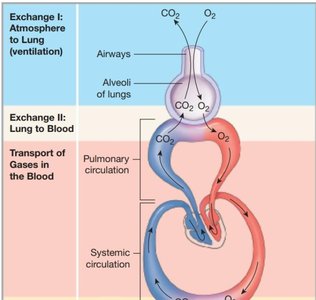
Respiration involves several steps: ventilation, external respiration (gas exchange between alveoli and blood), transport of gases in blood, and internal respiration (gas exchange between blood and tissues).
External Respiration: Exchange of O2 and CO2 between alveoli and pulmonary capillaries.
Internal Respiration: Exchange of O2 and CO2 between systemic capillaries and tissues.
Cellular Respiration: Utilization of O2 in ATP synthesis within cells.

Factors Affecting Gas Exchange
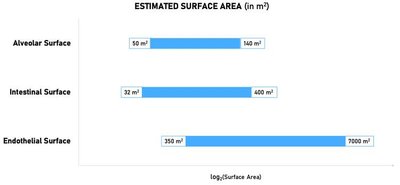
Surface Area: Large alveolar surface area enhances gas exchange.
Membrane Thickness: Thicker membranes slow diffusion.
Partial Pressure Gradients: The difference in partial pressures drives diffusion.
Solubility: CO2 is more soluble in plasma than O2.
Oxygen Transport in Blood
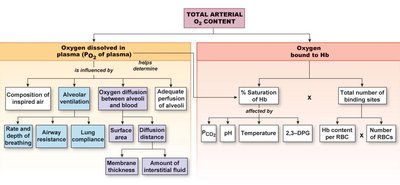
Oxygen is transported in two forms: dissolved in plasma and bound to hemoglobin (Hb).
Dissolved O2: Follows Henry’s Law; limited by low solubility.
Hemoglobin-bound O2: Each Hb molecule can bind up to four O2 molecules, greatly increasing blood’s oxygen-carrying capacity.
Oxygen Dissociation Curve: Describes the relationship between PO2 and Hb saturation; affected by pH, CO2, temperature, and 2,3-DPG (Bohr effect).

Carbon Dioxide Transport in Blood
Dissolved CO2: About 7% is transported dissolved in plasma.
Bicarbonate (HCO3-): About 70% is converted to bicarbonate by carbonic anhydrase in red blood cells.
Carbamino Compounds: About 23% binds to hemoglobin as carbaminohemoglobin.
Regulation of Ventilation and Acid-Base Balance
Neural Control of Breathing
Ventilation is regulated by the brainstem, responding to changes in CO2, O2, and pH, as well as voluntary and emotional influences.
Central Chemoreceptors: Located in the medulla, sensitive to CO2 and pH changes.
Peripheral Chemoreceptors: Located in carotid and aortic bodies, respond to O2, CO2, and pH.
Protective Reflexes: Irritant receptors trigger coughing, sneezing, and bronchoconstriction.
Acid-Base Balance
The respiratory system helps maintain acid-base balance by regulating CO2 exhalation. The Henderson-Hasselbalch equation describes the relationship between pH, bicarbonate, and CO2:
Equation:
Respiratory Acidosis: Caused by hypoventilation (CO2 retention).
Respiratory Alkalosis: Caused by hyperventilation (CO2 loss).
Metabolic Compensation: Kidneys adjust HCO3- reabsorption and H+ excretion.
Ventilation-Perfusion Ratio
Matching of Ventilation and Perfusion
Efficient gas exchange requires matching of alveolar ventilation (V) and pulmonary capillary perfusion (Q). The V/Q ratio varies in different regions of the lung due to gravity and posture.
Base of Lung: Higher perfusion and ventilation.
Apex of Lung: Lower perfusion and ventilation.
Mismatch: Can lead to hypoxemia if not corrected.
Summary Table: Types of Hypoxia
Type | Definition | Typical Causes |
|---|---|---|
Hypoxic hypoxia | Low arterial PO2 | High altitude, hypoventilation, diffusion impairment, V/Q mismatch, asthma |
Ischemic hypoxia | Reduced blood flow | Heart failure, shock, thrombosis |
Histotoxic hypoxia | Cells unable to use O2 | Cyanide poisoning |
Anemic hypoxia | Low O2 bound to Hb | Anemia, CO poisoning, hemorrhage |
Clinical Relevance
Spirometry: Used to distinguish obstructive (e.g., asthma, COPD) from restrictive (e.g., fibrosis) lung diseases.
Flow-Volume Loops: Help diagnose and monitor lung disease progression.
Dead Space: Anatomical dead space does not participate in gas exchange; residual volume prevents alveolar collapse.
Additional info: This guide integrates foundational concepts from animal and human physiology, referencing standard textbooks and clinical applications. It is suitable for ANP college-level exam preparation.
