 Back
Respiratory System: Structure, Function, and Mechanisms
Study Guide - Smart Notes
 Tailored notes based on your materials, expanded with key definitions, examples, and context.
Respiratory System Overview
General Functions of the Respiratory System
The respiratory system is essential for gas exchange, oxygen delivery, and removal of carbon dioxide from the body. It supports cellular respiration, which is necessary for ATP production in tissues.
Ventilation (Breathing): The mechanical process of moving air into and out of the lungs.
Gas Exchange: Occurs between blood and lungs (external respiration) and between blood and tissues (internal respiration).
Oxygen Utilization: Oxygen is used by tissues for cellular respiration to produce ATP.
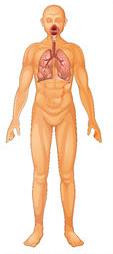
External vs. Internal Respiration
External Respiration: Ventilation and gas exchange in the lungs.
Internal Respiration: Oxygen utilization and gas exchange in tissues.
Anatomy of the Respiratory System
Conducting and Respiratory Zones
The respiratory tract is divided into two functional zones: the conducting zone and the respiratory zone. The conducting zone transports air, while the respiratory zone is the site of gas exchange.
Conducting Zone: Includes trachea, bronchi, and terminal bronchioles; functions to move air to the respiratory zone.
Respiratory Zone: Includes respiratory bronchioles and alveoli; site of gas exchange.
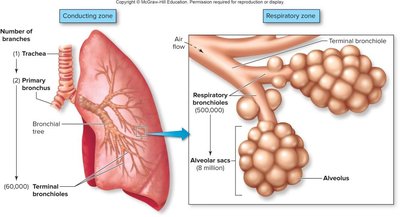
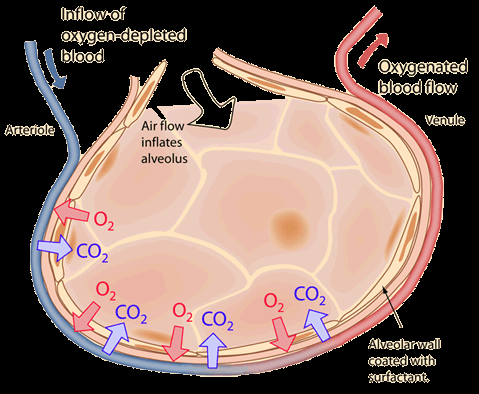
Alveoli and Gas Exchange
Gas exchange occurs in the alveoli by diffusion, driven by differences in partial pressures of oxygen and carbon dioxide.
Oxygen: Higher concentration in alveoli than in blood, diffuses into blood.
Carbon Dioxide: Higher concentration in blood than in alveoli, diffuses out of blood.
Gas Laws and Partial Pressures
Dalton’s Law of Partial Pressures
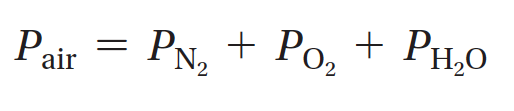
Dalton’s Law states that the total pressure of a mixture of gases is the sum of the pressures of each individual gas.
Partial Pressure: The pressure exerted by each gas in a mixture.
Application: Partial pressures drive the movement of gases during respiration.
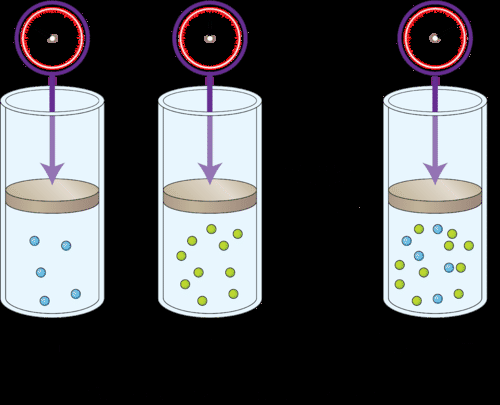
Equation:
Henry’s Law
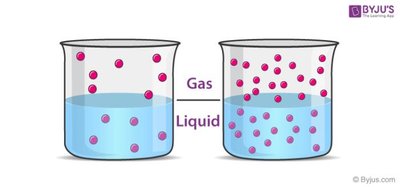
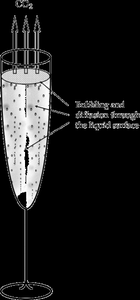
Henry’s Law states that the solubility of a gas in a liquid is directly proportional to the partial pressure of that gas above the liquid.
Higher Partial Pressure: Leads to more gas dissolving in the liquid.
Application: Explains how gases dissolve in blood plasma.
Mechanisms of Pulmonary Ventilation
Boyle’s Law and Breathing
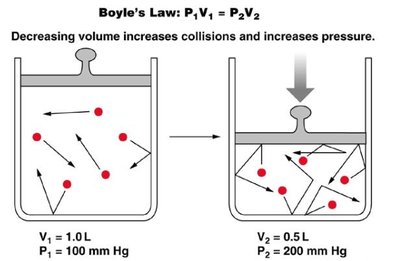
Boyle’s Law describes the inverse relationship between the pressure and volume of a gas. This principle is fundamental to pulmonary ventilation.
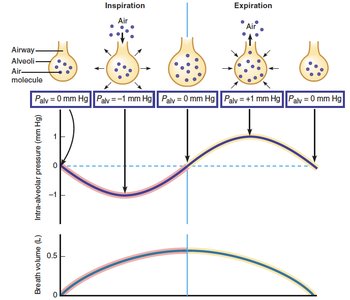
Inspiration: Increase in lung volume decreases intrapulmonary pressure, causing air to flow in.
Expiration: Decrease in lung volume increases intrapulmonary pressure, causing air to flow out.
Equation:
Role of the Diaphragm and Thoracic Cavity
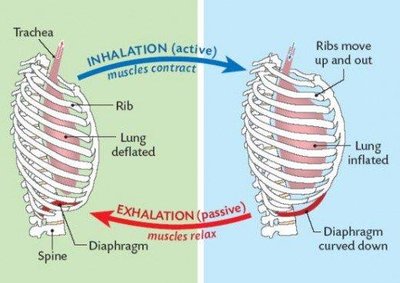
The diaphragm is the primary muscle involved in breathing. Its contraction and relaxation change the volume of the thoracic cavity, affecting lung pressure.
Contracted Diaphragm: Increases thoracic volume, decreases pressure, air flows in.
Relaxed Diaphragm: Decreases thoracic volume, increases pressure, air flows out.
Mechanics of Breathing
Breathing involves coordinated movement of the diaphragm and intercostal muscles, resulting in changes in lung volume and pressure.
Inhalation: Active process, muscles contract.
Exhalation: Passive process, muscles relax.
Pressure Relationships in the Thoracic Cavity
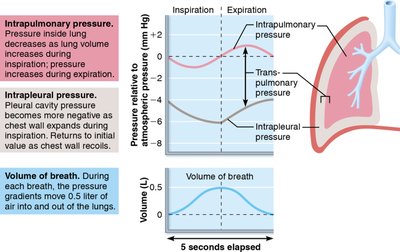
Intrapulmonary, Intrapleural, and Transpulmonary Pressures
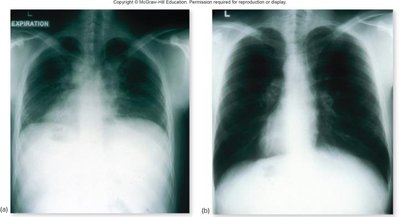
Pressure differences within the thoracic cavity are crucial for lung expansion and contraction.
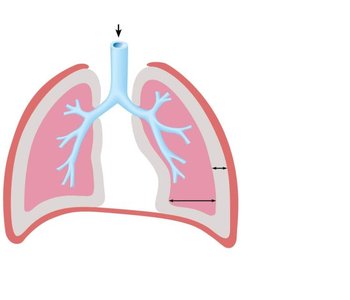
Intrapulmonary Pressure: Pressure within the alveoli.
Intrapleural Pressure: Pressure within the pleural cavity, normally less than intrapulmonary pressure.
Transpulmonary Pressure: Difference between intrapulmonary and intrapleural pressures; keeps lungs expanded.
Pressure Changes During Ventilation
During each breath, pressure gradients move air in and out of the lungs. The number of air molecules and lung volume affect intra-alveolar pressure.
Pneumothorax and Lung Collapse
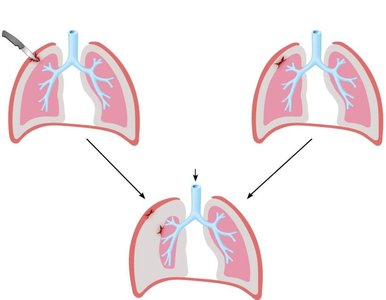
Pneumothorax occurs when air enters the pleural cavity, causing intrapleural pressure to equalize with intrapulmonary pressure, resulting in lung collapse (atelectasis).
Causes: Trauma (e.g., knife wound) or spontaneous rupture of pleura.
Effect: Loss of negative pressure, lung recoils and collapses.
Factors Affecting Pulmonary Ventilation
Lung Compliance
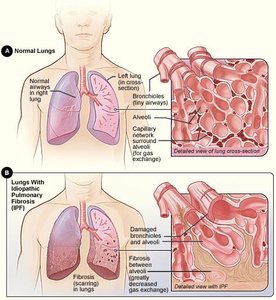
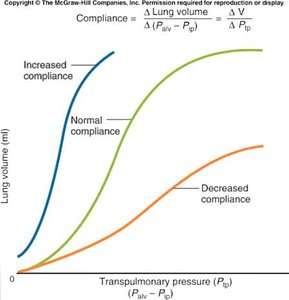
Compliance refers to the ease with which the lungs expand under pressure. High compliance means lungs stretch easily; low compliance indicates stiffness.
High Compliance: Lungs expand easily.
Low Compliance: Seen in pulmonary fibrosis, where scar tissue restricts expansion.
Lung Elasticity
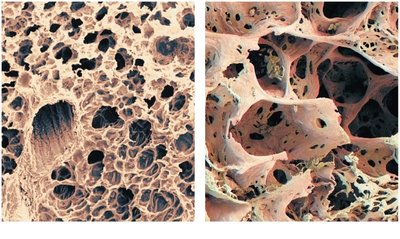
Elasticity is the ability of the lungs to return to their original shape after stretching. Healthy lungs have high elasticity, but diseases like emphysema reduce this property.
Emphysema: Alveoli lose elasticity, lungs remain over-inflated.
Surface Tension and Surfactant
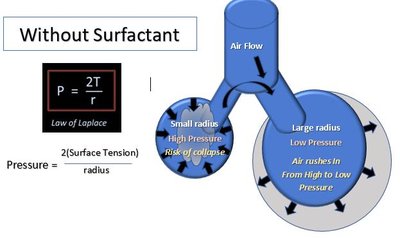
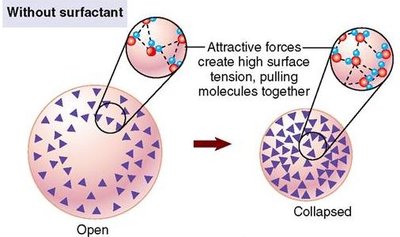
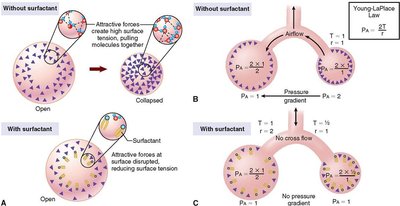
Surface tension in alveoli is caused by water molecules attracting each other. According to LaPlace’s Law, smaller alveoli are at risk of collapse due to higher pressure. Surfactant reduces surface tension, equalizing pressure and preventing collapse.
LaPlace’s Law: (Pressure increases as radius decreases)
Surfactant: Disrupts attractive forces, reduces surface tension, stabilizes alveoli.
Compliance, Elasticity, and Surface Tension
Elasticity and surface tension restrict lung expansion, decreasing compliance and making the lungs stiffer.
Pulmonary Function Tests
Spirometry and Lung Volumes
Spirometry measures lung volumes and capacities, helping diagnose restrictive and obstructive lung disorders.
Tidal Volume (TV): Air moved during normal breathing.
Inspiratory Reserve Volume (IRV): Air inhaled forcibly beyond tidal volume.
Expiratory Reserve Volume (ERV): Air exhaled forcibly beyond tidal volume.
Residual Volume (RV): Air remaining in lungs after maximal expiration.
Term | Definition |
|---|---|
Tidal volume | Volume of gas inspired or expired in an unforced respiratory cycle |
Inspiratory reserve volume | Maximum volume of gas inspired during forced breathing in addition to tidal volume |
Expiratory reserve volume | Maximum volume of gas expired during forced breathing in addition to tidal volume |
Residual volume | Volume of gas remaining in the lungs after a maximum expiration |
Lung Capacities
Total Lung Capacity (TLC): Total amount of gas in lungs after maximum inspiration.
Vital Capacity (VC): Maximum amount of gas expired after maximum inspiration.
Inspiratory Capacity (IC): Maximum amount of gas inspired after normal tidal expiration.
Functional Residual Capacity (FRC): Amount of gas remaining in lungs after normal tidal expiration.
Term | Definition |
|---|---|
Total lung capacity | Total amount of gas in the lungs after a maximum inspiration |
Vital capacity | Maximum amount of gas expired after a maximum inspiration |
Inspiratory capacity | Maximum amount of gas inspired after a normal tidal expiration |
Functional residual capacity | Amount of gas remaining in the lungs after a normal tidal expiration |
Mechanisms of Gas Exchange and Transport
Partial Pressure Gradients and Gas Movement
Gas exchange is driven by partial pressure gradients. Oxygen moves from alveoli to blood, and carbon dioxide moves from blood to alveoli.
Oxygen: High PO2 in alveoli, low PO2 in blood.
Carbon Dioxide: High PCO2 in blood, low PCO2 in alveoli.
Ventilation-Perfusion Coupling
Ventilation-perfusion coupling ensures optimal gas exchange by matching airflow (ventilation) to blood flow (perfusion) in the lungs.
Low Alveolar PO2: Pulmonary arterioles constrict.
High Alveolar PO2: Pulmonary arterioles dilate.
Hemoglobin and Oxygen Transport
Most oxygen in blood is bound to hemoglobin in red blood cells. Hemoglobin can carry four oxygen molecules, and its affinity for oxygen changes with PO2.
Oxyhemoglobin: Hemoglobin bound to oxygen.
Deoxyhemoglobin: Hemoglobin after releasing oxygen.
Carboxyhemoglobin: Hemoglobin bound to carbon monoxide (dangerous).
Oxyhemoglobin Dissociation Curve
The curve shows the relationship between PO2 and hemoglobin saturation. Factors such as pH, temperature, and fetal hemoglobin affect the curve.
Right Shift: Easier oxygen unloading (e.g., exercise, low pH).
Left Shift: Easier oxygen loading (e.g., fetal hemoglobin).
Carbon Dioxide Transport
CO2 is transported in blood as dissolved gas, bound to hemoglobin, or as bicarbonate ions. The reversible reaction is:
Bicarbonate: Most CO2 is converted to bicarbonate for transport.
pH Regulation: Changes in CO2 affect blood pH.
Summary Table: Key Respiratory Volumes and Capacities
Volume/Capacity | Definition |
|---|---|
Tidal Volume (TV) | Amount of air moved during normal breathing |
Inspiratory Reserve Volume (IRV) | Air inhaled forcibly beyond tidal volume |
Expiratory Reserve Volume (ERV) | Air exhaled forcibly beyond tidal volume |
Residual Volume (RV) | Air remaining in lungs after maximal expiration |
Total Lung Capacity (TLC) | Sum of all lung volumes |
Vital Capacity (VC) | Total exchangeable amount |
Inspiratory Capacity (IC) | Amount that can be breathed in after normal expiration |
Functional Residual Capacity (FRC) | Amount left in lungs after normal expiration |
Additional info: These notes expand on the original material with academic context, definitions, and relevant examples to ensure completeness and clarity for college-level study.
