 Back
BackSensation, Perception, and Sensory Transduction in Anatomy & Physiology
Study Guide - Smart Notes
 Tailored notes based on your materials, expanded with key definitions, examples, and context.
Sensation and Perception
Definitions and Processes
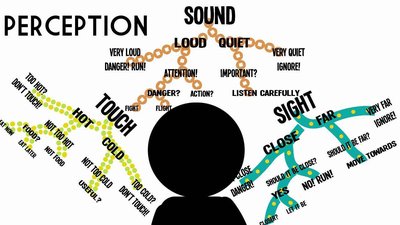
Sensation and perception are fundamental concepts in anatomy and physiology, describing how the body detects and interprets stimuli from the environment. Sensation refers to the awareness of a stimulus, requiring four main processes: stimulation, transduction, conduction, and translation. Perception is the conscious awareness and interpretation of these sensations, allowing us to respond appropriately to our surroundings.
Sensation: Involves detection of stimuli and conversion into neural signals.
Perception: Involves interpretation of sensory information in the brain.
Processes:
Stimulation: Activation of sensory receptors.
Transduction: Conversion of stimulus into electrical signals.
Conduction: Transmission of signals to the CNS.
Translation: Interpretation of signals in the brain.
Example: Touching a hot object activates thermoreceptors, which send signals to the brain, resulting in the perception of heat.
Organization of the Nervous System
CNS and PNS Overview
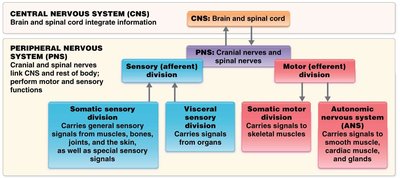
The nervous system is divided into the Central Nervous System (CNS) and Peripheral Nervous System (PNS). The CNS integrates information, while the PNS links the CNS to the rest of the body, performing motor and sensory functions.
CNS: Brain and spinal cord.
PNS: Cranial and spinal nerves.
Divisions:
Sensory (afferent): Carries signals to CNS.
Motor (efferent): Carries signals from CNS to effectors.
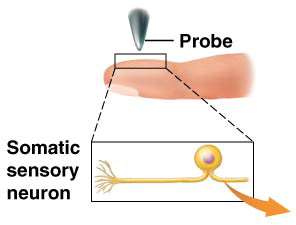
Somatic Sensory Division: Carries general sensory signals from muscles, bones, joints, skin, and special senses.
Visceral Sensory Division: Carries signals from organs.
Somatic Motor Division: Controls skeletal muscles.
Autonomic Nervous System: Controls smooth muscle, cardiac muscle, and glands.
Sensory Transduction
Mechanism of Signal Conversion
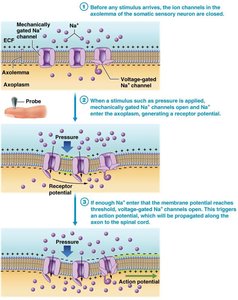
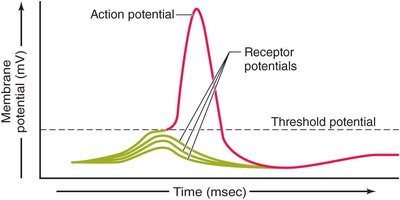
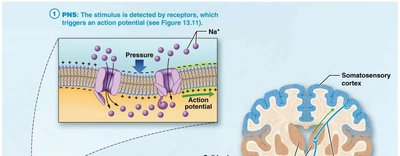
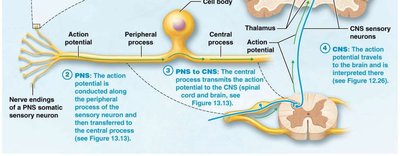
Sensory transduction is the process by which a stimulus is converted into an electrical signal in the nervous system. This involves the generation of receptor potentials and, if the threshold is reached, action potentials that are conducted to the CNS.
Receptor Potentials: Produced when a stimulus is detected, often due to influx of sodium ions (Na+).
Action Potentials: Generated when receptor potentials reach threshold, allowing the signal to be transmitted to the CNS.
Adaptation: Occurs when a stimulus remains but action potentials stop; can be rapid or slow.
Classification of Sensory Receptors
Types and Functions
Sensory receptors are classified based on their microscopic structure, location, and the type of stimulus they detect. These include mechanoreceptors, thermoreceptors, nociceptors, photoreceptors, and chemoreceptors.
Microscopic Structure: Free nerve endings, encapsulated endings, or separate cells.
Location:
Exteroreceptors: Detect external stimuli.
Interoreceptors: Detect internal stimuli.
Type of Stimulus: Mechanical, temperature, pain, light, chemicals.
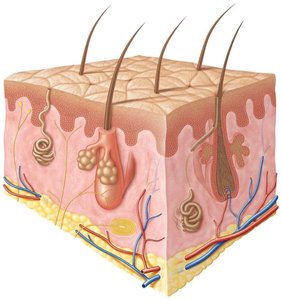
Mechanoreceptors in Skin
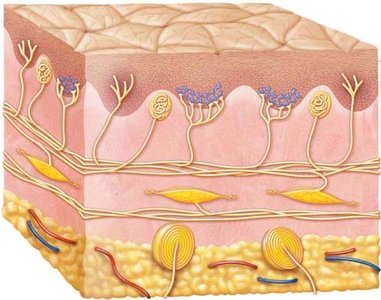
Mechanoreceptors are specialized for detecting touch, pressure, vibration, and stretch. Each type has a unique function and adaptation rate.
Mechanoreceptor | Function |
|---|---|
Merkel cell fiber | Discriminative touch with fine spatial resolution (slow adapting) |
Tactile corpuscle (Meissner) | Discriminative touch with less spatial resolution (rapid adapting) |
Ruffini ending (bulbous corpuscle) | Stretch and movement (slow adapting) |
Lamellated corpuscle (Pacinian) | Vibration and deep pressure (rapid adapting) |
Proprioceptors
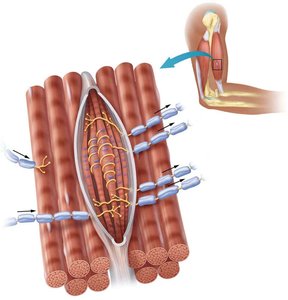
Proprioceptors are not found in the skin but in muscles, tendons, and joints. They provide information about movement and position, contributing to the kinesthetic sense.
Sensory Neurons: Speed and Receptive Fields
Conduction Speed and Touch Discrimination
The speed of sensory neuron conduction depends on axon diameter and myelination. Fast conduction is associated with proprioception, while slow conduction is linked to pain and temperature.
Fast Conduction: Large diameter, myelinated axons (proprioception).
Slow Conduction: Small diameter, unmyelinated axons (pain, temperature).
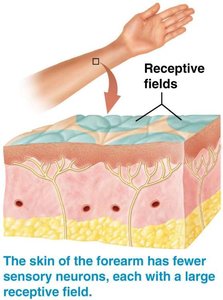
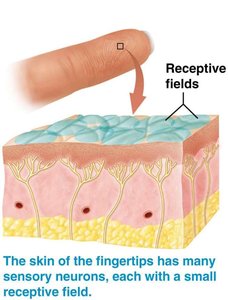
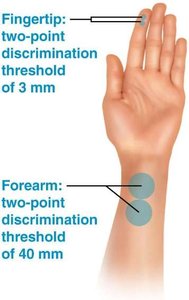
Touch Discrimination: Higher density of small-field receptors increases ability to identify type and source of touch.
Dermatomes and Pain Perception
Mapping Sensory Pathways
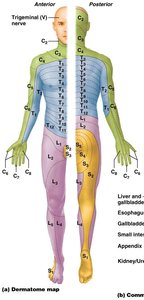
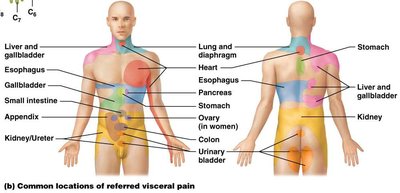
Dermatomes are regions of skin innervated by specific spinal nerves, used to map sensory pathways. Nociceptors provide information about tissue damage and disease symptoms, and pain can be localized as somatic (superficial or deep), visceral, or referred, and classified as fast or slow.
Detection and Perception of Sensation
Neural Pathways
Sensory information is carried to the CNS by (pseudo)unipolar neurons. Visceral sensory information terminates in the brainstem/diencephalon, while somatic sensory information terminates in the somatosensory cortex of the cerebrum.
CNS Integration and Homeostasis
Integration Centers
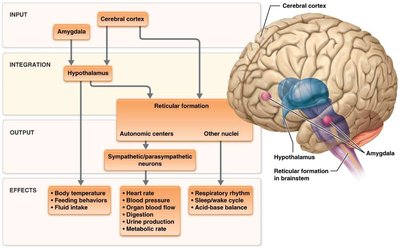
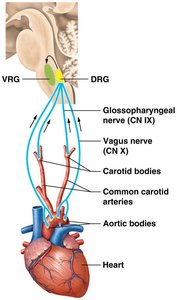
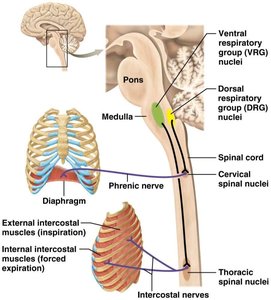
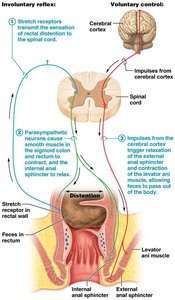
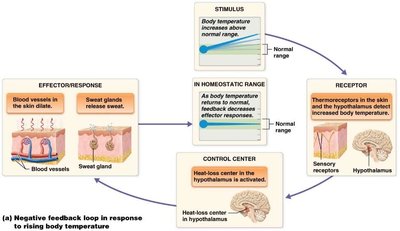
Sensory information is integrated in the hypothalamus and autonomic centers, regulating functions such as thirst, hunger, heat, respiratory, cardiac, digestive, thermoregulation, micturition, and water balance.
Examples:
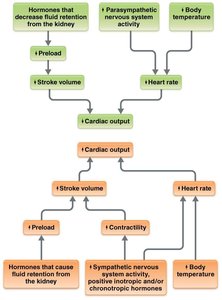
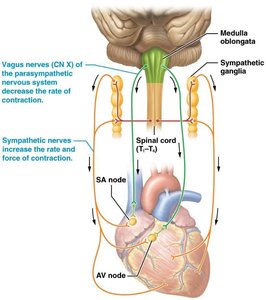
Cardiac function: Heart rate and force of contraction controlled in the brainstem.
Respiratory function: Rate and depth of ventilation controlled by dorsal and ventral respiratory group nuclei.
Digestive function: Enteric nervous system controls most processes; defecation via parasympathetic function.
Thermoregulation: Heat-loss and heat-gain centers in hypothalamus.
Micturition: Centers in pons control urination via parasympathetic function.
Water balance: Osmoreceptors and baroreceptors send information to thirst centers in hypothalamus.
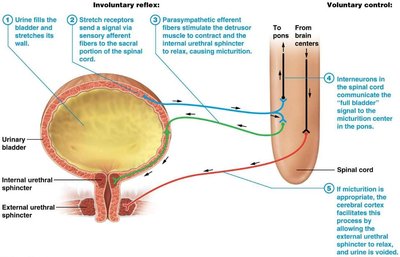
Nervous and Endocrine System Integration
Hypothalamus and Pituitary Relationship
The hypothalamus and pituitary gland have a close anatomical relationship, allowing for efficient communication and control between the nervous and endocrine systems. This integration is essential for maintaining homeostasis and regulating bodily functions.
Key Equations and Concepts
Action Potential Generation
The generation of an action potential depends on the membrane potential reaching a threshold:
Threshold Potential: The minimum membrane potential required to trigger an action potential.
Equation:
Homeostasis
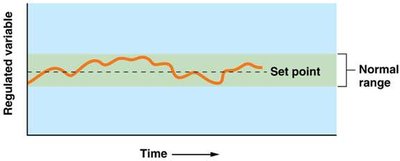
Homeostasis is maintained by negative feedback loops:
Equation:
Summary Table: Sensory Receptor Types
Type | Stimulus Detected | Location |
|---|---|---|
Mechanoreceptor | Touch, pressure, vibration, stretch | Skin, muscles, tendons |
Thermoreceptor | Temperature | Skin |
Nociceptor | Pain | Skin, organs |
Photoreceptor | Light | Eyes |
Chemoreceptor | Chemicals | Tongue, nose, blood vessels |
Additional info: Academic context was added to clarify the processes of sensation, perception, sensory transduction, and integration in the nervous system, as well as to provide definitions and examples for key terms.
