 Back
Sensory Systems: General Principles and Receptors
Study Guide - Smart Notes
 Tailored notes based on your materials, expanded with key definitions, examples, and context.
General Information on Sensation
Perception and Sensory Processing
Perception is the conscious awareness and interpretation of sensory information. It is not only determined by the incoming sensory signals but also by the state of the nervous system and the way the brain processes these signals. For example, phantom pain is a phenomenon where individuals perceive pain in a limb that has been amputated, illustrating how perception can occur without actual sensory input.
Perception varies with the state of the nervous system: Factors such as attention, expectation, and previous experiences can alter how stimuli are perceived.
Processing affects perception: The brain integrates and interprets sensory signals, which can modify the final perception.
Sensation depends on the receptor and pathway: The type of receptor activated and the neural pathway it follows determine the nature of the sensation experienced.
Sensory Receptors
Overview and Sensory Modalities
Sensory receptors are specialized cells or nerve endings that detect changes in the environment (stimuli) and provide the central nervous system (CNS) with information about these stimuli. Sensory modalities refer to the different types of sensations that receptors can detect.
General senses: Include pain, temperature, touch, pressure, vibration, and proprioception (sense of body position).
Special senses: Include smell, vision, taste, balance, and hearing.
Sensory Reception
Steps in Sensory Reception
The process of sensory reception involves several key steps that convert environmental stimuli into neural signals that can be interpreted by the brain.
Stimulation: A physical or chemical stimulus activates a sensory receptor.
Transduction: The receptor converts the stimulus into an electrical signal (receptor or generator potential).
Generation: If the receptor potential reaches a threshold, it triggers an action potential (nerve impulse).
Transmission: The action potential is transmitted along sensory neurons to the CNS.
Integration: The CNS processes and interprets the incoming sensory information.
Sensory Receptors – Characteristics
Key Properties of Receptor Systems
All sensory receptor systems share several important characteristics that determine how they detect and transmit information.
Specificity: Each receptor is specialized to respond to a particular type of stimulus.
Receptive field: The area monitored by a single receptor cell.
Dynamic range: The range of stimulus intensities a receptor can detect.
Range shifting: Receptors can adjust their sensitivity to different stimulus intensities.
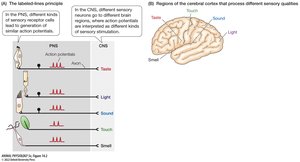
Labeled line: Each sensory pathway carries information about a specific type of stimulus to a particular region of the brain.
Sensory coding: The pattern of action potentials encodes information about stimulus type, intensity, and location.
Processing: Sensory information is processed both peripherally (at the receptor or spinal cord level) and centrally (in the brain).
Adaptation: Receptors can decrease their response to a constant stimulus over time (peripheral or central adaptation).
Sensitivity modulation: Sensitivity can be increased or decreased before the stimulus is received, allowing the nervous system to prioritize certain inputs.
Sensory Receptor Types
Free and Encapsulated Nerve Endings
Sensory receptors can be classified based on their structure and the way they generate electrical signals.
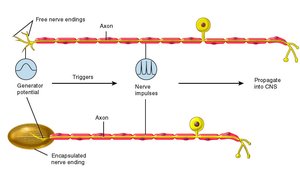
Free nerve endings: Simple, unspecialized nerve endings that detect pain, temperature, and some touch sensations.
Encapsulated nerve endings: Nerve endings surrounded by specialized structures that enhance their sensitivity to specific stimuli (e.g., pressure, vibration).
Generator potentials: Local changes in membrane potential in response to a stimulus, which can trigger action potentials if they reach threshold.
Specialized Receptor Cells
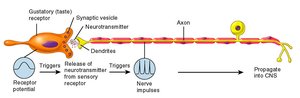
Some sensory systems use specialized receptor cells that are not neurons but communicate with sensory neurons via synapses.
Receptor potential: A graded electrical response to a stimulus in a specialized receptor cell.
When the receptor potential is strong enough, it causes the release of neurotransmitters, which then trigger action potentials in the associated sensory neuron.
Classification of General Senses
By Location Monitored
Exteroceptors: Detect external stimuli (e.g., touch, temperature, pain from the skin).
Proprioceptors: Monitor the position and movement of muscles and joints.
Interoceptors: Detect internal stimuli from organs (e.g., stretch, chemical changes).
By Stimulus Type
Nociceptors: Respond to pain, including heat, mechanical damage, and chemical signals.
Thermoreceptors: Detect changes in temperature (cold and warm receptors).
Mechanoreceptors: Respond to mechanical forces such as touch, pressure, vibration, and proprioception.
Chemoreceptors: Detect chemical changes (e.g., in blood or interstitial fluid).
Additional info: Sensory systems are essential for interacting with the environment and maintaining homeostasis. Understanding the types and properties of sensory receptors is foundational for studying the somatic and special senses in anatomy and physiology.
