 Back
BackSimple and Complex Reflex Pathways: Components and Sequence
Study Guide - Smart Notes
 Tailored notes based on your materials, expanded with key definitions, examples, and context.
Q1. What are the basic components of a reflex pathway, and how do they function together?
Background
Topic: Reflex Pathways in Physiology
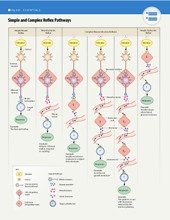
This question explores the essential elements of reflex pathways, which are critical for maintaining homeostasis. Reflex pathways can be simple or complex, involving sensors, integrating centers, and effectors.
Key Terms and Concepts:
Sensor: Detects changes in physiological variables (stimulus).
Afferent neuron: Delivers sensory information from the periphery to the integrating center.
Integrating center: Interprets sensory information and generates a response (e.g., brain, spinal cord, endocrine system).
Efferent neuron: Delivers information from the integrating center to the effector.
Effector: Changes physiological variables to restore homeostasis.
Response: The change in organ activity resulting from effector action.
Step-by-Step Guidance
Identify the stimulus that initiates the reflex pathway (e.g., change in temperature).
Determine which sensor detects the stimulus and sends information to the integrating center.
Describe the role of the afferent neuron in transmitting sensory information to the integrating center.
Explain how the integrating center processes the information and decides on the appropriate response.
Outline how the efferent neuron carries the output signal to the effector.
Try solving on your own before revealing the answer!
Final Answer:
The basic components of a reflex pathway are: stimulus, sensor, afferent neuron, integrating center, efferent neuron, effector, and response. Each part plays a specific role in detecting changes, processing information, and restoring homeostasis.
