 Back
Skeletal Muscle Movements, Roles, and Anatomy
Study Guide - Smart Notes
 Tailored notes based on your materials, expanded with key definitions, examples, and context.
Muscle Movements, Roles, and Names
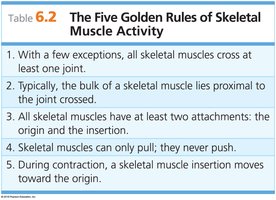
The Five Golden Rules of Skeletal Muscle Activity
Understanding skeletal muscle activity is essential for grasping how the body produces movement. The following five rules summarize the fundamental principles of skeletal muscle function:
Rule 1: With few exceptions, all skeletal muscles cross at least one joint.
Rule 2: The bulk of a skeletal muscle typically lies proximal to the joint it crosses.
Rule 3: All skeletal muscles have at least two attachments: the origin (fixed point) and the insertion (movable point).
Rule 4: Skeletal muscles can only pull; they never push.
Rule 5: During contraction, a skeletal muscle's insertion moves toward its origin.
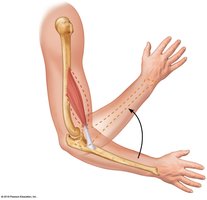
Muscle Attachments: Origin and Insertion
Muscles are attached to bones at two or more points. The origin is the attachment to an immovable or less movable bone, while the insertion is attached to a movable bone. When a muscle contracts, the insertion moves toward the origin, producing movement across a joint.
Types of Body Movements
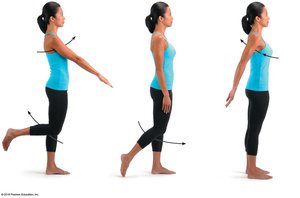
Flexion, Extension, and Hyperextension
Body movements occur when muscles contract across joints. The main types of angular movements include:
Flexion: Decreases the angle of the joint, bringing two bones closer together. Common in hinge joints (e.g., knee, elbow) and ball-and-socket joints (e.g., hip).
Extension: Increases the angle between two bones, typical of straightening the elbow or knee.
Hyperextension: Extension beyond the anatomical position (greater than 180°).
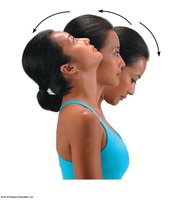
Rotation
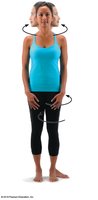
Rotation is the movement of a bone around its longitudinal axis. This is common in ball-and-socket joints, such as the shoulder and hip, and also occurs when shaking the head "no" (atlas and axis vertebrae).
Abduction, Adduction, and Circumduction
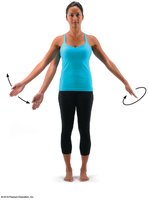
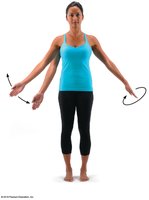
Abduction: Movement of a limb away from the midline of the body.
Adduction: Movement of a limb toward the midline of the body.
Circumduction: A circular movement that combines flexion, extension, abduction, and adduction, common in ball-and-socket joints.
Special Movements of the Body
Dorsiflexion: Lifting the foot so that its superior surface approaches the shin.
Plantar Flexion: Pointing the toes away from the head.
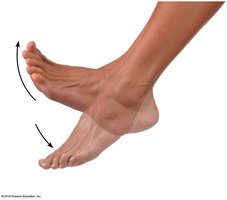
Inversion: Turning the sole of the foot medially.
Eversion: Turning the sole of the foot laterally.
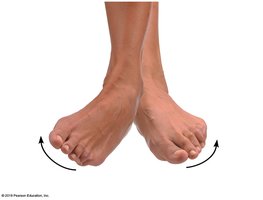
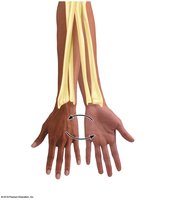
Supination: Rotating the forearm laterally so the palm faces anteriorly; radius and ulna are parallel.
Pronation: Rotating the forearm medially so the palm faces posteriorly; radius and ulna cross.
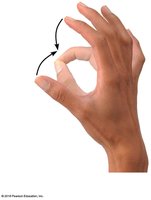
Opposition: Moving the thumb to touch the tips of other fingers on the same hand, a movement unique to humans and some primates.
Interactions of Skeletal Muscles in the Body
Muscle Roles
Muscles work in groups to produce coordinated movements. The main roles include:
Prime Mover (Agonist): The muscle with the major responsibility for a specific movement.
Antagonist: The muscle that opposes or reverses a prime mover.
Synergist: A muscle that aids a prime mover or reduces undesirable movements.
Fixator: Specialized synergists that stabilize the origin of a prime mover.
Naming Skeletal Muscles
Criteria for Naming Muscles
Skeletal muscles are named based on several criteria:
Direction of muscle fibers: e.g., rectus (straight)
Relative size: e.g., maximus (largest)
Location: e.g., temporalis (over temporal bone)
Number of origins: e.g., triceps (three heads)
Location of origin and insertion: e.g., sternocleidomastoid (originates on sternum and clavicle, inserts on mastoid process)
Shape: e.g., deltoid (triangular)
Action: e.g., flexor (flexes a bone), extensor (extends a bone)
Developmental Aspects of the Muscular System
Muscle Development and Health
Muscle control develops as the nervous system matures, typically in a superior/inferior and proximal/distal direction. Regular exercise is essential for maintaining muscle health; without it, muscles atrophy, while vigorous exercise leads to hypertrophy. Aging results in decreased muscle mass and increased sinewiness, but exercise can help retain muscle strength and mass.
