 Back
Skeletal Muscles: Origins, Insertions, and Actions
Study Guide - Smart Notes
 Tailored notes based on your materials, expanded with key definitions, examples, and context.
Skeletal Muscles: Origins, Insertions, and Actions
Introduction to Skeletal Muscles
Skeletal muscles are specialized tissues responsible for voluntary movements of the human body. They are attached to bones via tendons and function by contracting to produce movement at joints. Each skeletal muscle is characterized by its origin (the fixed attachment), insertion (the movable attachment), and action (the specific movement produced). Understanding these aspects is fundamental for identifying muscle function and anatomical location.
Appendicular Muscles
Anterior Upper Extremity Muscles
Deltoid: Origin: Clavicle, acromion process Insertion: Diaphysis of humerus Action: Arm abduction (lifting the arm away from the body)
Biceps Brachii: Origin: Coracoid process Insertion: Radial tuberosity Action: Elbow flexion (bending the elbow)
Brachialis: Origin: Distal humerus Insertion: Coronoid process Action: Lifts ulna with elbow flexion
Brachioradialis: Origin: Distal humerus Insertion: Styloid process of the radius Action: Lifts radius with elbow flexion
Anterior Thigh Muscles
Tensor Fascia Latae: Origin: Iliac crest Insertion: Iliotibial tract Action: Steadies the knee during walking
Rectus Femoris: Origin: Anterior iliac spine Insertion: Patella and tibial tuberosity Action: Extends the knee and flexes the thigh at the hip
Vastus Lateralis: Origin: Greater trochanter Insertion: Patella and tibial tuberosity Action: Extends the knee
Vastus Medialis: Origin: Diaphysis of femur Insertion: Patella and tibial tuberosity Action: Extends the knee
Sartorius: Origin: Anterior iliac spine Insertion: Proximal tibia Action: Flexes, abducts, and laterally rotates the thigh
Gracilis: Origin: Pubis, ischium Insertion: Medial tibia Action: Adducts the thigh
Anterior Leg Muscle
Tibialis Anterior: Origin: Tibia Insertion: Medial cuneiform, 1st metatarsal Action: Dorsiflexion (lifting the foot upwards)
Posterior Upper Extremity Muscle
Triceps Brachii: Origin: Posterior humerus Insertion: Olecranon process Action: Extends the elbow
Posterior Thigh Muscles
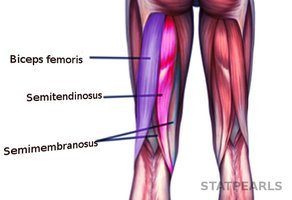
The posterior thigh muscles, also known as the hamstring group, are essential for knee flexion and hip extension. They include the biceps femoris, semitendinosus, and semimembranosus.
Biceps Femoris: Origin: Ischial tuberosity Insertion: Fibula Action: Flexes the knee and extends the thigh
Semitendinosus: Origin: Ischial tuberosity Insertion: Tibia Action: Flexes the knee and extends the thigh
Semimembranosus: Origin: Ischial tuberosity Insertion: Tibia Action: Flexes the knee and extends the thigh
Posterior Leg Muscles
Gastrocnemius: Origin: Distal femur Insertion: Calcaneus (heel bone) Action: Plantar flexion (pointing the foot downward)
Soleus: Origin: Fibula, tibia Insertion: Calcaneus Action: Plantar flexion
Summary Table: Major Appendicular Muscles
Muscle | Origin | Insertion | Action |
|---|---|---|---|
Deltoid | Clavicle, acromion process | Diaphysis of humerus | Arm abduction |
Biceps Brachii | Coracoid process | Radial tuberosity | Elbow flexion |
Rectus Femoris | Anterior iliac spine | Patella, tibial tuberosity | Extends knee, flexes thigh |
Biceps Femoris | Ischial tuberosity | Fibula | Flexes knee, extends thigh |
Gastrocnemius | Distal femur | Calcaneus | Plantar flexion |
Additional info: The above table summarizes the main origin, insertion, and action for selected appendicular muscles, which are critical for movement and stability of the limbs.
