 Back
BackSolubility and Complex Ions: Principles, Calculations, and Applications
Study Guide - Smart Notes
 Tailored notes based on your materials, expanded with key definitions, examples, and context.
Solubility and Complex Ions
Introduction to Solubility Equilibria
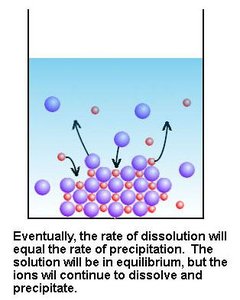
Solubility equilibria describe the dynamic balance between a solid and its dissolved ions in a solution. Understanding these equilibria is essential for predicting the formation of precipitates and the behavior of ionic compounds in aqueous solutions.
Solution: A homogeneous mixture of two or more substances, typically consisting of a solvent (present in larger amount) and a solute (present in smaller amount).
Types of Solutions:
Unsaturated Solution: Contains less solute than the maximum amount that can dissolve at a given temperature ("dilute").
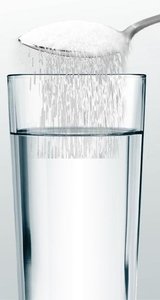
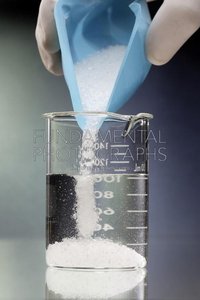
Saturated Solution: Contains the maximum amount of solute that will dissolve at a specific temperature ("concentrated").
Supersaturated Solution: Contains more solute than is present in a saturated solution; unstable and can precipitate excess solute.
Solubility: The maximum amount of solute that can be dissolved in a given amount of solvent at a specific temperature, usually expressed in g/L or mol/L.

Solubility Product Constant (Ksp)
The solubility product constant, Ksp, quantifies the equilibrium between a solid and its ions in a saturated solution. It is specific for each ionic compound at a given temperature.
General Form: For a salt AB that dissociates as AB(s) ↔ A+(aq) + B-(aq):
Solids and liquids do not appear in the equilibrium expression because their concentrations are constant.
Magnitude of Ksp: Indicates the extent of solubility; a larger Ksp means greater solubility.
Calculating Ion Concentrations Using Ksp
To determine the concentration of ions in equilibrium with a solid, set up the balanced dissociation equation and substitute known values into the Ksp expression.
Example: For SrCrO4 (s) ↔ Sr2+ (aq) + CrO42- (aq),
If M and , then:
M
Predicting Precipitate Formation: The Ion Product (Q)
The ion product (Q) is calculated like Ksp but uses initial (not equilibrium) concentrations. Comparing Q to Ksp predicts whether a precipitate will form:
Q < Ksp: No precipitate forms; the solution is unsaturated.
Q > Ksp: Precipitate forms; the solution is supersaturated.
Q = Ksp: The solution is saturated; no further precipitation or dissolution occurs.
Solubility and Molar Solubility
Molar solubility (s) is the number of moles of solute that dissolve per liter of solution to form a saturated solution. The relationship between Ksp and s depends on the stoichiometry of the dissociation reaction.
For AgCl:
For Cu(OH)2:
Solubility (g/L) can be calculated by multiplying molar solubility by the molar mass (MM):
Factors Affecting Solubility
Several factors influence the solubility of ionic compounds in water:
Common Ion Effect: The presence of a common ion decreases solubility due to Le Chatelier's principle.
Complex Ion Formation: The formation of complex ions increases solubility by removing ions from solution.
pH: Acidic salts are more soluble in basic solutions, and basic salts are more soluble in acidic solutions.
Equilibria Involving Complex Ions
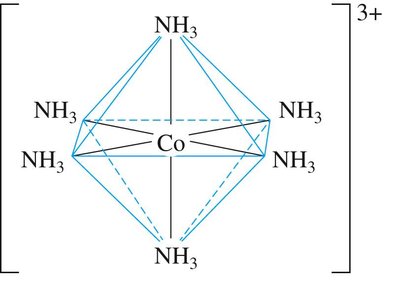
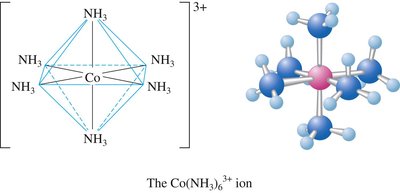
A complex ion is a charged species consisting of a central metal ion bonded to molecules or anions called ligands. The equilibrium constant for complex ion formation is called the formation constant (Kf).
Example:
Complex ion formation increases the solubility of otherwise insoluble salts.
Summary Table: Ksp Expressions for Various Compounds
Compound | Dissociation | Ksp Expression |
|---|---|---|
AgCl | AgCl ↔ Ag+ + Cl- | |
Cu(OH)2 | Cu(OH)2 ↔ Cu2+ + 2OH- | |
Ag2CrO4 | Ag2CrO4 ↔ 2Ag+ + CrO42- | |
Al(OH)3 | Al(OH)3 ↔ Al3+ + 3OH- | |
Fe2S3 | Fe2S3 ↔ 2Fe3+ + 3S2- |
Additional info: The table above summarizes the relationship between the stoichiometry of dissociation and the Ksp expression for common ionic compounds.
Solubility Rules
Solubility rules help predict whether a precipitate will form when two solutions are mixed. These rules are based on empirical observations of ionic compound solubility in water.
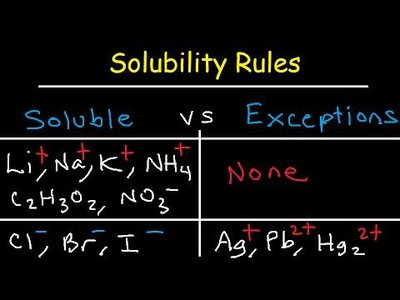
Most salts of alkali metals (Li+, Na+, K+, NH4+) and nitrates (NO3-) are soluble.
Chlorides, bromides, and iodides are generally soluble except with Ag+, Pb2+, and Hg22+.
Worked Example: Precipitate Formation
Example: Will a precipitate form when 200 mL of 0.20 M NaOH is added to 1 L of 0.10 M CaCl2?
Calculate final concentrations after mixing (total volume = 1200 mL):
M
M
Calculate Q:
Since (), a precipitate will form.
Summary Table: Factors Affecting Solubility
Factor | Effect on Solubility |
|---|---|
Common Ion Effect | Decreases solubility |
Complex Ion Formation | Increases solubility |
pH (Acidic/Basic) | Acidic salts more soluble in base; basic salts more soluble in acid |
Summary
Solubility equilibria are governed by the solubility product constant (Ksp).
Precipitate formation can be predicted by comparing the ion product (Q) to Ksp.
Factors such as common ions, complex ion formation, and pH significantly affect solubility.
Complex ions increase the solubility of sparingly soluble salts by forming stable species in solution.
