 Back
BackSpecial Senses: Anatomy, Physiology, and Clinical Relevance
Study Guide - Smart Notes
 Tailored notes based on your materials, expanded with key definitions, examples, and context.
Special Senses
Overview of the Special Senses
The special senses include smell, taste, vision, hearing, and equilibrium (balance). Each sense relies on specialized receptor organs, neural pathways, and interpretation by the brain. These senses are essential for communication, orientation, nutrition, mobility, safety, and independence, making them highly relevant in nursing care.
Smell (Olfaction)
Taste (Gustation)
Vision
Hearing
Equilibrium (Balance)
Types of Sensory Receptors
Different senses utilize distinct types of sensory receptors:
Chemoreceptors — detect chemical stimuli (smell and taste)
Photoreceptors — detect light (vision)
Mechanoreceptors — detect mechanical changes (hearing and balance)
Smell (Olfaction)
Anatomy of Olfaction
The sense of smell enables detection of food, recognition of danger, enjoyment of pleasant odors, and contributes to flavor and appetite. The olfactory system consists of several key structures:
Nasal cavity
Olfactory epithelium
Lamina propria
Olfactory receptor neurons
Olfactory bulb
Olfactory receptors are specialized neurons located in the olfactory epithelium. Their cilia project into mucus, where they detect chemicals dissolved in the mucus and send impulses to the brain.
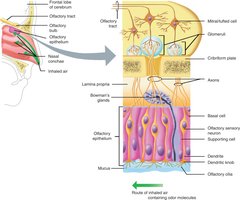
Physiology of Smell
Odorant molecules dissolve in the mucus of the nasal cavity and bind to olfactory receptors. This triggers electrical impulses that travel via the olfactory nerve to the olfactory bulb and then to the brain for interpretation.
Clinical Relevance in Nursing
Changes in smell can affect appetite, nutrition, enjoyment of food, detection of environmental danger, and overall quality of life.
Taste (Gustation)
Anatomy of Taste
Taste allows us to enjoy food and drink, detect harmful substances, stimulate appetite, and work with smell to create flavor. The sense of taste is associated with taste buds, which are sensory receptors found mainly on the tongue and oral cavity. The rough feel of the tongue is due to these projections.
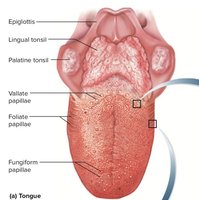
Taste Buds
Taste buds are located in peg-like projections of the tongue's mucosa. There are three major cell types in taste buds:
Supporting cells — form the majority of the taste bud
Gustatory (taste) cells — chemoreceptors responsible for sensing taste
Basal cells — stem cells that mature into new receptor cells
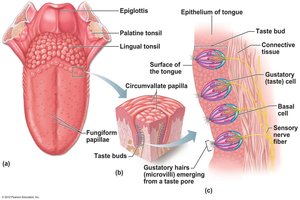
Physiology of Taste
Taste occurs when chemicals from food dissolve in saliva and contact gustatory cells in the taste buds. These cells generate nerve impulses that are sent to the brain for interpretation.
Clinical Relevance in Nursing
Altered taste can lead to poor appetite, reduced food intake, weight loss, malnutrition risk, and reduced enjoyment of eating.
Vision
Importance and Anatomy of Vision
Vision is the most studied sense, with nearly 70% of all sensory receptors located in the eyes. It is crucial for mobility, communication, reading, self-care, medicine safety, and environmental awareness.
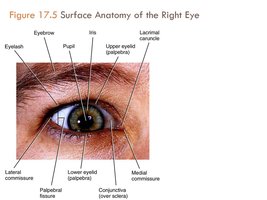
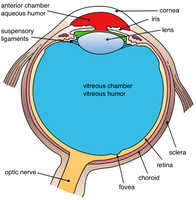
Internal Structure of the Eyeball
The wall of the eye consists of three layers:
Fibrous layer — includes the cornea and sclera
Vascular layer — includes the iris and choroid
Neural layer — includes the retina
Key structures: cornea, iris, lens, retina, optic nerve.
Photoreceptors
Rods — function in dim light, support night vision, do not detect color well
Cones — function in bright light, detect color, provide sharp visual detail
Lens and Eye Chambers
Lens — refracts light and focuses images on the retina
Anterior segment — contains aqueous humor
Posterior segment — contains vitreous humor
Clinical Relevance in Nursing
Visual impairment may increase falls risk, affect mobility, reading, medicine safety, and independence.
Common Disorders Affecting Vision
Cataract — clouding of the lens
Glaucoma — increased intraocular pressure damaging the optic nerve
Myopia — nearsightedness
Hyperopia — farsightedness
Astigmatism — irregular curvature of the cornea or lens
Color blindness — inability to distinguish certain colors
Night blindness — poor vision in low light
Hearing
Importance and Anatomy of Hearing
Hearing is essential for communication, environmental awareness, safety, social interaction, and emotional wellbeing. The ear is divided into external, middle, and inner regions, each with specialized structures for sound transmission and detection.
Types of Hearing Loss
Conductive hearing loss — problem transmitting sound through the external or middle ear (e.g., wax, infection, otosclerosis)
Sensorineural hearing loss — problem in the inner ear or auditory nerve (e.g., damage to receptors or nerves)
Clinical Relevance in Nursing
Hearing impairment may affect communication, consent, understanding of instructions, confidence, and social interaction.
Nursing actions: face the patient, reduce background noise, speak clearly, check understanding.
Equilibrium (Balance)
Anatomy and Physiology of Balance
Balance depends on the vestibular apparatus in the inner ear, vision, proprioception, and brain integration of sensory input. The vestibular apparatus includes the vestibule (for static equilibrium) and semicircular canals (for dynamic equilibrium).
Static equilibrium — detects head position when the body is still; receptors are in the vestibule
Dynamic equilibrium — detects rotational movement of the head; receptors are in the semicircular canals
Problems Affecting Equilibrium
Dizziness
Vertigo
Nausea
Unsteadiness
Falls
Examples: inner ear disorders, Ménière’s syndrome, neurological problems
Clinical Relevance in Nursing
Balance disorders increase risk of falls, injury, loss of confidence, reduced independence, and mobility.
Nursing priorities: assess falls risk, support safe mobilization, observe dizziness or vertigo, escalate concerning symptoms.
Summary
The special senses are smell, taste, vision, hearing, and balance. Each sense depends on specialized receptors and neural pathways. Disorders can affect safety, communication, mobility, and nutrition. Nurses must recognize sensory impairment and adapt care appropriately.
Recap Questions
What is the difference between rods and cones?
Why can sensory loss increase patient risk?
What is the difference between conductive and sensorineural hearing loss?
How can altered taste affect patient care?
