 Back
BackSpinal Cord and Spinal Nerves: Structure, Function, and Protection
Study Guide - Smart Notes
 Tailored notes based on your materials, expanded with key definitions, examples, and context.
Spinal Cord and Spinal Nerves
Spinal Cord Protection
The spinal cord is protected by several anatomical structures that ensure its integrity and function. These include bony protection, meninges, and specialized ligaments.
Bony Protection: The vertebral canal houses the spinal cord, shielding it from external injury.
Meninges: Three connective tissue layers surround the spinal cord and brain:
Dura mater: Outermost, dense irregular fibrous connective tissue. Extends from the foramen magnum to S2. Surrounded by the epidural space (contains fatty tissue).
Subdural space: Potential space between dura and arachnoid mater; may fill with blood after trauma (subdural hematoma).
Arachnoid mater: Middle, web-like layer. Thinner than dura, made of fibrous and elastic tissue. The subarachnoid space (between arachnoid and pia) contains cerebrospinal fluid (CSF).
Pia mater: Innermost, highly vascular, adheres to spinal cord. Denticulate ligaments (lateral extensions) stabilize the cord.
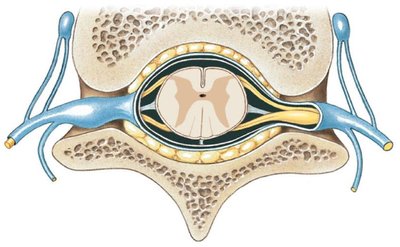
External Anatomy of the Spinal Cord
The spinal cord's external features are important for understanding its function and clinical relevance.
Length: Extends from the foramen magnum to L1; about ¾ inch in diameter.
Conus medullaris: Tapered end of the cord.
Cervical and Lumbar Enlargements: Widenings where nerves for upper and lower limbs emerge.
Cauda equina: "Horse's tail" of nerve roots extending below the cord.
Filum terminale: Extension of pia mater anchoring the cord to the coccyx.
Anterior median fissure: Deep groove on the anterior surface.
Posterior median sulcus: Shallower groove on the posterior surface.
Internal Anatomy of the Spinal Cord
The spinal cord's internal structure consists of gray and white matter, each with distinct functions.
Gray Matter: Butterfly-shaped region containing cell bodies, neuroglia, and unmyelinated axons.
Posterior (Dorsal) horn: Receives sensory input.
Anterior (Ventral) horn: Contains motor neuron cell bodies (lower motor neurons).
Lateral horn: Origin of autonomic (sympathetic and parasympathetic) efferent nerves.
Gray commissure: Crossbar connecting right and left sides (association/interneurons).
Central canal: Runs lengthwise, continuous with the brain's 4th ventricle, contains CSF.
White Matter: Surrounds gray matter, composed of myelinated axons (motor and sensory).
Regions: Anterior, posterior, and lateral columns.
Specific Tracts of the White Matter
White matter contains ascending and descending tracts that transmit sensory and motor information.
Ascending Tracts: Carry sensory information to the brain.
Anterior Spinothalamic tract: Touch and pressure.
Lateral Spinothalamic tract: Pain and temperature.
Fasciculus cuneatus and gracilis: Discriminative touch, proprioception, vibration, stereognosis, and weight discrimination.
Descending Tracts: Carry motor information from the brain.
Anterior corticospinal tract: Controls trunk muscles.
Lateral corticospinal tract: Controls extremity muscles.
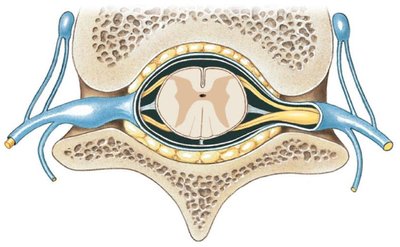
Spinal Nerve Anatomy
Spinal nerves are essential for communication between the spinal cord and the body. There are 31 pairs, each with specific roots and branches.
Spinal Nerves: 8 cervical, 12 thoracic, 5 lumbar, 5 sacral, 1 coccygeal.
Posterior (Dorsal) root: Sensory fibers entering the dorsal horn; contains dorsal root ganglion (cell bodies of unipolar sensory neurons).
Anterior (Ventral) root: Motor fibers leaving the ventral horn.
Branches of a Typical Spinal Nerve
After exiting the vertebral column, spinal nerves divide into several branches, each serving different regions.
Posterior (Dorsal) ramus: Supplies muscles and skin of the posterior trunk.
Anterior (Ventral) ramus: Supplies anterior/lateral trunk and extremities; forms plexi (cervical, brachial, lumbar, sacral).
Rami Communicantes: Contains visceral efferents for smooth muscle and glands.
Spinal Nerve Coverings
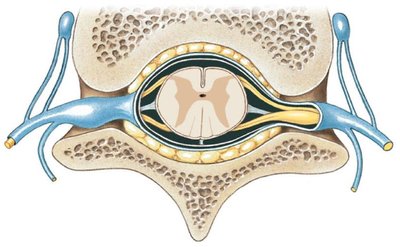
Spinal nerves are protected by three connective tissue layers:
Epineurium: Surrounds entire nerve; continuous with dura mater.
Perineurium: Surrounds groups of nerve fibers (fascicles).
Endoneurium: Surrounds individual nerve fibers.
Plexi and Nerves of the Body
Spinal nerves form plexi that innervate specific regions and muscles.
Cervical Plexus (C1-C5): Skin and muscles of head, neck, upper shoulders. Phrenic nerve innervates the diaphragm.
Brachial Plexus (C5-T1): Skin and muscles of upper extremity. Includes musculocutaneous, median, ulnar, axillary, and radial nerves.
Thoracic Nerves (T2-T12): Intercostal nerves; motor to intercostal spaces, posterior trunk, upper abdominal muscles; sensory to thorax skin.
Lumbar Plexus (L1-L4): Skin and muscles of abdomen, genitals, anterior/medial thigh. Femoral nerve innervates iliopsoas, pectineus, sartorius, quadriceps.
Sacral Plexus (L4-S4): Skin and muscles of buttock, perineum, posterior thigh, leg, and foot. Includes sciatic, tibial, superficial and deep peroneal nerves.
Reflexes
Reflexes are rapid, automatic responses to environmental changes, mediated by a reflex arc.
Reflex: Fast, predictable, automatic response; inherent, not learned.
Reflex Arc Components:
Receptor: Senses environmental changes (e.g., free nerve endings, Pacinian corpuscles, Merkel's discs, muscle spindles, Golgi tendon organs).
Sensory neuron: Transmits information from receptor to spinal cord.
Integrating center: Region in brain or spinal cord; relays information to motor neurons or other neurons.
Motor neuron: Sends motor information from ventral horn to effector.
Effector: Body part responding to motor neuron.
