 Back
Stages and Mechanisms of Labor and Parturition
Study Guide - Smart Notes
 Tailored notes based on your materials, expanded with key definitions, examples, and context.
Parturition and the Stages of Labor
Overview of Parturition
Parturition is the process of giving birth, marking the culmination of pregnancy. It typically occurs within a week of the calculated due date, which is estimated from the last menstrual period. The sequence of events that expel the fetus from the uterus is collectively known as labor.
Labor is divided into three main stages: dilation, expulsion, and placental stages.
The fetus plays a major role in determining the timing of birth through hormonal signaling.
Initiation of Labor: Hormonal and Physiological Mechanisms
Hormonal Cascade Leading to Labor
The initiation of labor is a complex process involving both fetal and maternal factors. The maturation of the fetal hypothalamus and adrenal glands triggers a hormonal cascade that prepares the uterus for labor.
Fetal CRH (Corticotropin-Releasing Hormone) increases, stimulating the fetal adrenal glands to release more cortisol.
Fetal cortisol enhances placental CRH production, creating a positive feedback loop and leading to a rapid rise in fetal cortisol levels.
High fetal cortisol levels promote final maturation of the fetal lungs and increase the production of surfactant protein A (SP-A), signaling readiness for birth.
Placental estrogen production rises sharply, while progesterone action decreases due to receptor changes.
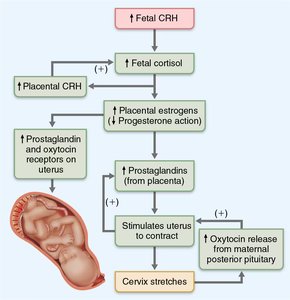
Estrogens prepare the cervix for dilation by increasing prostaglandin synthesis and receptor expression, leading to cervical softening and thinning.
Estrogens also prepare the myometrium (uterine muscle) for contraction by increasing synthesis of contractile proteins and gap junctions, making the uterus more excitable.
Prostaglandins and oxytocin become the primary chemical messengers driving uterine contractions during true labor.
Braxton Hicks contractions are weak, irregular contractions that may occur before true labor, often referred to as "false labor." True labor is characterized by strong, regular contractions that lead to cervical dilation and delivery.
Stages of Labor
Dilation Stage
The dilation stage is the period from the onset of labor until the cervix is fully dilated (about 10 cm in diameter). It is the longest stage of labor.
Contractions begin in the upper uterus and move downward, initially spaced far apart and lasting short durations.
As labor progresses, contractions become more frequent and intense, involving the lower uterus as well.
The cervix softens, thins (effaces), and dilates under the pressure of the baby's head.
The amnion ruptures, releasing amniotic fluid ("water breaking").
Engagement occurs when the baby's head enters the true pelvis, and the head rotates to navigate the birth canal.
Expulsion Stage
The expulsion stage lasts from full cervical dilation to the delivery of the infant.
Strong contractions occur every 2–3 minutes, lasting about 1 minute each.
The urge to push increases as the baby's head descends.
Crowning is when the largest part of the baby's head distends the vulva.
An episiotomy (surgical incision) may be performed to prevent tissue tearing.
After the head is delivered, the rest of the body follows quickly, and the umbilical cord is clamped and cut.
Vertex presentation (head-first) is the most common and safest for delivery. Breech presentation (buttocks or feet first) complicates delivery and may require forceps or a cesarean section (C-section).
Placental Stage
The placental stage involves the delivery of the placenta and fetal membranes (afterbirth), usually within 30 minutes after the infant's birth.
Continued uterine contractions compress blood vessels, limit bleeding, and detach the placenta from the uterine wall.
The umbilical cord is examined to ensure the presence of two arteries and one vein; abnormalities may indicate cardiovascular issues in the newborn.
Clinical Considerations and Homeostatic Imbalances
Dystocia and Cesarean Section
Dystocia is prolonged and difficult labor, often due to a deformed or narrow pelvis. It can lead to maternal fatigue and fetal brain damage (e.g., cerebral palsy or epilepsy). In such cases, a cesarean section (C-section) is performed, involving surgical delivery through the abdominal and uterine walls.
Role of Prostaglandins and Clinical Interventions
Prostaglandins are essential for initiating labor; drugs that inhibit prostaglandin synthesis (e.g., ibuprofen) can delay labor and are sometimes used to prevent preterm birth.
Key Terms and Concepts
Parturition: The act of giving birth.
Labor: The process of expelling the fetus from the uterus, divided into dilation, expulsion, and placental stages.
Breech presentation: Delivery position where the baby's buttocks or feet are presented first instead of the head.
Prostaglandins: Hormones that play a major role in cervical ripening and uterine contractions.
Oxytocin: A hormone released from the maternal posterior pituitary that stimulates uterine contractions.
Summary Table: Stages of Labor
Stage | Main Events | Duration |
|---|---|---|
Dilation | Cervix dilates to 10 cm, contractions begin, amniotic sac ruptures | 6–12 hours or more |
Expulsion | Delivery of infant, crowning, umbilical cord cut | 20–50 minutes (first birth), shorter in subsequent births |
Placental | Delivery of placenta and membranes (afterbirth) | Within 30 minutes after birth |
Check Your Understanding
What is a breech presentation? Answer: A breech presentation is when the baby is positioned to deliver buttocks or feet first, rather than head first.
What chemical is most responsible for triggering true labor? Answer: Prostaglandins are most responsible for triggering true labor, with oxytocin also playing a key role.
