 Back
Step-by-Step Guidance for Anatomy and Physiology Practice Exam (NURS1022)
Study Guide - Smart Notes
 Tailored notes based on your materials, expanded with key definitions, examples, and context.
Q22. From what structure does sensible perspiration occur?
Background
Topic: Integumentary System
This question tests your understanding of the skin's accessory structures and their functions, specifically sweat glands and their role in perspiration.
Key Terms:
Sensible perspiration: Sweat that is produced by sweat glands and can be detected as moisture on the skin.
Accessory structures: Includes hair, glands, and other components embedded in the skin.
Step-by-Step Guidance
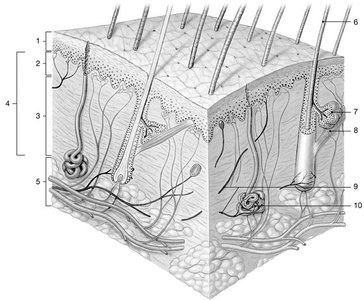
Examine the labeled structures in the provided diagram of the integumentary system.
Recall that sensible perspiration is produced by sweat glands, specifically the eccrine (merocrine) glands.
Identify which numbered structure in the diagram corresponds to the sweat gland responsible for sensible perspiration.
Compare the location and appearance of each labeled structure to determine which is the sweat gland.
Try solving on your own before revealing the answer!
Final Answer: Structure 10 (Sweat gland)
Sensible perspiration occurs from the sweat gland, which is labeled as structure 10 in the diagram. These glands are responsible for producing sweat that helps regulate body temperature.
Q23. Which layer is the primary barrier against environmental hazards?
Background
Topic: Skin Structure and Function
This question tests your knowledge of the layers of the skin and their protective functions.
Key Terms:
Epidermis: The outermost layer of the skin, providing a barrier against pathogens, chemicals, and physical damage.
Dermis: The middle layer, containing connective tissue, blood vessels, and accessory structures.
Hypodermis (subcutaneous layer): The deepest layer, mainly composed of fat and connective tissue.
Step-by-Step Guidance
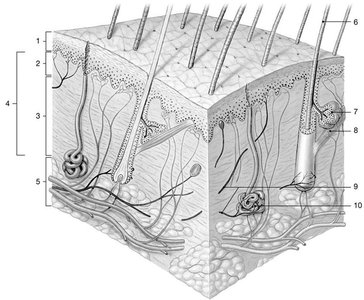
Review the diagram and identify the labeled layers of the skin.
Recall which layer is most exposed to the environment and acts as the primary barrier.
Consider the functions of each layer: protection, sensation, and insulation.
Match the labeled numbers to the correct anatomical layer.
Try solving on your own before revealing the answer!
Final Answer: Layer 1 (Epidermis)
The epidermis, labeled as layer 1, is the primary barrier against environmental hazards. It protects underlying tissues from pathogens, chemicals, and physical injury.
Q90. Identify the structure labeled "19."
Background
Topic: Cardiovascular System – Heart Anatomy
This question tests your ability to identify specific anatomical structures of the heart, particularly the valves that regulate blood flow.
Key Terms:
Pulmonary semilunar valve: Valve between the right ventricle and the pulmonary artery, preventing backflow into the ventricle.
Heart valves: Structures that ensure unidirectional blood flow through the heart chambers.
Step-by-Step Guidance
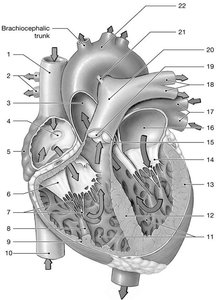
Examine the heart diagram and locate the structure labeled "19."
Recall the anatomical position and function of each heart valve.
Compare the labeled structure to the typical location of the pulmonary semilunar valve.
Consider the direction of blood flow from the right ventricle to the pulmonary artery.
Try solving on your own before revealing the answer!
Final Answer: Pulmonary semilunar valve
The structure labeled "19" is the pulmonary semilunar valve, which prevents backflow of blood from the pulmonary artery into the right ventricle.
