 Back
Step-by-Step Guidance for Human Anatomy and Physiology Workbook (Module 1)
Study Guide - Smart Notes
 Tailored notes based on your materials, expanded with key definitions, examples, and context.
Q1. List the general function and main organs of each human organ system.
Background
Topic: Human Organ Systems
This question tests your knowledge of the major organ systems in the human body, their primary functions, and the main organs that comprise each system.
Key Terms:
Organ system: A group of organs that work together to perform one or more functions.
Examples: Integumentary, Skeletal, Muscular, Nervous, Respiratory, Digestive, Cardiovascular, Immune, Endocrine, Reproductive, Urinary.
Step-by-Step Guidance
Review your textbook or lecture notes to identify each organ system listed.
For each system, write a brief summary of its main function (e.g., protection, movement, communication).
List the primary organs associated with each system (e.g., skin for integumentary, bones for skeletal).
Compare and contrast the systems to see how they interact or overlap in function.
Try solving on your own before revealing the answer!
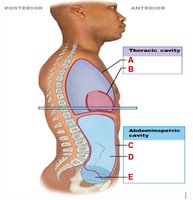
Q2. Label the major cavities of the body shown in figure 1. Name one organ found in each cavity.
Background
Topic: Body Cavities
This question assesses your ability to identify and name the major body cavities and recognize organs located within them.
Key Terms:
Body cavity: A space within the body that contains organs.
Thoracic cavity, abdominopelvic cavity, cranial cavity, spinal cavity, pelvic cavity.
Step-by-Step Guidance
Examine Figure 1 to identify the labeled cavities (A–E).
Match each label to the correct anatomical cavity (e.g., thoracic, abdominal).
Recall or look up one organ that is located in each cavity (e.g., heart in thoracic, stomach in abdominal).
Try solving on your own before revealing the answer!
Q3. What structure separates the thoracic and abdominal cavities and what tissue(s) is it made of? Bonus: Name the nerve(s) that innervate this structure.
Background
Topic: Anatomical Structures and Innervation
This question tests your understanding of the anatomical boundaries between major body cavities and the tissues and nerves involved.
Key Terms:
Diaphragm: The muscle that separates the thoracic and abdominal cavities.
Innervation: The supply of nerves to a structure.
Step-by-Step Guidance
Identify the structure that forms the boundary between the thoracic and abdominal cavities.
Describe the tissue composition of this structure (e.g., skeletal muscle).
Research or recall the nerve(s) responsible for innervating this structure.
Try solving on your own before revealing the answer!
Q4. What is the collective name for the contents of the anterior/ventral cavity?
Background
Topic: Body Cavities and Contents
This question asks you to recall the term used for the organs and structures within the ventral (anterior) cavity.
Key Terms:
Ventral cavity: The front body cavity, including thoracic and abdominopelvic cavities.
Viscera: The collective term for internal organs.
Step-by-Step Guidance
Review the definition of the ventral cavity and its subdivisions.
Recall the term used for the organs within these cavities.
Try solving on your own before revealing the answer!
Q5. What are the main functions of serous membranes? Give an example using one of the cavities in question 2.
Background
Topic: Serous Membranes
This question tests your understanding of the role of serous membranes in protecting and supporting organs within body cavities.
Key Terms:
Serous membrane: A thin membrane lining body cavities and covering organs.
Functions: Reduce friction, protect organs, produce serous fluid.
Step-by-Step Guidance
List the main functions of serous membranes (e.g., lubrication, protection).
Choose one cavity from question 2 and describe how serous membranes function there (e.g., pleura in thoracic cavity).
Try solving on your own before revealing the answer!
Q6. What clinical condition develops when air enters the potential space of the pleural membrane?
Background
Topic: Clinical Anatomy
This question tests your knowledge of pathological conditions related to the pleural membrane.
Key Terms:
Pleural membrane: The membrane surrounding the lungs.
Pneumothorax: Condition when air enters the pleural space.
Step-by-Step Guidance
Recall the anatomy of the pleural membrane and its function.
Identify what happens when air enters the pleural space.
Research or recall the clinical term for this condition.
Try solving on your own before revealing the answer!
Q7. What is the clinical condition called when the membrane of the abdominal cavity is inflamed?
Background
Topic: Clinical Anatomy
This question tests your knowledge of inflammation of the abdominal cavity membrane.
Key Terms:
Peritoneum: The membrane lining the abdominal cavity.
Inflammation: The body's response to injury or infection.
Step-by-Step Guidance
Recall the name of the membrane lining the abdominal cavity.
Identify the clinical term for inflammation of this membrane.
Try solving on your own before revealing the answer!
Q8. Identify all the major organs found in each of the following body cavities.
Background
Topic: Body Cavities and Organs
This question tests your ability to list the organs contained within specific body cavities.
Key Terms:
Cerebrospinal cavity, thoracic cavity, abdominal cavity, pelvic cavity.
Step-by-Step Guidance
Review the anatomical location of each cavity.
List the major organs found in each cavity (e.g., brain in cerebrospinal, lungs in thoracic).
Note any differences between male and female pelvic cavities.
Try solving on your own before revealing the answer!
Q9. How does an organ differ from a tissue? Give one example of a tissue and an organ.
Background
Topic: Levels of Organization
This question tests your understanding of the difference between tissues and organs.
Key Terms:
Tissue: A group of similar cells performing a specific function.
Organ: A structure composed of two or more types of tissues working together.
Step-by-Step Guidance
Define tissue and organ using your textbook or notes.
Provide one example of each (e.g., muscle tissue, heart as an organ).
Try solving on your own before revealing the answer!
Q10. Using the gastro-intestinal tract as an example, list the cavity/cavities in which organs of this system are found.
Background
Topic: Organ Systems and Body Cavities
This question tests your ability to locate organs of the digestive system within body cavities.
Key Terms:
Gastro-intestinal tract: The digestive system.
Abdominal cavity, pelvic cavity.
Step-by-Step Guidance
List the organs of the gastro-intestinal tract (e.g., stomach, intestines).
Identify which body cavities these organs are located in.
Try solving on your own before revealing the answer!
Q11. Do all organs of the body lie within a body cavity? If not, give an example.
Background
Topic: Anatomy and Organ Location
This question tests your understanding of organ placement in the body.
Key Terms:
Body cavity: Internal space containing organs.
Examples of organs outside cavities (e.g., kidneys).
Step-by-Step Guidance
Review the definition of body cavities.
Identify any organs that are not located within a cavity.
Try solving on your own before revealing the answer!
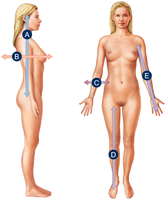
Q12. Match the letter in figure 2 to the correct anatomical directional term.
Background
Topic: Anatomical Directional Terms
This question tests your ability to use and understand directional terms in anatomy.
Key Terms:
Anterior/ventral, posterior/dorsal, caudal, cranial, distal, proximal, medial, lateral.
Step-by-Step Guidance
Study Figure 2 and identify the direction each letter represents.
Match each letter to the correct anatomical term (e.g., A = anterior).
Review definitions of each directional term.
Try solving on your own before revealing the answer!
Q13. Describe how the body is sectioned by the Frontal/Coronal, Sagittal, and Transverse planes. Where might we see this terminology used in health care?
Background
Topic: Anatomical Planes
This question tests your understanding of the three main anatomical planes and their relevance in health care.
Key Terms:
Frontal/Coronal plane: Divides body into anterior and posterior.
Sagittal plane: Divides body into left and right.
Transverse plane: Divides body into superior and inferior.
Step-by-Step Guidance
Define each anatomical plane and describe how it divides the body.
Give examples of how these planes are used in medical imaging or procedures.
Try solving on your own before revealing the answer!
Q14. Describe the position of each of the following using anatomical, directional terms: Ear (compared to the nose and chin), Elbow (compared to the wrist and shoulder), Vertebrae (compared to sternum and kidneys).
Background
Topic: Anatomical Position and Directional Terms
This question tests your ability to use directional terms to describe the location of body parts relative to others.
Key Terms:
Directional terms: Medial, lateral, proximal, distal, anterior, posterior.
Step-by-Step Guidance
For each pair, identify the correct directional term (e.g., ear is lateral to nose).
Use anatomical position as your reference point.
Try solving on your own before revealing the answer!
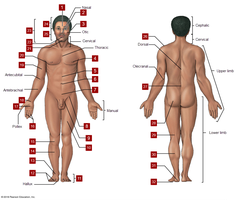
Q15. Match the label in figure 3 to the correct anatomical region.
Background
Topic: Anatomical Regions
This question tests your ability to identify and name anatomical regions of the body.
Key Terms:
Anatomical regions: Cephalic, sural, digits, gluteal, buccal, crural, pedal, pelvis, brachial, facial, calcaneal, mammary, patellar, inguinal, orbital, cranial, acromial, popliteal, carpal, oral, pubic, axillary, tarsal, palmar, femoral, mental, frontal, abdominal, lumbar, umbilical, plantar.
Step-by-Step Guidance
Study Figure 3 and locate each label.
Match each label to the correct anatomical region name.
Review definitions and locations of each region.
Try solving on your own before revealing the answer!
Q16. Identify the nine abdominal regions and quadrant names using your text as a reference.
Background
Topic: Abdominal Regions and Quadrants
This question tests your ability to name and locate the nine regions and four quadrants of the abdomen.
Key Terms:
Abdominal regions: Right/left hypochondriac, epigastric, right/left lumbar, umbilical, right/left iliac, hypogastric.
Quadrants: Right upper, left upper, right lower, left lower.
Step-by-Step Guidance
Review the diagram of abdominal regions and quadrants.
Identify and name each region and quadrant using prefixes, suffixes, and stem words.
Try solving on your own before revealing the answer!
