 Back
Step-by-Step Guidance for Muscle Contraction and Structure Questions
Study Guide - Smart Notes
 Tailored notes based on your materials, expanded with key definitions, examples, and context.
Q1. What are the steps of the cross-bridge cycle in skeletal muscle contraction?
Background
Topic: Skeletal Muscle Contraction Mechanism
This question tests your understanding of how myosin and actin interact during muscle contraction, specifically the sequence of events known as the cross-bridge cycle.
Key Terms and Formulas:
Cross-bridge: The connection formed between myosin heads and actin filaments.
Power stroke: The action of myosin pulling actin, causing muscle contraction.
ATP: The molecule required for detachment and re-cocking of the myosin head.
Step-by-Step Guidance
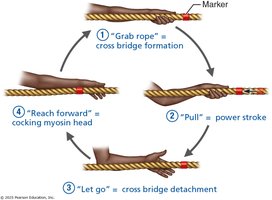
Start by identifying the four main steps in the cross-bridge cycle: cross-bridge formation, power stroke, cross-bridge detachment, and re-cocking of the myosin head.
Understand that ATP binding to myosin is necessary for detachment from actin, and ATP hydrolysis is required for the myosin head to re-cock.
Relate each step to the physical actions shown in the diagram: grabbing the rope (cross-bridge formation), pulling (power stroke), letting go (detachment), and reaching forward (re-cocking).
Think about how calcium ions regulate this process by exposing binding sites on actin.
Try solving on your own before revealing the answer!
Final Answer:
The cross-bridge cycle consists of four steps: (1) myosin head binds to actin (cross-bridge formation), (2) myosin pulls actin (power stroke), (3) myosin detaches from actin (cross-bridge detachment), and (4) myosin head re-cocks (ready for another cycle). ATP and calcium are essential for these steps.
This cycle repeats as long as calcium and ATP are available, resulting in muscle contraction.
Q2. What is the relationship between sarcomere structure and muscle contraction?
Background
Topic: Sarcomere Structure and Function
This question tests your ability to connect the microscopic structure of the sarcomere to the process of muscle contraction.
Key Terms and Formulas:
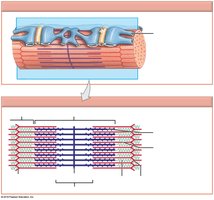
Sarcomere: The basic contractile unit of muscle, defined by Z-discs.
Actin (thin filament): Anchored to Z-discs, slides past myosin during contraction.
Myosin (thick filament): Located in the center of the sarcomere, forms cross-bridges with actin.
Step-by-Step Guidance
Identify the main components of the sarcomere: Z-discs, actin (thin filaments), myosin (thick filaments), and the bands/zones (A band, I band, H zone).
Understand that muscle contraction occurs when actin filaments slide past myosin filaments, shortening the sarcomere.
Relate the shortening of the sarcomere to the overall shortening of the muscle fiber and thus the muscle itself.
Consider how the arrangement of thick and thin filaments allows for repeated cross-bridge cycling and force generation.
Try solving on your own before revealing the answer!
Final Answer:
The sarcomere shortens during contraction as actin filaments slide past myosin filaments, bringing Z-discs closer together. This microscopic change results in the macroscopic shortening of the muscle.
The arrangement of filaments and bands is essential for efficient force production and muscle movement.
Q3. How do motor units contribute to muscle force and control?
Background
Topic: Motor Units and Muscle Force
This question tests your understanding of how groups of muscle fibers are controlled by motor neurons and how this affects muscle force and precision.
Key Terms and Formulas:
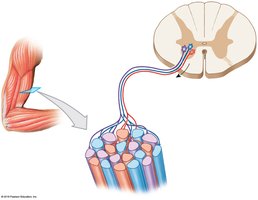
Motor unit: A single motor neuron and all the muscle fibers it innervates.
Innervation ratio: The number of muscle fibers per motor neuron.
Recruitment: The process of activating more motor units to increase muscle force.
Step-by-Step Guidance
Define a motor unit and understand its components: one motor neuron and the muscle fibers it controls.
Recognize that muscles with small motor units (few fibers per neuron) allow for fine control, while large motor units (many fibers per neuron) generate more force but less precision.
Understand that increasing muscle force involves recruiting more motor units, not just increasing the activity of a single unit.
Consider how the nervous system modulates force by varying the number and size of active motor units.
Try solving on your own before revealing the answer!
Final Answer:
Motor units are fundamental to muscle force and control. Small motor units allow for precise movements, while large motor units provide greater force. Recruitment of additional motor units increases muscle force.
The innervation ratio determines the muscle's ability for fine motor control versus powerful contractions.
