 Back
BackStructure and Function of Long Bones
Study Guide - Smart Notes
 Tailored notes based on your materials, expanded with key definitions, examples, and context.
Structure of Typical Long Bone
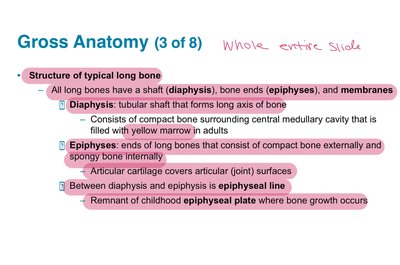
Main Components of Long Bones
Long bones are essential structural elements of the skeletal system, characterized by a distinct shaft, bone ends, and specialized membranes. Understanding their anatomy is crucial for comprehending bone growth, function, and pathology.
Diaphysis: The tubular shaft forming the long axis of the bone.
Consists of compact bone surrounding the central medullary cavity.
The medullary cavity is filled with yellow marrow in adults, which primarily stores fat.
Epiphyses: The ends of long bones.
Composed of compact bone externally and spongy bone internally.
Articular cartilage covers the joint surfaces, providing smooth movement and reducing friction.
Membranes: Specialized connective tissue layers surrounding and lining the bone.
Epiphyseal Line and Plate
The epiphyseal line is a remnant of the epiphyseal plate, which is the site of bone growth during childhood. This structure is critical for longitudinal bone development.
Epiphyseal Plate: A layer of hyaline cartilage where bone growth occurs in children and adolescents.
Epiphyseal Line: In adults, the plate is replaced by bone, forming the epiphyseal line.
Growth at the epiphyseal plate is regulated by hormones such as growth hormone.
Detailed Anatomy of Long Bone (Humerus Example)
Long Bone Structure: Humerus of Arm
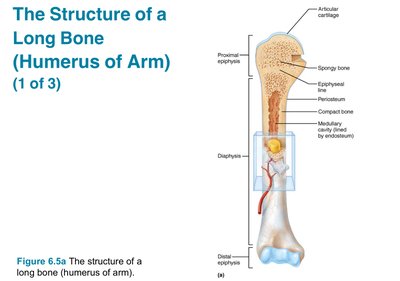
The humerus, a representative long bone, illustrates the typical anatomical features found in all long bones. These features are essential for understanding bone physiology and clinical conditions.
Proximal and Distal Epiphyses: The ends of the bone, containing spongy bone and covered by articular cartilage.
Diaphysis: The shaft, composed of compact bone and housing the medullary cavity.
Medullary Cavity: Contains yellow bone marrow in adults.
Periosteum: The membrane covering the outer surface of the bone.
Endosteum: The membrane lining the internal surfaces, including the medullary cavity.
Microscopic Structure: Compact and Spongy Bone
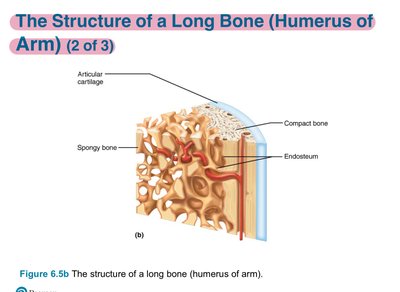
Long bones are composed of two main types of osseous tissue: compact bone and spongy bone. Each has distinct structural and functional properties.
Compact Bone: Dense and strong, forming the outer layer of the bone.
Spongy Bone: Porous and lightweight, found primarily in the epiphyses.
Endosteum: Lines the internal surfaces of the bone, including the spaces within spongy bone.
Articular Cartilage: Covers the surfaces where bones meet at joints, reducing friction and absorbing shock.
Key Terms and Definitions
Diaphysis: Shaft of a long bone.
Epiphysis: End of a long bone.
Epiphyseal Plate: Growth plate made of cartilage.
Epiphyseal Line: Remnant of the growth plate in adults.
Medullary Cavity: Central cavity containing bone marrow.
Periosteum: Membrane covering the bone's exterior.
Endosteum: Membrane lining the bone's interior.
Articular Cartilage: Cartilage covering joint surfaces.
Compact Bone: Dense bone tissue.
Spongy Bone: Porous bone tissue.
Summary Table: Structure of a Typical Long Bone
Component | Description | Main Function |
|---|---|---|
Diaphysis | Shaft; compact bone surrounding medullary cavity | Provides strength and support |
Epiphysis | Ends; compact bone externally, spongy bone internally | Forms joints, absorbs shock |
Epiphyseal Plate/Line | Cartilage plate (children); line (adults) | Site of bone growth |
Medullary Cavity | Central cavity in diaphysis | Contains yellow marrow (fat storage) |
Periosteum | Outer membrane | Protection, attachment for tendons/ligaments |
Endosteum | Inner membrane | Bone growth and remodeling |
Articular Cartilage | Cartilage covering joint surfaces | Reduces friction, absorbs shock |
Additional info:
Bone growth occurs at the epiphyseal plate through endochondral ossification, a process regulated by hormones.
Yellow bone marrow primarily stores fat, while red bone marrow (not shown here) is involved in blood cell production.
