 Back
Study Guidance for ANP Nervous System: Ions, Gradients, and Membrane Potentials
Study Guide - Smart Notes
 Tailored notes based on your materials, expanded with key definitions, examples, and context.
Q1. What is an electrochemical gradient, and how does it affect ion movement across a membrane?
Background
Topic: Electrochemical Gradients in Neurons
This question tests your understanding of how ions (such as sodium and potassium) move across cell membranes, driven by both electrical and concentration gradients. These gradients are fundamental to nerve cell function and the generation of membrane potentials.
Key Terms and Formulas:
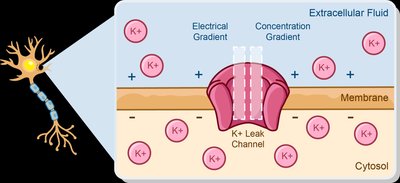
Electrochemical Gradient: The combined effect of the electrical gradient (charge difference) and concentration gradient (difference in ion concentration) across a membrane.
Electrical Gradient: Ions move toward areas of opposite charge.
Concentration Gradient: Ions move from areas of high concentration to low concentration.
Step-by-Step Guidance
Identify the two main forces acting on ions: the electrical gradient (charge difference) and the concentration gradient (difference in ion concentration).
Consider how each gradient would direct the movement of a specific ion (e.g., potassium or sodium) across the membrane.
Determine which gradient is stronger if they oppose each other; the stronger gradient will drive the net flow of ions.
Apply this reasoning to a scenario, such as potassium ions moving through a K+ channel, and predict the direction of movement based on both gradients.
Try solving on your own before revealing the answer!
Final Answer:
The electrochemical gradient is the sum of the electrical and concentration gradients. For potassium ions, the concentration gradient typically drives them out of the cell, while the electrical gradient pulls them back in. The net movement depends on which gradient is stronger.
Q2. How do sodium and potassium concentrations differ inside and outside a neuron, and what effect does this have on ion movement?
Background
Topic: Sodium and Potassium Distribution in Neurons
This question focuses on the typical distribution of sodium (Na+) and potassium (K+) ions in neurons and how these distributions create concentration gradients that drive ion movement.
Key Terms and Formulas:
Intracellular: Inside the cell
Extracellular: Outside the cell
Concentration Gradient: Drives ions from high to low concentration
Step-by-Step Guidance
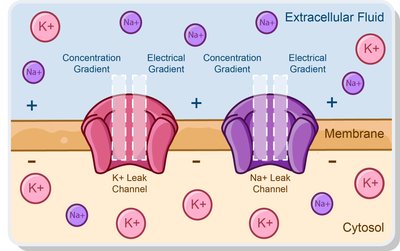
Recall that sodium (Na+) concentration is higher outside the cell, while potassium (K+) concentration is higher inside the cell.
Understand that the concentration gradient for sodium drives it into the cell, and for potassium, it drives it out of the cell.
Consider how the electrical gradient may affect these movements, often opposing or reinforcing the concentration gradient.
Apply this knowledge to predict the direction of ion flow for both sodium and potassium in a resting neuron.
Try solving on your own before revealing the answer!
Final Answer:
Sodium is higher outside and moves into the cell, while potassium is higher inside and moves out. The concentration gradients drive these movements, but the electrical gradient can modify the net flow.
Q3. What is the sodium-potassium pump, and how does it maintain ion gradients in neurons?
Background
Topic: Sodium-Potassium Pump (Na+/K+ ATPase)
This question examines the role of the sodium-potassium pump in actively transporting ions against their gradients, which is essential for maintaining the resting membrane potential.
Key Terms and Formulas:
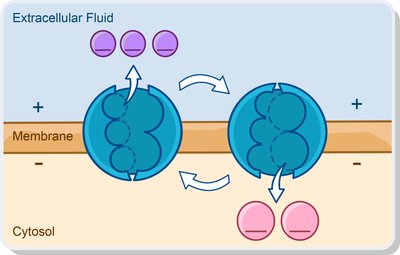
Active Transport: Movement of ions against their gradient using energy (ATP).
Na+/K+ ATPase: Ejects 3 Na+ ions from the cell and brings in 2 K+ ions.
Step-by-Step Guidance
Recognize that the sodium-potassium pump uses ATP to move sodium and potassium ions against their concentration gradients.
Recall the pump's stoichiometry: it ejects 3 sodium ions for every 2 potassium ions it brings in.
Understand how this action maintains high sodium outside and high potassium inside the cell.
Consider what would happen if the pump were blocked (e.g., by a toxin), and how ion concentrations would change over time.
Try solving on your own before revealing the answer!
Final Answer:
The sodium-potassium pump maintains ion gradients by actively transporting sodium out and potassium in, which is critical for the resting membrane potential. Blocking the pump would disrupt these gradients.
