 Back
BackStudy Guidance for Fundamentals of the Nervous System and Nervous Tissue (ANP)
Study Guide - Smart Notes
 Tailored notes based on your materials, expanded with key definitions, examples, and context.
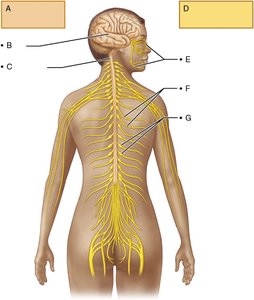
Q5. Name the two principal parts of the nervous system (A and D) and the structures that make up each part (B–C and E–G). Refer to Figure 11.2 for help.
Background
Topic: Structural organization of the nervous system
This question tests your understanding of the anatomical divisions of the nervous system and the major structures that belong to each division.
Key Terms:
Central Nervous System (CNS): The part of the nervous system consisting of the brain and spinal cord.
Peripheral Nervous System (PNS): The part of the nervous system outside the CNS, including nerves and ganglia.
Step-by-Step Guidance
Examine the diagram and identify the two main regions labeled A and D. These represent the principal divisions of the nervous system.
For each division, look for the structures labeled B, C, E, F, and G. These correspond to specific anatomical features within the CNS and PNS.
Recall that the CNS is composed of the brain and spinal cord, while the PNS includes nerves that branch out from the CNS to the rest of the body.
Match each label to its correct structure based on its location in the diagram (e.g., brain, spinal cord, peripheral nerves).
Try solving on your own before revealing the answer!
Final Answer:
A: Central Nervous System (CNS) B: Brain C: Spinal cord D: Peripheral Nervous System (PNS) E: Cranial nerves F: Spinal nerves G: Ganglia
The CNS consists of the brain and spinal cord, while the PNS includes cranial nerves, spinal nerves, and ganglia. These structures work together to receive, process, and respond to information throughout the body.
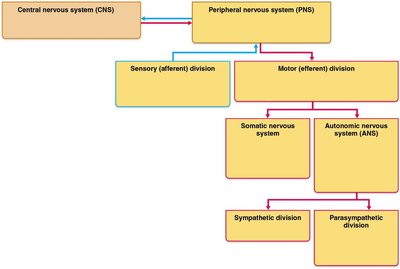
Q6. Use Figure 11.3 to help you complete the flowchart of the organization of the nervous system.
Background
Topic: Functional organization of the nervous system
This question tests your ability to understand and organize the divisions and subdivisions of the nervous system, including sensory and motor pathways.
Key Terms:
Sensory (afferent) division: Carries information from receptors to the CNS.
Motor (efferent) division: Carries information from the CNS to effectors (muscles and glands).
Somatic nervous system: Controls voluntary movements.
Autonomic nervous system (ANS): Controls involuntary functions.
Sympathetic and parasympathetic divisions: Subdivisions of the ANS.
Step-by-Step Guidance
Start at the top of the flowchart with the two main divisions: CNS and PNS.
Follow the branches to identify the sensory (afferent) and motor (efferent) divisions within the PNS.
Within the motor division, distinguish between the somatic nervous system and the autonomic nervous system.
Further subdivide the autonomic nervous system into sympathetic and parasympathetic divisions.
Try solving on your own before revealing the answer!
Final Answer:
The flowchart should show the CNS and PNS as main branches, with the PNS further divided into sensory and motor divisions. The motor division splits into the somatic and autonomic nervous systems, and the autonomic system is divided into sympathetic and parasympathetic branches.
This organization helps clarify how information is processed and transmitted throughout the nervous system.
