 Back
BackStudy Guidance for Human Anatomy and Physiology (NURS1022 Module 1)
Study Guide - Smart Notes
 Tailored notes based on your materials, expanded with key definitions, examples, and context.
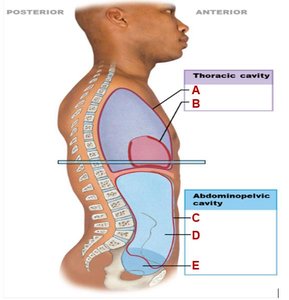
Q2. Label the major cavities of the body shown in figure 1. Name one organ found in each cavity.
Background
Topic: Body Cavities and Associated Organs
This question tests your understanding of the anatomical divisions of the human body, specifically the major cavities and the organs located within them. Recognizing these cavities is fundamental for describing organ locations and understanding clinical terminology.
Key Terms:
Thoracic cavity: The chest cavity, housing organs such as the lungs and heart.
Abdominopelvic cavity: The cavity below the diaphragm, containing digestive, urinary, and reproductive organs.
Pleural cavity: Surrounds each lung.
Pericardial cavity: Contains the heart.
Peritoneal cavity: Encloses abdominal organs.
Abdominal cavity: Contains organs like the stomach and liver.
Pelvic cavity: Contains organs such as the bladder and reproductive organs.
Step-by-Step Guidance
Examine the diagram and identify the labeled cavities (A–E). Match each label to its anatomical name using your textbook or lecture notes.
Recall the main organ(s) associated with each cavity. For example, the pleural cavity (A) contains the lungs, while the pericardial cavity (B) contains the heart.
For the abdominopelvic cavity, distinguish between the abdominal (D) and pelvic (E) regions, and identify a key organ in each (e.g., stomach in abdominal, bladder in pelvic).
Write down one organ for each cavity, making sure you understand why that organ is located there based on anatomical boundaries.
Try solving on your own before revealing the answer!
Final Answer:
A: Pleural cavity – Lungs B: Pericardial cavity – Heart C: Peritoneal cavity – Intestines D: Abdominal cavity – Stomach E: Pelvic cavity – Bladder
Each cavity houses specific organs, and knowing their locations helps in clinical assessment and communication.
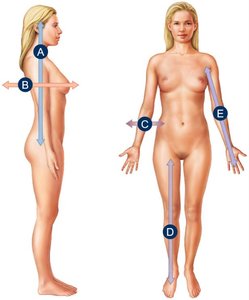
Q12. Match the directional terms to the labels in the anatomical position figure.
Background
Topic: Anatomical Directional Terms
This question assesses your ability to use standard anatomical terminology to describe locations and directions on the human body. These terms are essential for clear communication in healthcare settings.
Key Terms:
Anterior/Ventral: Toward the front of the body.
Posterior/Dorsal: Toward the back of the body.
Cranial: Toward the head.
Caudal: Toward the tail or lower part of the body.
Medial: Toward the midline.
Lateral: Away from the midline.
Proximal: Closer to the point of attachment.
Distal: Farther from the point of attachment.
Step-by-Step Guidance
Look at the figure and identify the direction each arrow or label represents (A–E).
Recall the definitions of each directional term and match them to the corresponding label based on the body’s orientation.
For example, the arrow pointing toward the head is cranial, while the one toward the feet is caudal.
Write the correct directional term next to each label, ensuring you understand the spatial relationships.
Try solving on your own before revealing the answer!
Final Answer:
A: Cranial B: Caudal C: Medial D: Proximal E: Distal
These terms help describe precise locations and directions in anatomy and clinical practice.
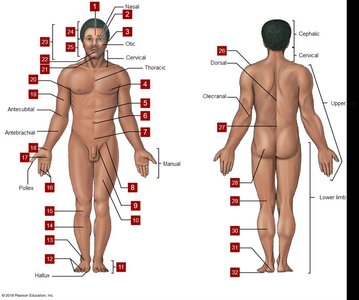
Q15. Match the label in figure 3 to the correct anatomical region.
Background
Topic: Anatomical Body Regions
This question tests your ability to identify and name the anatomical regions of the body, which is important for describing physical assessment findings and understanding medical documentation.
Key Terms:
Cephalic: Head region.
Sural: Calf region.
Digits: Fingers and toes.
Gluteal: Buttocks region.
Buccal: Cheek region.
Crural: Leg region.
Pedal: Foot region.
Pelvis: Pelvic region.
Step-by-Step Guidance
Examine the figure and locate each numbered label.
Use your textbook or lecture notes to match each label to the correct anatomical region name.
Write the region name next to each label, making sure you understand the location and significance of each region.
Pay attention to regions with two labels (e.g., digits for fingers and toes).
Try solving on your own before revealing the answer!
Final Answer:
23: Cephalic 30: Sural 16/12: Digits 28: Gluteal 3: Buccal 14: Crural 11: Pedal 7: Pelvis 19: Brachial 25: Facial 31: Calcaneal 4: Mammary 15: Patellar 8: Inguinal 2: Orbital 24: Cranial 26: Acromial 29: Popliteal 18: Carpal 22: Oral 9: Pubic 20: Axillary 13: Tarsal 17: Palmar 10: Femoral 21: Mental 1: Frontal 5: Abdominal 27: Lumbar 6: Umbilical 32: Plantar
Matching these regions helps in accurate documentation and communication in clinical settings.
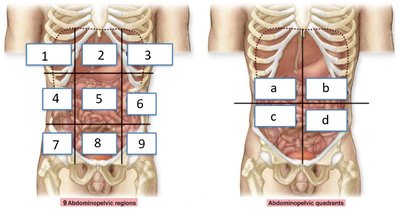
Q16. Identify the nine abdominal regions and quadrant names labelled in the figure.
Background
Topic: Abdominal Regions and Quadrants
This question tests your ability to identify and name the nine regions and four quadrants of the abdomen, which is essential for describing locations of pain, pathology, or procedures.
Key Terms:
Hypochondriac: Upper lateral regions.
Epigastric: Upper central region.
Lumbar: Middle lateral regions.
Umbilical: Central region.
Inguinal: Lower lateral regions.
Hypogastric: Lower central region.
Quadrants: RUQ, LUQ, RLQ, LLQ.
Step-by-Step Guidance
Examine the figure and identify the nine regions (1–9) and four quadrants (a–d).
Recall the names and locations of each region and quadrant using prefixes, suffixes, and stem words.
Write the correct name next to each label, making sure you understand the clinical significance of each area.
Practice describing locations using these terms, as they are commonly used in health care.
Try solving on your own before revealing the answer!
Final Answer:
1: Right hypochondriac region 2: Epigastric region 3: Left hypochondriac region 4: Right lumbar region 5: Umbilical region 6: Left lumbar region 7: Right inguinal region 8: Hypogastric (pubic) region 9: Left inguinal region a: Right upper quadrant (RUQ) b: Left upper quadrant (LUQ) c: Right lower quadrant (RLQ) d: Left lower quadrant (LLQ)
These regions and quadrants are used to localize symptoms and findings in clinical practice.
