 Back
BackStudy Guidance: Heart Chambers and Associated Vessels
Study Guide - Smart Notes
 Tailored notes based on your materials, expanded with key definitions, examples, and context.
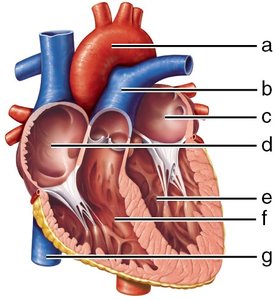
Q1. Assign the letters (a–g) to their corresponding heart structures in the diagram.
Background
Topic: Anatomy of the Heart
This question tests your knowledge of the internal anatomy of the heart, specifically the identification of its chambers and major vessels. Understanding these structures is essential for tracing blood flow and comprehending cardiovascular physiology.
Key Terms:
Aorta: The main artery carrying oxygen-rich blood from the left ventricle to the body.
Pulmonary trunk: The vessel carrying oxygen-poor blood from the right ventricle to the lungs.
Right atrium: Receives oxygen-poor blood from the body via the superior and inferior vena cava.
Left atrium: Receives oxygen-rich blood from the lungs via the pulmonary veins.
Right ventricle: Pumps oxygen-poor blood to the lungs.
Left ventricle: Pumps oxygen-rich blood to the systemic circuit.
Inferior vena cava: Returns oxygen-poor blood from the lower body to the right atrium.
Step-by-Step Guidance
Examine the diagram and note the orientation: the heart is shown in a frontal section, revealing the chambers and major vessels.
Identify the vessels and chambers based on their position and direction of blood flow. For example, the aorta is typically the large red vessel arching upward and to the left.
Recall the order of blood flow: blood enters the right atrium (from the body), moves to the right ventricle, then to the pulmonary trunk (to the lungs). Oxygen-rich blood returns via the pulmonary veins to the left atrium, then to the left ventricle, and exits through the aorta.
Match each letter (a–g) to the correct structure using anatomical landmarks and the flow of blood.
Try solving on your own before revealing the answer!
Final Answer:
a: Aorta
b: Pulmonary trunk
c: Left atrium
d: Right atrium
e: Left ventricle
f: Right ventricle
g: Inferior vena cava
Each structure is identified based on its anatomical position and function in the heart's blood flow.
