 Back
BackStudy Guidance: Major Anatomical Features of the Human Brain
Study Guide - Smart Notes
 Tailored notes based on your materials, expanded with key definitions, examples, and context.
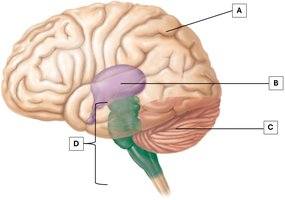
Q2. Name the four main regions of the brain as labelled on the image below (figure 1).
Background
Topic: Anatomy of the Brain
This question is testing your ability to identify the major anatomical regions of the human brain. Understanding these regions is fundamental for studying their functions and roles in the nervous system.
Key Terms:
Cerebrum: The largest part of the brain, responsible for higher brain functions.
Diencephalon: Contains structures such as the thalamus and hypothalamus, involved in sensory and autonomic functions.
Cerebellum: Coordinates movement and balance.
Brainstem: Controls basic life functions such as breathing and heart rate.
Step-by-Step Guidance
Examine the labelled diagram of the brain. Identify the four main regions based on their location and appearance.
Recall the general anatomical layout: the cerebrum is the largest and most superior, the cerebellum is posterior and inferior, the brainstem is inferior and connects to the spinal cord, and the diencephalon is centrally located.
Match each label (A, B, C, D) to the correct region by considering their position and typical features.
Review the functions associated with each region to help confirm your identification.
Try solving on your own before revealing the answer!
Final Answer:
A: Cerebrum B: Diencephalon C: Cerebellum D: Brainstem
These are the four main anatomical regions of the brain, each with distinct functions and locations.
