 Back
BackStudy Guide: Articulations (Joints) – Structure, Types, and Movements
Study Guide - Smart Notes
 Tailored notes based on your materials, expanded with key definitions, examples, and context.
Q1. Describe the structural and functional classifications of joints in the body.
Background
Topic: Joint Classification
This question tests your understanding of how joints (articulations) are categorized based on their structure (what they're made of) and function (how much movement they allow).
Key Terms and Concepts:
Structural classification: Based on the material binding the bones and whether a joint cavity is present (fibrous, cartilaginous, synovial).
Functional classification: Based on the amount of movement allowed (synarthrosis, amphiarthrosis, diarthrosis).
Step-by-Step Guidance
List the three main structural types of joints: fibrous, cartilaginous, and synovial. Briefly describe what connects the bones in each type.
List the three main functional types of joints: synarthrosis (immovable), amphiarthrosis (slightly movable), and diarthrosis (freely movable). Match each to the structural types where appropriate.
Think of examples for each classification (e.g., suture for fibrous/synarthrosis, pubic symphysis for cartilaginous/amphiarthrosis, shoulder for synovial/diarthrosis).
Try solving on your own before revealing the answer!
Q2. Identify the structures associated with synovial joints.
Background
Topic: Synovial Joint Anatomy
This question focuses on the anatomy of synovial joints, which are the most movable type of joint in the body.
Key Terms and Structures:
Joint cavity (contains synovial fluid)
Articular cartilage
Synovial membrane
Fibrous capsule
Ligament
Tendon / tendon sheath
Bursa
Periosteum
Step-by-Step Guidance
Review diagrams of synovial joints and locate each structure listed above.
Understand the function of each structure (e.g., articular cartilage reduces friction, synovial fluid lubricates the joint).
Practice labeling a diagram with these structures. Use the provided images for reference.
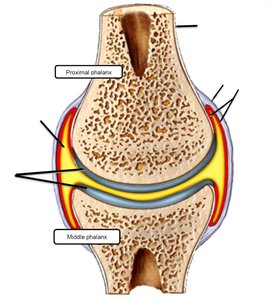
Try solving on your own before revealing the answer!
Q3. Describe the variety of movements allowed at synovial joints.
Background
Topic: Movements at Synovial Joints
This question tests your knowledge of the different types of movements possible at synovial joints and examples of where they occur in the body.
Key Terms:
Flexion, extension, hyperextension
Abduction, adduction
Rotation, circumduction
Pronation, supination
Inversion, eversion
Dorsiflexion, plantarflexion
Protraction, retraction
Elevation, depression
Step-by-Step Guidance
Define each movement term in your own words (e.g., flexion = decreasing the angle between two bones).
Give an example of a joint where each movement occurs (e.g., flexion at the elbow).
Identify which movements are considered 'special movements' (e.g., pronation/supination, inversion/eversion).
Try solving on your own before revealing the answer!
Q4. Label the following diagram: Figure 8.2 Anterior View of Knee Joint
Background
Topic: Knee Joint Anatomy
This question asks you to identify and label the major ligaments, bones, and cartilages of the knee joint on a diagram.
Key Structures to Identify:
Tibial (medial) collateral ligament (MCL)
Fibular (lateral) collateral ligament (LCL)
Anterior cruciate ligament (ACL)
Posterior cruciate ligament (PCL)
Medial and lateral meniscus
Patella, patellar ligament
Femur, tibia, fibula
Step-by-Step Guidance
Study the anatomy of the knee joint, focusing on the location and function of each structure listed above.
Practice labeling a diagram of the knee joint, using the image provided as a reference.
Review the orientation (anterior view) to ensure correct placement of each label.
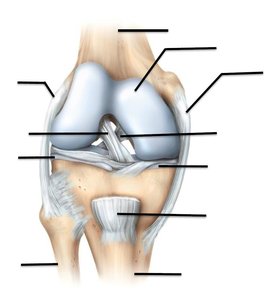
Try solving on your own before revealing the answer!
Q5. For each of the following activities, state which joints are involved in the specified movements, and also state which movements are occurring at each joint.
Background
Topic: Functional Application of Joint Movements
This question asks you to apply your knowledge of joint types and movements to real-life activities.
Key Steps:
Break down each activity into its component movements (e.g., climbing stairs involves flexion and extension at the hip, knee, and ankle).
Identify the joints involved in each movement (e.g., hip joint, knee joint, ankle joint).
Describe the specific movement at each joint (e.g., flexion at the knee, dorsiflexion at the ankle).
Try solving on your own before revealing the answer!
