 Back
Study Guide: Cell Structure and Membrane Transport (ANP College Level)
Study Guide - Smart Notes
 Tailored notes based on your materials, expanded with key definitions, examples, and context.
Q1. What function of a membrane protein is illustrated below?
Background
Topic: Membrane Transport Proteins
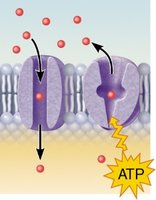
This question tests your understanding of the different functions of membrane proteins, specifically how they facilitate the movement of substances across the plasma membrane. The image shows two types of transport: one that allows substances to move down their concentration gradient, and another that uses ATP to move substances against their gradient.
Key Terms and Concepts:
Channel Protein: A membrane protein that allows specific molecules or ions to pass through the membrane by diffusion.
Pump (Carrier Protein): A membrane protein that uses energy (often from ATP) to move substances against their concentration gradient.
Active Transport: The movement of substances against their concentration gradient, requiring energy input.
Facilitated Diffusion: The movement of substances down their concentration gradient with the help of a membrane protein, without energy input.
Step-by-Step Guidance
Examine the left side of the image: Notice that the red spheres are moving through a channel in the membrane, following the direction of the concentration gradient (from high to low concentration). This suggests a passive process.
Examine the right side of the image: Here, red spheres are being transported in the opposite direction (from low to high concentration), and ATP is being used. This indicates an active process that requires energy.
Recall that passive transport (like facilitated diffusion) does not require energy, while active transport (like a pump) does require ATP to move substances against their gradient.
Identify which function is being illustrated by each protein: One is facilitating diffusion, and the other is actively transporting molecules using ATP.
Try solving on your own before revealing the answer!
Final Answer: The left protein illustrates facilitated diffusion, and the right protein illustrates active transport (ATP-powered pump).
The left protein allows substances to move down their concentration gradient without energy input, while the right protein uses ATP to move substances against their gradient.
Q2. Write the letters for each step of the sodium-potassium pump in order from start to finish.
Background
Topic: Primary Active Transport (Sodium-Potassium Pump)
This question tests your understanding of the sodium-potassium pump, a crucial membrane protein that maintains the electrochemical gradients of sodium and potassium ions across the plasma membrane. This pump is essential for nerve impulse transmission and muscle contraction.
Key Terms and Concepts:
Sodium-Potassium Pump (Na+/K+ ATPase): A membrane protein that uses ATP to transport sodium and potassium ions against their concentration gradients.
ATP Hydrolysis: The breakdown of ATP to provide energy for active transport.
Electrochemical Gradient: The combined difference in concentration and charge that affects the movement of ions.
Step-by-Step Guidance
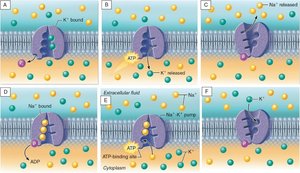
Identify the starting point: The pump binds three sodium ions from the cytoplasm (look for the image where three Na+ are attached inside the cell).
ATP binds to the pump and is hydrolyzed, transferring a phosphate group to the pump (phosphorylation).
The pump changes shape, releasing the sodium ions to the extracellular space.
Two potassium ions from the extracellular fluid bind to the pump.
The phosphate group is released, causing the pump to return to its original shape and release potassium ions into the cytoplasm.
The pump is now ready to start the cycle again by binding sodium ions.
Try solving on your own before revealing the answer!
Final Answer: The correct order is D, E, F, C, A, B.
This sequence follows the binding and release of sodium and potassium ions, ATP hydrolysis, and the conformational changes of the pump.
