Back
BackStudy Guide: Human Anatomy & Physiology (ANP) Lab Activities and Concepts
Study Guide - Smart Notes
 Tailored notes based on your materials, expanded with key definitions, examples, and context.
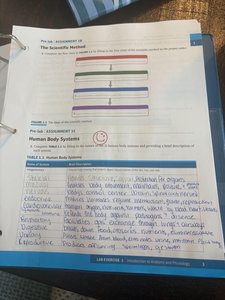
Q1. What are the main human body systems and their primary functions?
Background
Topic: Human Body Systems
This question tests your understanding of the major organ systems in the human body and their main roles in maintaining homeostasis and supporting life.
Key Terms and Concepts:
Organ System: A group of organs that work together to perform one or more functions.
Examples: Circulatory, Respiratory, Digestive, Nervous, Muscular, Skeletal, Endocrine, Lymphatic, Urinary, Reproductive, Integumentary.
Step-by-Step Guidance
List each major body system (e.g., circulatory, respiratory, digestive, etc.).
For each system, identify its primary function (e.g., the circulatory system transports blood and nutrients).
Think about which organs belong to each system (e.g., heart for circulatory, lungs for respiratory).
Consider how each system interacts with others to maintain homeostasis.
Try solving on your own before revealing the answer!
Q2. What are the anatomical directions and body planes used in describing the human body?
Background
Topic: Anatomical Position, Directional Terms, and Body Planes
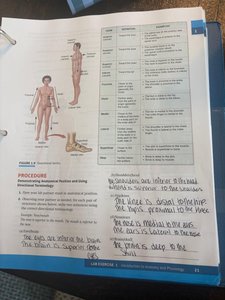
This question assesses your ability to use anatomical terminology to describe locations and sections of the body.
Key Terms and Concepts:
Directional Terms: Superior, inferior, anterior, posterior, medial, lateral, proximal, distal, superficial, deep.
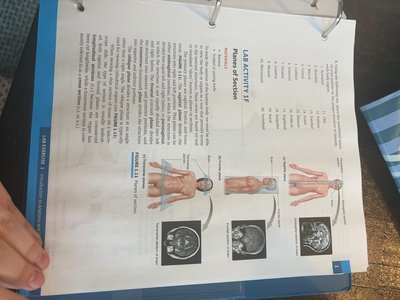
Body Planes: Sagittal, frontal (coronal), transverse (horizontal).
Step-by-Step Guidance
Review the definitions of each directional term and be able to apply them to body parts (e.g., "the nose is superior to the mouth").
Understand the three main body planes and what type of section each creates (e.g., sagittal divides left/right).
Practice describing the location of one structure relative to another using these terms.
Visualize or sketch the planes on a diagram to reinforce your understanding.
Try solving on your own before revealing the answer!
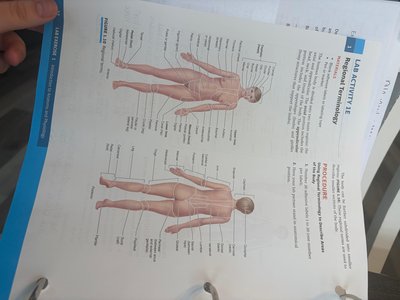
Q3. How do you identify and describe the major regions of the human body?
Background
Topic: Regional Terminology
This question focuses on naming and locating the major anatomical regions of the body using correct terminology.
Key Terms and Concepts:
Body Regions: Cephalic, cervical, thoracic, abdominal, pelvic, brachial, femoral, etc.
Regional Terms: Used to specify areas of the body more precisely than general terms.
Step-by-Step Guidance
Study the labeled diagrams of the human body showing anterior and posterior regions.
Memorize the names and locations of the main regions (e.g., "brachial" for arm, "femoral" for thigh).
Practice matching regional terms to their corresponding body parts.
Use flashcards or diagrams to reinforce your memory of these terms.
Try solving on your own before revealing the answer!
Q4. What are the main body cavities and what organs do they contain?
Background
Topic: Body Cavities and Membranes
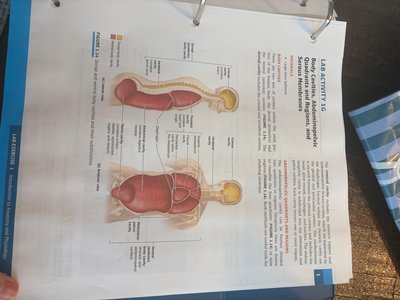
This question tests your knowledge of the major cavities in the human body and the organs found within each.
Key Terms and Concepts:
Body Cavities: Dorsal (cranial, vertebral), ventral (thoracic, abdominopelvic).
Organs: Brain, spinal cord, heart, lungs, stomach, intestines, etc.
Membranes: Meninges, pleura, pericardium, peritoneum.
Step-by-Step Guidance
Identify the two main body cavities (dorsal and ventral) and their subdivisions.
List the organs found in each cavity (e.g., brain in cranial, heart in thoracic).
Understand the membranes that line or cover these cavities and organs.
Practice labeling diagrams of the body cavities and their contents.
Try solving on your own before revealing the answer!
Q5. What are the basic types of organic molecules and their functions in the body?
Background
Topic: Organic Molecules in Biology
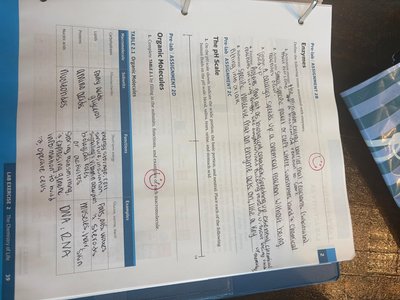
This question covers the four main classes of organic molecules and their roles in human physiology.
Key Terms and Concepts:
Carbohydrates: Energy source, structure.
Lipids: Energy storage, membranes, hormones.
Proteins: Structure, enzymes, transport, signaling.
Nucleic Acids: Genetic information (DNA, RNA).
Step-by-Step Guidance
List the four main types of organic molecules found in the body.
For each type, describe its basic structure (e.g., monosaccharides for carbohydrates).
Explain the primary function(s) of each molecule type in the body.
Give examples of where each type is found or used in the body.
Try solving on your own before revealing the answer!
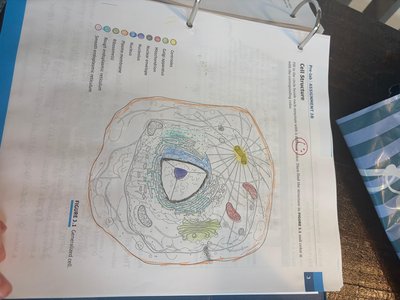
Q6. How do you describe and identify the main parts of a cell and their functions?
Background
Topic: Cell Structure and Function
This question tests your ability to recognize cell organelles and explain their roles in cellular processes.
Key Terms and Concepts:
Cell Membrane: Controls entry/exit of substances.
Nucleus: Contains genetic material.
Mitochondria: Produces energy (ATP).
Other Organelles: Ribosomes, endoplasmic reticulum, Golgi apparatus, lysosomes, etc.
Step-by-Step Guidance
Study diagrams of a typical animal cell and identify each labeled organelle.
Learn the function of each organelle (e.g., mitochondria = energy production).
Practice matching organelle names to their functions.
Review how these organelles work together to keep the cell alive.
Try solving on your own before revealing the answer!