 Back
Study Guide: Male Reproductive System (ANP College Level)
Study Guide - Smart Notes
 Tailored notes based on your materials, expanded with key definitions, examples, and context.
Anatomy of the Male Reproductive System
Overview of Male Reproductive Structures
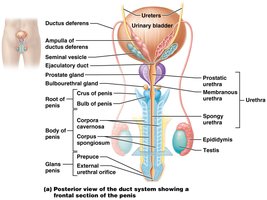
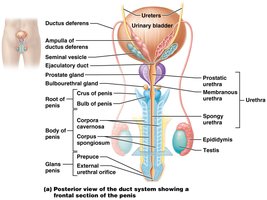
The male reproductive system consists of internal and external structures responsible for the production, maturation, and delivery of sperm, as well as the secretion of hormones such as testosterone. - Testes: Produce sperm and testosterone. - Duct System: Transports sperm from testes to exterior. - Accessory Glands: Produce seminal fluid. - Penis: Delivers sperm into the female reproductive tract. 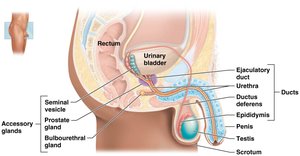
Testes and Scrotum
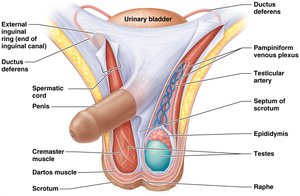
The testes are paired organs located within the scrotum, which protects and regulates their temperature for optimal sperm production. - Scrotum: Maintains temperature 2–3°C below body temperature, essential for spermatogenesis. - Connective tissue divides the testis into lobules, each containing seminiferous tubules. 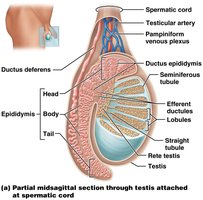
Seminiferous Tubules
Seminiferous tubules are the site of sperm production and contain specialized cells. - Spermatogenic cells: Form sperm. - Sustentacular (Sertoli) cells: Support and nourish developing sperm; produce testicular fluid. - Interstitial (Leydig) cells: Secrete testosterone. 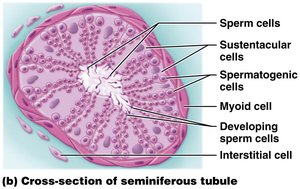
Duct System and Sperm Transport
Epididymis
The epididymis is a long, coiled duct where sperm mature and are stored. - Sperm move from efferent ductules into the ductus epididymis. - Sperm mature over several months; unused sperm are resorbed. 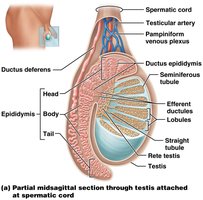
Ductus Deferens
The ductus deferens transports sperm from the epididymis to the ejaculatory duct. - Located within the spermatic cord, which also contains blood vessels and nerves. - Passes through the inguinal canal and over the bladder. - Contains three layers of smooth muscle for propulsion during ejaculation. 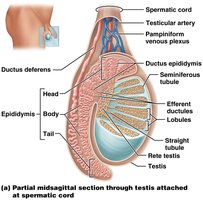
Ejaculatory Duct and Urethra
- Ejaculatory duct: Formed by the junction of the ampulla of ductus deferens and the duct of the seminal vesicle; empties into the urethra. - Urethra: Conducts urine and semen to the exterior. 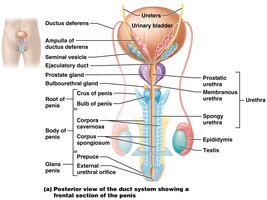
Accessory Sex Glands
Seminal Vesicles
Paired glands that secrete a yellowish fluid making up 60–70% of semen volume. - Contains nutrients for sperm and substances that promote sperm motility. 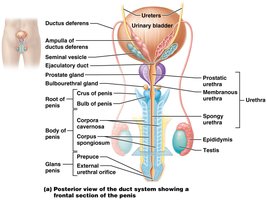
Prostate Gland
Single gland surrounding the urethra; produces milky, alkaline secretions (20–30% of semen volume). - Neutralizes acidic environment of urethra and female reproductive tract. - May enlarge with age (benign prostatic hyperplasia or prostate cancer). 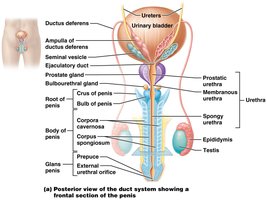
Bulbourethral Glands
Also called Cowper’s glands; secrete thick, alkaline mucus-like fluid. - Lubricates urethra and neutralizes acidic urine prior to ejaculation. 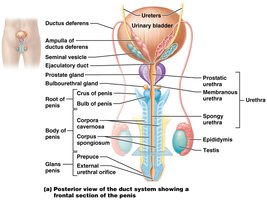
Semen Composition and Function
Semen
Semen is a mixture of sperm and fluids from the testes, seminal vesicles, prostate, and bulbourethral glands. - Sperm constitute about 5% of total semen volume. - Each ejaculate contains 2.5–5.0 ml with 40–750 million sperm. 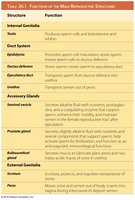
Male Reproductive System Physiology
Spermatogenesis
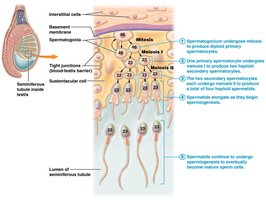
Spermatogenesis is the process of sperm production, beginning at puberty in the seminiferous tubules. - Spermatogonia (diploid) divide by mitosis. - Some become primary spermatocytes (diploid), which undergo meiosis I to form secondary spermatocytes (haploid). - Secondary spermatocytes undergo meiosis II to produce spermatids (haploid), which mature into sperm. 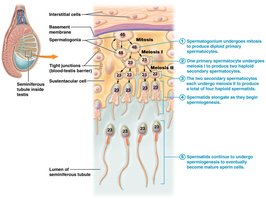
Sustentacular (Sertoli) Cells
These cells support and nourish developing sperm, form the blood-testis barrier, and secrete testicular fluid. 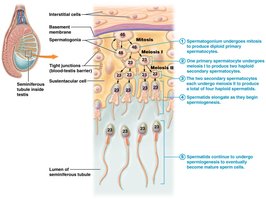
Hormonal Control of Male Reproduction
Testosterone production and spermatogenesis are regulated by the hypothalamic-pituitary-gonadal (HPG) axis. - GnRH from hypothalamus stimulates release of LH and FSH from anterior pituitary. - LH stimulates Leydig cells to produce testosterone. - FSH stimulates Sertoli cells to support spermatogenesis. - Negative feedback regulates hormone levels. 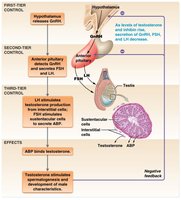
Functions of Male Reproductive Structures
Summary Table
Structure | Function |
|---|---|
Testis | Produces sperm cells and testosterone |
Epididymis | Promotes sperm cell maturation; stores sperm |
Ductus deferens | Transports sperm cells from epididymis to ejaculatory duct |
Ejaculatory duct | Functions as sperm duct; joins ductus deferens and seminal vesicle |
Seminal vesicle | Secretes alkaline fluid with nutrients; promotes sperm motility |
Prostate gland | Secretes slightly alkaline fluid; enhances sperm motility |
Bulbourethral gland | Secretes mucus-like fluid; lubricates and neutralizes urethra |
Penis | Moves sperm into female reproductive tract |
Male Sexual Response
Erection and Ejaculation
The male sexual response consists of two phases: erection and ejaculation. - Erection: Parasympathetic reflex causes release of nitric oxide, dilating arterioles and filling erectile bodies with blood. - Ejaculation: Sympathetic control; emission moves sperm and semen into urethra, expulsion propels semen out via muscle contraction. - Orgasm: Coincides with ejaculation; followed by resolution and refractory period. 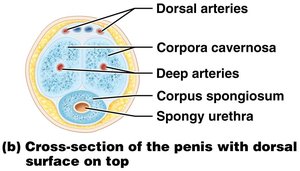
Testosterone and Male Characteristics
Physiological Effects of Testosterone
Testosterone is essential for spermatogenesis and development of secondary sex characteristics. - Secondary sex characteristics: Growth of body hair, deepened voice, thickened skin, increased sebaceous gland secretion. - Somatic effects: Increased bone density, muscle mass, erythrocyte count, and libido.
Clinical Considerations
Infertility
Male infertility may result from low sperm count, hormonal imbalances, or damage to testes. - Defined as inability to achieve pregnancy after one year.
Cryptorchidism
Failure of testes to descend into scrotum; results in absence of sperm production.
Prostate Disorders
- Benign prostatic hyperplasia: Non-cancerous enlargement of prostate, may obstruct urethra. - Prostate cancer: Treated with surgery, radiation, or chemotherapy.
Erectile Dysfunction (Impotence)
Inability to maintain an erection; may be due to vascular, neurological, or psychological factors.
Summary
The male reproductive system is a complex network of organs and glands responsible for the production, maturation, and delivery of sperm, as well as the secretion of hormones that regulate male physiology and secondary sex characteristics. Understanding its anatomy and physiology is essential for recognizing normal function and clinical disorders.
