 Back
Study Guide: Muscle Systems, Motor Units, EMG, and Lever Mechanics
Study Guide - Smart Notes
 Tailored notes based on your materials, expanded with key definitions, examples, and context.
Q1. What is a lever, in general?
Background
Topic: Muscles and Bones as Lever Systems
This question is testing your understanding of how levers function in both physics and anatomy, and how muscles use bones as levers to produce movement.
Key Terms and Formulas
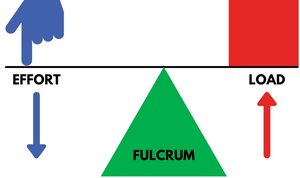
Lever: A rigid bar that moves on a fixed point called the fulcrum when a force (effort) is applied to it.
Fulcrum: The fixed point around which the lever rotates.
Effort: The force applied to move the lever.
Load: The resistance or weight that the lever moves.
Step-by-Step Guidance
Start by identifying the three main components of a lever: the fulcrum (pivot point), the effort (force applied), and the load (resistance to be moved).
Think about common examples of levers in everyday life, such as a seesaw or crowbar, and relate these to how bones and muscles interact in the body.
In the human body, bones act as the rigid bars, joints serve as fulcrums, and muscles provide the effort to move loads (body parts or external objects).
Try solving on your own before revealing the answer!
Final Answer:
A lever is a rigid structure that moves around a fixed point (fulcrum) when a force (effort) is applied to it, allowing a load to be moved with less effort. In anatomy, bones act as levers, joints as fulcrums, and muscles provide the effort.
