 Back
Study Guide: Sensory Systems and General Sensation
Study Guide - Smart Notes
 Tailored notes based on your materials, expanded with key definitions, examples, and context.
Sensory Systems and General Sensation
Introduction to Sensory Systems
Sensory systems are responsible for detecting and processing stimuli from both the external and internal environments. These systems allow the body to respond to changes and maintain homeostasis. Sensory receptors are specialized cells or structures that convert various forms of energy into nerve signals, which are then interpreted by the central nervous system (CNS).
Stimulus: Any event or thing that causes a response or action, such as heat, sound, or pressure.
Sensation: The awareness of a stimulus.
Perception: The interpretation of what the stimulus is or what it means.
General senses: Include tactile senses (touch, pressure, temperature, pain, vibration) with receptors distributed throughout the body.
Special senses: Include vision, hearing, balance, olfaction, and gustation, with receptors located in specific organs.
General Properties of Sensory Receptors
All sensory receptors function by converting stimulus energy into electrical impulses, a process known as transduction. Not all sensory signals reach the CNS; only those delivered to the CNS result in sensation.
Transduction: Conversion of stimulus energy into electrical signals.
Key information transmitted: Type of stimulus, location, intensity, and duration.
Classification of Sensory Receptors
Sensory receptors can be classified based on their distribution, type, location, and structure.
By Body Distribution
General Senses (Somatosensory): Receptors distributed throughout the body.
Special Senses: Receptors limited to the head, innervated by cranial nerves, and located in complex sense organs.
By Type of Stimulus Detected
Thermoreceptors: Detect heat and cold.
Photoreceptors: Detect light energy.
Nociceptors: Detect pain.
Chemoreceptors: Detect chemicals.
Mechanoreceptors: Detect physical deformation.
By Location (Origin)
Exteroceptors: Located near the body surface; respond to external stimuli (e.g., skin, auditory, visual receptors).
Interoceptors: Located internally within viscera; respond to internal stimuli (e.g., stretch receptors in hollow organs, chemoreceptors for taste and smell).
Proprioceptors: A type of interoceptor found in skeletal muscle, tendons, joints, and ligaments; enable the sense of body and limb position.
By Receptor Structure
Nonencapsulated: Dendritic endings of sensory neurons without connective tissue wrapping ("free nerve endings"). Respond mainly to pain and temperature.
Merkel discs (tactile discs): Nonencapsulated free nerve endings associated with epidermal cells.
Hair root plexuses: Nonencapsulated free nerve endings that respond when hair is bent.
Encapsulated: Dendritic endings enclosed by connective tissue.
Meissner corpuscles (tactile corpuscles): Encapsulated nerve endings in the dermis of hairless skin; respond to touch and vibrations.
Ruffini corpuscles (bulbous corpuscles): Encapsulated nerve endings in the dermis; respond to deep pressure and skin stretching.
Pacinian corpuscles (lamellated corpuscles): Encapsulated nerve endings in deep dermis; respond to deep pressure and vibrations.
Krause End Bulbs: Encapsulated nerve endings in mucous membranes and skin; respond mainly to cold temperature and light touch.
Receptor Physiology
Receptors convert stimulus energy into electrical signals, enabling the CNS to interpret sensory information. The density and distribution of cutaneous receptors affect sensitivity and perception.
Density of Cutaneous Receptors: Areas with higher receptor density (e.g., fingers) have greater sensitivity; areas with lower density (e.g., back, legs) have less sensitivity.
Receptive Field: The sensory space where stimuli can evoke a response, corresponding to the span of dendritic endings of a somatosensory neuron.
Receptive Field Size
Large receptive fields: Detect stimuli over a wide area but provide less precise perception (e.g., legs, back).
Small receptive fields: Detect stimuli over a narrow area, enabling more precise perception (e.g., fingers).
Sensory Receptor Adaptation
When sensory receptors are stimulated over an extended period, some adapt by reducing their response frequency, resulting in decreased sensation intensity. This process is known as receptor adaptation.
Phasic Receptors: Rapidly adapting; respond quickly but cease responding after repeated stimulation.
Tonic Receptors: Adapt slowly or not at all; continue responding as long as the stimulus exists.
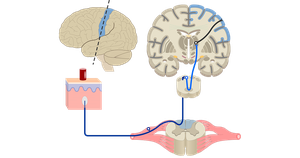
Example: Sensory Pathways
Sensory information from receptors is transmitted via nerve pathways to the CNS, where it is processed and interpreted. The pathway typically involves the peripheral nerves, spinal cord, and brain.
Summary Table: Classification of Sensory Receptors
Classification | Type | Location | Example |
|---|---|---|---|
By Distribution | General Senses | Throughout body | Touch, pain, temperature |
By Distribution | Special Senses | Head (sense organs) | Vision, hearing, taste |
By Type | Thermoreceptor | Skin, mucous membranes | Detects heat/cold |
By Type | Photoreceptor | Eye (retina) | Detects light |
By Type | Nociceptor | Skin, viscera | Detects pain |
By Structure | Nonencapsulated | Skin, hair follicles | Free nerve endings |
By Structure | Encapsulated | Dermis, mucous membranes | Meissner, Pacinian corpuscles |
