 Back
BackStudy Guide: Spinal Cord Tracts and Motor Pathways
Study Guide - Smart Notes
 Tailored notes based on your materials, expanded with key definitions, examples, and context.
Spinal Cord Tracts: Organization and Function
Overview of Spinal Cord Tracts
The spinal cord contains organized bundles of nerve fibers called tracts, which are essential for transmitting sensory and motor information between the body and the brain. These tracts are classified into two main categories based on their direction and function:
Ascending tracts: Carry sensory information from peripheral receptors to the brain.
Descending tracts: Transmit motor commands from the brain to the spinal cord and peripheral effectors.
Ascending Tracts
Ascending tracts are responsible for delivering sensory information to higher centers in the brain. The level of awareness of this information depends on whether the tract synapses in the thalamus:
Conscious sensory information: Tracts that synapse in the thalamus raise sensory input to conscious awareness.
Subconscious sensory information: Tracts that do not synapse in the thalamus keep sensory input at a subconscious level.
Descending Tracts
Descending motor tracts are two-neuron systems, consisting of an upper motor neuron and a lower motor neuron. The upper motor neuron originates in the brain, travels downwards, and synapses with the lower motor neuron in the spinal cord.
Upper motor neuron: Located in the brain; initiates voluntary movement.
Lower motor neuron: Located in the anterior or lateral horn of the spinal cord; directly innervates skeletal muscle.
Major Sensory and Motor Tracts
The Spinothalamic Tracts
The spinothalamic tracts are ascending pathways that carry sensations of pain, temperature, and crude touch and pressure to the brain.
Pain and temperature: Transmitted via lateral spinothalamic tract.
Crude touch and pressure: Transmitted via anterior spinothalamic tract.
The Spinocerebellar Tracts
Spinocerebellar tracts are ascending pathways that carry proprioceptive information to the cerebellum. These tracts are unique because they do not synapse in the thalamus, and thus the sensory information remains subconscious.
First-order and second-order neurons: Only these two types are present in spinocerebellar tracts.
No thalamic synapse: Sensory information is not consciously perceived.
The Posterior Columns
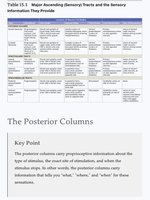
The posterior columns are ascending tracts that carry highly specific proprioceptive information, including the type, site, and timing of stimulation. This allows the brain to determine "what," "where," and "when" for these sensations.
Proprioception: Awareness of body position and movement.
Fine touch and vibration: Also transmitted via posterior columns.
Descending Motor Tracts
The Corticospinal Tracts
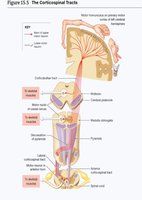
The corticospinal tracts are the most important descending motor pathways for voluntary, fine motor control of the limbs. They include the corticobulbar, lateral corticospinal, and anterior corticospinal tracts.
Corticobulbar tract: Controls muscles of the head and neck.
Lateral corticospinal tract: Controls distal limb muscles for fine movements.
Anterior corticospinal tract: Controls axial muscles.
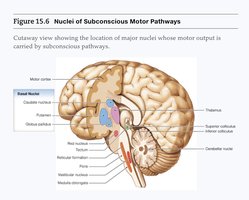
Subconscious Motor Pathways
Subconscious motor pathways involve nuclei in the brain that regulate involuntary motor activities, such as muscle tone, posture, and balance. These pathways include the rubrospinal, tectospinal, vestibulospinal, and reticulospinal tracts.
Rubrospinal tract: Facilitates flexor muscle activity.
Tectospinal tract: Coordinates head and eye movements.
Vestibulospinal tract: Maintains balance and posture.
Reticulospinal tract: Modulates muscle tone and reflexes.
Levels of Somatic Motor Control
Regulation of Lower Motor Neuron Activity
Lower motor neuron activity is regulated by descending motor pathways and by higher centers within the brain. These higher centers are influenced by sensory input and other motor centers, allowing for complex integration and coordination of movement.
Descending pathways: Directly influence lower motor neurons.
Higher brain centers: Integrate sensory and motor information for refined control.
Motor Tracts in the CNS and PNS
Organization of Somatic and Autonomic Motor Systems
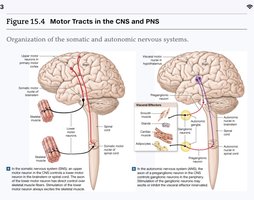
The central and peripheral nervous systems organize motor tracts to control both voluntary (somatic) and involuntary (autonomic) functions. Somatic motor tracts control skeletal muscle, while autonomic motor tracts regulate smooth muscle, cardiac muscle, and glands.
Somatic motor system: Involves upper and lower motor neurons for voluntary movement.
Autonomic motor system: Involves preganglionic and postganglionic neurons for involuntary control.
Principal Descending and Ascending Tracts: Summary Tables
Principal Descending (Motor) Tracts and Associated Nuclei
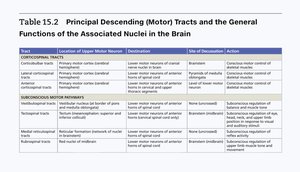
This table summarizes the major descending motor tracts, their origins, destinations, sites of decussation, and actions.
Tract | Location of Upper Motor Neuron | Destination | Site of Decussation | Action |
|---|---|---|---|---|
Corticobulbar | Primary motor cortex (border of area) | Lower motor neuron of cranial nerve | Brainstem | Conscious motor control of skeletal muscles |
Lateral corticospinal | Primary motor cortex | Lower motor neuron of anterior horn | Pyramids of medulla oblongata | Conscious motor control of skeletal muscles |
Anterior corticospinal | Primary motor cortex | Lower motor neuron of anterior horn | Level of lower motor neuron | Conscious motor control of skeletal muscles |
Rubrospinal | Red nucleus of midbrain | Lower motor neuron of anterior horn | Brainstem (midbrain) | Subconscious regulation of muscle tone and movement of distal portions of upper limbs |
Tectospinal | Superior and inferior colliculi | Lower motor neuron of anterior horn | Brainstem (midbrain) | Subconscious regulation of eye, head, neck, and upper limb position in response to visual and auditory stimuli |
Vestibulospinal | Vestibular nucleus at border of pons and medulla oblongata | Lower motor neuron of anterior horn | No decussation | Subconscious regulation of balance and muscle tone |
Medial reticulospinal | Reticular formation | Lower motor neuron of anterior horn | No decussation | Subconscious regulation of reflex activity |
Major Ascending (Sensory) Tracts and Sensory Information
This table summarizes the major ascending sensory tracts and the types of sensory information they carry.
Tract | Type of Sensory Information | Origin | Destination |
|---|---|---|---|
Spinothalamic | Pain, temperature, crude touch, pressure | Peripheral sensory receptors | Thalamus |
Spinocerebellar | Proprioceptive information | Muscle spindles, tendons | Cerebellum |
Posterior columns | Fine touch, vibration, proprioception | Peripheral sensory receptors | Cerebral cortex |
Summary
The spinal cord tracts are essential for the transmission of sensory and motor information. Ascending tracts deliver sensory input to the brain, while descending tracts control voluntary and involuntary motor functions. Understanding the organization and function of these tracts is fundamental for students of anatomy and physiology, especially in the context of the nervous system.
