 Back
Study Guide: The Cardiovascular System – Blood Vessels (ANP)
Study Guide - Smart Notes
 Tailored notes based on your materials, expanded with key definitions, examples, and context.
Q1. What are blood vessels and what is their primary function in the circulatory system?
Background
Topic: Introduction to Blood Vessels
This question tests your understanding of the basic definition and role of blood vessels in the human body.
Key Terms:
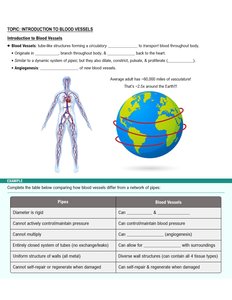
Blood Vessels: Tubular structures (arteries, veins, capillaries) that transport blood throughout the body.
Circulatory System: The system responsible for moving blood, nutrients, gases, and wastes to and from cells.
Step-by-Step Guidance
Recall that blood vessels are part of a closed circulatory system, forming a network that reaches all body tissues.
Think about the main function of this network: what does it deliver and remove from tissues?
Consider the three main types of blood vessels and their general roles (arteries, veins, capillaries).
Try solving on your own before revealing the answer!
Final Answer:
Blood vessels are dynamic tubes that transport blood throughout the body, delivering oxygen and nutrients to tissues and removing waste products. They form a closed circuit that is essential for maintaining homeostasis.
Q2. How do blood vessels differ from a simple network of pipes?
Background
Topic: Blood Vessel Structure vs. Pipes
This question asks you to compare the unique features of blood vessels to those of inanimate pipes, focusing on their structure and function.
Key Terms:
Permeability: Ability to allow substances to pass through.
Vasoconstriction/Vasodilation: Ability to change diameter to regulate blood flow and pressure.
Step-by-Step Guidance
List the characteristics of pipes (e.g., rigid, cannot change diameter, not permeable).
Contrast these with blood vessels, which can change diameter and allow exchange of substances.
Think about how blood vessels respond to damage compared to pipes.
Try solving on your own before revealing the answer!
Final Answer:
Blood vessels are flexible, can change diameter, are permeable to certain substances, and can repair themselves, unlike rigid, impermeable pipes.
Q3. What are the three main types of blood vessels, and what is the primary function of each?
Background
Topic: Types of Blood Vessels
This question tests your knowledge of the classification of blood vessels and their roles in circulation.
Key Terms:
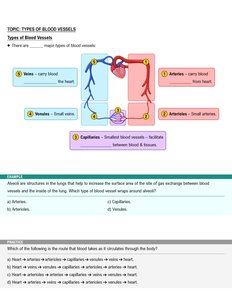
Arteries: Carry blood away from the heart.
Veins: Carry blood toward the heart.
Capillaries: Facilitate exchange of substances between blood and tissues.
Step-by-Step Guidance
Recall the direction of blood flow for each vessel type relative to the heart.
Think about which vessel type is involved in nutrient and gas exchange.
Consider the structural differences that support each vessel's function.
Try solving on your own before revealing the answer!
Final Answer:
Arteries carry blood away from the heart, veins carry blood toward the heart, and capillaries allow exchange of gases, nutrients, and wastes between blood and tissues.
Q4. What are the three layers (tunics) of a typical blood vessel, and what is the main function of each?
Background
Topic: General Blood Vessel Structure
This question focuses on the anatomy of blood vessel walls and the role of each layer.
Key Terms:
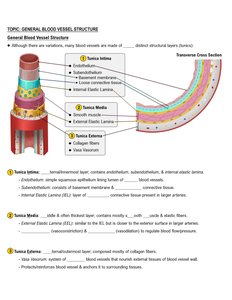
Tunica Intima: Innermost layer, in contact with blood flow.
Tunica Media: Middle layer, contains smooth muscle and elastic fibers.
Tunica Externa (Adventitia): Outermost layer, provides structural support.
Step-by-Step Guidance
Identify the location of each tunic from innermost to outermost.
Recall the main tissue type found in each layer (e.g., endothelium, smooth muscle, connective tissue).
Think about how each layer contributes to the function and integrity of the vessel.
Try solving on your own before revealing the answer!
Final Answer:
The tunica intima provides a smooth lining for blood flow, the tunica media regulates vessel diameter and blood pressure, and the tunica externa protects and anchors the vessel.
