 Back
BackStudy Guide: The Endocrine System (Anatomy & Physiology)
Study Guide - Smart Notes
 Tailored notes based on your materials, expanded with key definitions, examples, and context.
Introduction to the Endocrine System
Types of Chemical Messengers
The endocrine system utilizes chemical messengers called hormones to regulate bodily functions. These messengers are distributed throughout the body and interact with specific receptors to elicit responses.
Chemical messenger: The molecule that transmits a signal.
Receptor: The protein that binds to the messenger and initiates a response.
Types of signaling:
Autocrine: Messenger acts on the same cell that secreted it.
Paracrine: Messenger acts on nearby cells.
Endocrine: Messenger distributed by the bloodstream to distant cells.
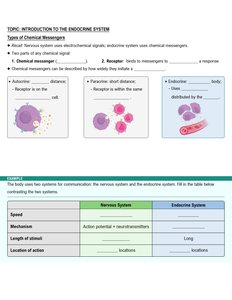
Comparison: Nervous System vs. Endocrine System
The nervous and endocrine systems both use messengers for communication, but differ in speed, mechanism, and duration of action.
Nervous System:
Speed: Fast
Mechanism: Action potentials and neurotransmitters
Length of signal: Short
Location of action: Localized
Endocrine System:
Speed: Slow
Mechanism: Hormones
Length of signal: Long
Location of action: Widespread
Components of the Endocrine System
Major Glands and Functions
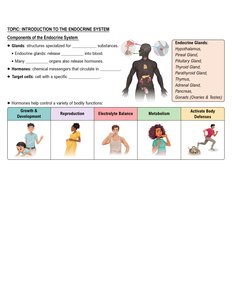
The endocrine system is composed of glands that secrete hormones into the bloodstream. These hormones regulate various bodily functions.
Glands: Specialized structures for hormone secretion (e.g., pituitary, thyroid, adrenal glands).
Hormones: Chemical messengers that circulate in blood.
Target cells: Cells with specific receptors for hormones.
Functions regulated:
Growth & Development
Reproduction
Electrolyte Balance
Metabolism
Active Body Defense
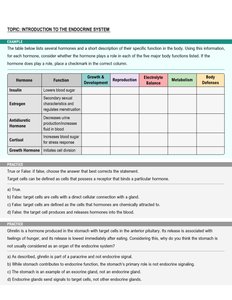
Examples of Hormones and Their Functions
Several hormones play roles in multiple body functions. The following table summarizes key hormones and their primary actions.
Hormone | Function | Growth & Development | Reproduction | Electrolyte Balance | Metabolism | Body Defense |
|---|---|---|---|---|---|---|
Insulin | Lowers blood sugar | X | ||||
Estrogen | Female sex hormone | X | X | |||
Antidiuretic Hormone | Reduces urine output | X | ||||
Adrenaline | Stimulates fight-or-flight | X | ||||
Growth Hormone | Stimulates tissue growth | X |
Hormones: Structure and Classification
Hormone Types
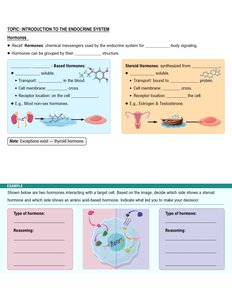
Hormones are classified based on their chemical structure and solubility.
Amino acid-based hormones:
Water-soluble
Transported in blood without carrier proteins
Bind to receptors on cell surface
Steroid hormones:
Lipid-soluble
Require transport proteins in blood
Bind to intracellular receptors
Exception: Thyroid hormones are amino acid-based but act like steroid hormones.
Transport and Action of Hormones
Steroid hormones require transport proteins to move through the bloodstream due to their lipid solubility. Amino acid-based hormones do not require such proteins.
Transport proteins:
Allow steroid hormones to cross cell membranes
Prevent rapid degradation
Maintain hormone levels in blood
Membrane-Bound Receptors and Secondary Messengers
Second Messenger Systems
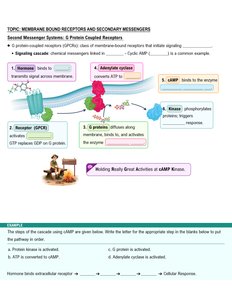
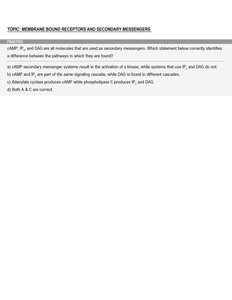
Many hormones act through membrane-bound receptors, initiating signaling cascades that use secondary messengers such as cAMP, IP3, and DAG.
G protein-coupled receptors (GPCRs): Initiate signaling cascades.
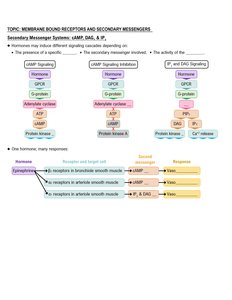
cAMP: Common secondary messenger produced by adenylyl cyclase.
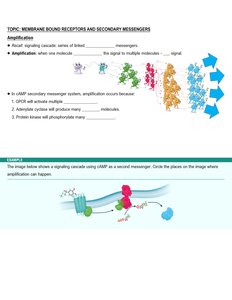
Signaling cascade: Amplifies the signal, allowing a small amount of hormone to produce a large cellular response.
Amplification in Signaling Cascades
Amplification occurs when one molecule activates many downstream molecules, increasing the strength of the signal.
GPCRs activate adenylyl cyclase, which produces many cAMP molecules.
Protein kinases phosphorylate many target proteins.
Other Secondary Messenger Systems
Hormones may induce different signaling cascades depending on the receptor and target cell. IP3 and DAG are other common secondary messengers.
IP3: Increases intracellular calcium.
DAG: Activates protein kinase C.
Intracellular Receptors and Direct Gene Action
Mechanism of Action
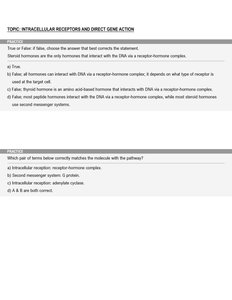
Steroid hormones and thyroid hormones act through intracellular receptors, directly influencing gene expression.
Receptor location: Cytoplasm or nucleus
Hormone-receptor complex: Binds to DNA, triggers transcription of specific genes
The Hypothalamus & Pituitary Gland
Hypothalamus-Pituitary Axis
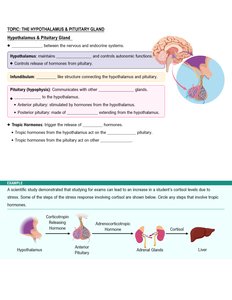
The hypothalamus links the nervous and endocrine systems, controlling hormone release from the pituitary gland.
Infundibulum: Structure connecting hypothalamus and pituitary
Anterior pituitary: Communicates via blood vessels (hypophyseal portal system)
Posterior pituitary: Communicates via neural connections
Tropic hormones: Stimulate release of hormones from other glands
Anterior Pituitary Hormones
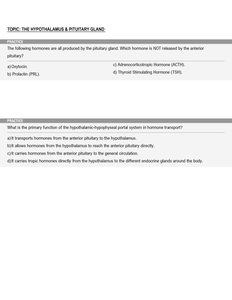
The anterior pituitary releases several hormones that regulate growth, metabolism, and reproduction.
Hormone | Target |
|---|---|
Growth Hormone (GH) | Liver, bones, cartilage |
Thyroid-Stimulating Hormone (TSH) | Thyroid gland |
Adrenocorticotropic Hormone (ACTH) | Adrenal cortex |
Follicle-Stimulating Hormone (FSH) | Ovaries, testes |
Luteinizing Hormone (LH) | Ovaries, testes |
Prolactin (PRL) | Breasts |
Posterior Pituitary Hormones
The posterior pituitary releases hormones produced by the hypothalamus.
Antidiuretic Hormone (ADH): Regulates water balance
Oxytocin: Stimulates uterine contractions and milk release
Review of Major Hormones
Summary Table of Major Hormones
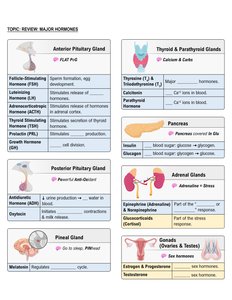
The following table summarizes the major hormones, their sources, and primary functions.
Gland | Hormone | Function |
|---|---|---|
Anterior Pituitary | GH, FSH, LH, TSH, ACTH, PRL | Growth, reproduction, metabolism |
Posterior Pituitary | ADH, Oxytocin | Water balance, reproduction |
Thyroid | T3, T4 | Metabolism |
Parathyroid | Parathyroid hormone | Calcium regulation |
Adrenal | Adrenaline, cortisol | Stress response |
Pancreas | Insulin, glucagon | Blood sugar regulation |
Pineal | Melatonin | Circadian rhythm |
Gonads | Estrogen, progesterone, testosterone | Sex hormones |
Additional info:
Hormones can be classified by their solubility and mechanism of action, which determines how they interact with target cells.
Secondary messenger systems allow for signal amplification, enabling hormones to exert effects at low concentrations.
The hypothalamus-pituitary axis is central to endocrine regulation, integrating signals from the nervous system and controlling hormone release throughout the body.
